Holdsworth Elizabeth A, Donaghy Bethany, Fox Kathleen M, Desai Pooja, Collier David H, Furst Daniel E
Adelphi Real World, Bollington, UK.
Amgen Inc., Thousand Oaks, CA, 91320, USA.
Rheumatol Ther. 2021 Dec;8(4):1637-1649. doi: 10.1007/s40744-021-00357-1. Epub 2021 Sep 2.
In patients with inadequate response or intolerance to first biologic disease-modifying antirheumatic drug (bDMARD), guidelines recommend switching to an agent of different mechanism of action or to another bDMARD. However, the reasons behind switching between bDMARD/targeted synthetic (ts)DMARD are not well documented in many studies. The objective of this study was to assess the rheumatologists' perceptions and behaviors towards choice of initial b/tsDMARD treatment and reasons for switching between bDMARDs/tsDMARDs, in the context of present treatment patterns.
This was a retrospective analysis of data collected from the 12th Adelphi Real World Disease Specific Programme for rheumatoid arthritis (RA). Qualified rheumatologists involved in treatment decision-making for ≥ 10 patients a month completed patient record forms (PRFs). Patients aged ≥ 18 years with RA diagnosis and receiving bDMARD/tsDMARD were included. The outcomes assessed were proportion of patients receiving bDMARD/tsDMARD at molecule and class levels; rheumatologist-reported reasons for choice of therapy; proportion of patients who switched bDMARDs/tsDMARDs; and rheumatologist-reported reasons for switching therapies.
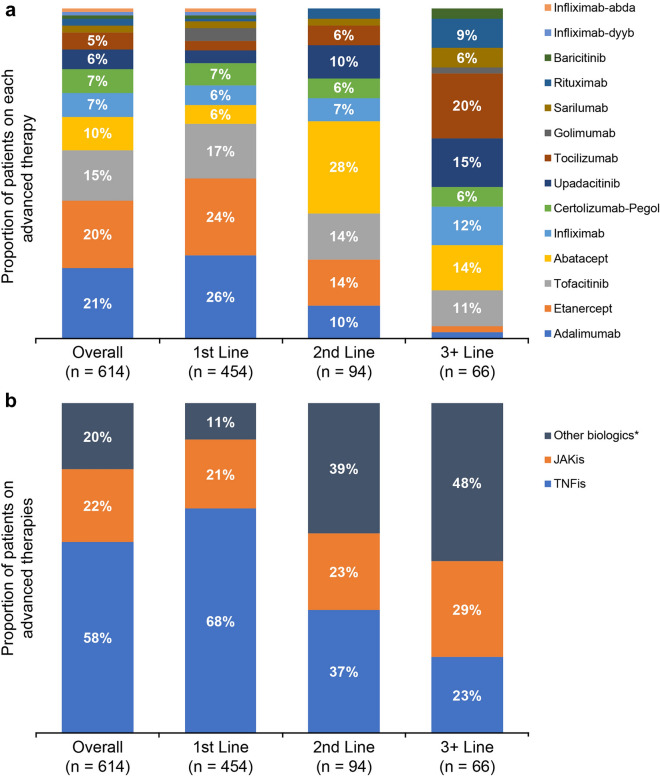
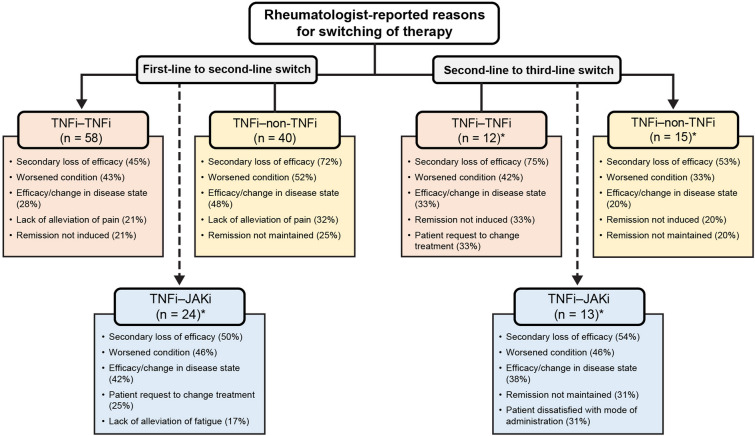
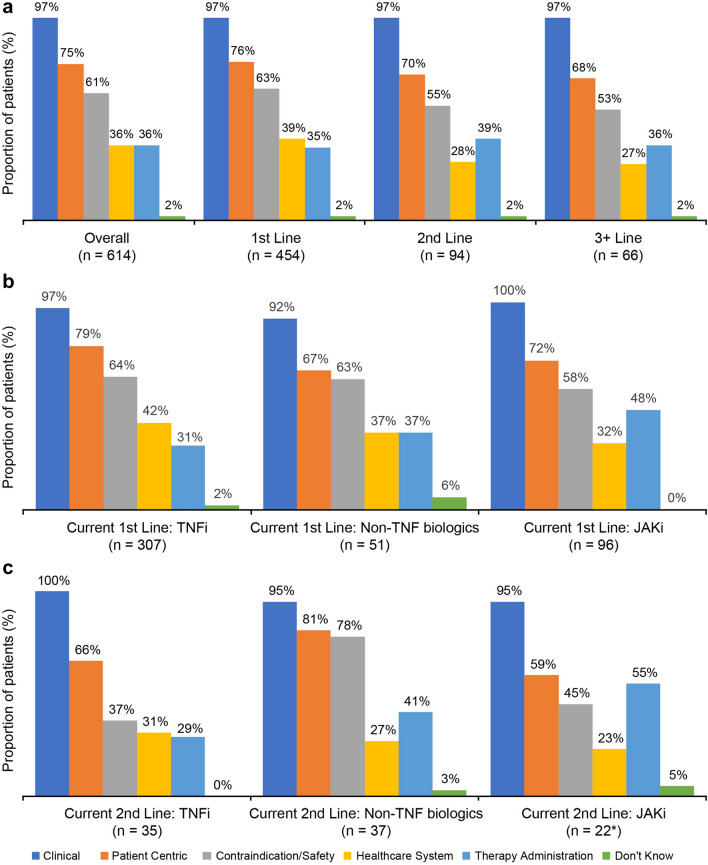
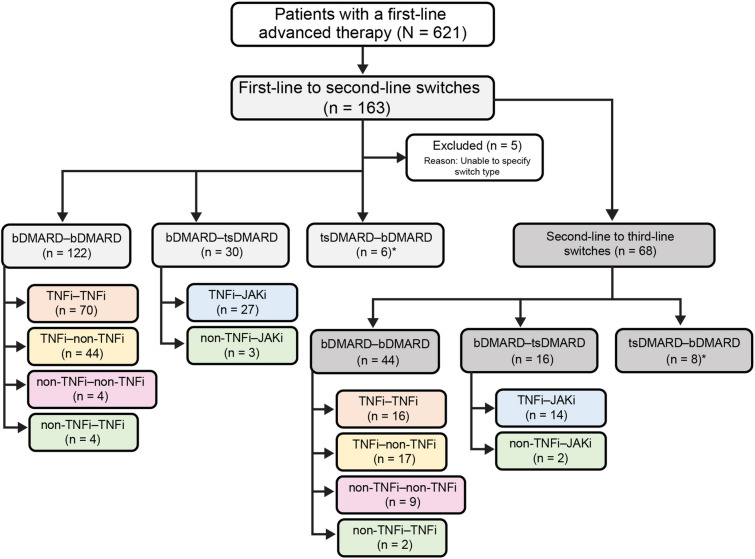
Eighty-six rheumatologists completed PRFs for 1027 patients. Of these, 621 were receiving bDMARD/tsDMARD at data collection. The majority (73%) of patients received first-line bDMARD/tsDMARD, and at first-line, 68% received a tumor necrosis factor inhibitor (TNFi) and 21% received a Janus kinase inhibitor (JAKi). The response option of strong overall efficacy was the primary reason for selecting first-line and second-line bDMARD/tsDMARD. A total of 163 patients had switched from first-line b/tsDMARD to second-line b/tsDMARD therapy. Of these, 44, 28, and 17% had switched from TNFi to another TNFi, TNFi to non-TNF biologic, and TNFi to JAKi, respectively. Lack of efficacy and worsening disease were the most frequent reasons for switching therapies.
TNFis remain the most prescribed b/tsDMARD for first-line and second-line treatments. Strong overall efficacy was the primary reason for selecting therapy and loss of efficacy was the primary reason for switching therapy.
对于对第一种生物性改善病情抗风湿药物(bDMARD)反应不足或不耐受的患者,指南建议换用作用机制不同的药物或另一种bDMARD。然而,许多研究并未充分记录在bDMARD/靶向合成(ts)DMARD之间换药的原因。本研究的目的是在当前治疗模式背景下,评估风湿病学家对初始b/tsDMARD治疗选择的看法和行为,以及在bDMARDs/tsDMARDs之间换药的原因。
这是一项对从第12届阿德尔菲类风湿关节炎(RA)真实世界疾病特定项目收集的数据进行的回顾性分析。每月参与≥10例患者治疗决策的合格风湿病学家填写患者记录表(PRF)。纳入年龄≥18岁、诊断为RA且正在接受bDMARD/tsDMARD治疗的患者。评估的结果包括在分子和类别水平接受bDMARD/tsDMARD治疗的患者比例;风湿病学家报告的治疗选择原因;更换bDMARDs/tsDMARDs的患者比例;以及风湿病学家报告的换药原因。
86名风湿病学家为1027例患者填写了PRF。其中,621例在数据收集时正在接受bDMARD/tsDMARD治疗。大多数(73%)患者接受一线bDMARD/tsDMARD治疗,在一线治疗中,68%的患者接受肿瘤坏死因子抑制剂(TNFi),21%的患者接受 Janus激酶抑制剂(JAKi)。强大的总体疗效这一反应选项是选择一线和二线bDMARD/tsDMARD的主要原因。共有163例患者从一线b/tsDMARD转换为二线b/tsDMARD治疗。其中,分别有44%、28%和17%的患者从TNFi转换为另一种TNFi、从TNFi转换为非TNF生物制剂、从TNFi转换为JAKi。疗效不佳和病情恶化是换药最常见的原因。
TNFi仍然是一线和二线治疗中处方最多的b/tsDMARD。强大的总体疗效是选择治疗的主要原因,而疗效丧失是换药的主要原因。