
新疆卡拉麦里自然保护区荒漠草原羊狂蝇(双翅目:狂蝇科)卵的空间分布。
Spatial distribution of Gasterophilus pecorum (Diptera) eggs in the desert steppe of the Kalamaili Nature Reserve (Xinjiang, China).
机构信息
Key Laboratory of Non-Invasive Research Technology for Endangered Species, School of Ecology and Nature Conservation, Beijing Forestry University, Beijing, 100083, China.
Chongqing Academy of Environmental Science, Chongqing, 401147, China.
出版信息
BMC Ecol Evol. 2021 Sep 6;21(1):169. doi: 10.1186/s12862-021-01897-4.
BACKGROUND
The dominant Gasterophilus species in the desert steppe (Xinjiang, China) Gasterophilus pecorum poses a serious threat to the reintroduced Przewalski's horses. We investigated the distribution pattern of G. pecorum eggs in June 2017.
METHODS
Two sampling methods, transect and grid, were used, and the results were analyzed via geostatistics by semivariance. The nest quadrat was used to determine the optimal quadrat size.
RESULTS
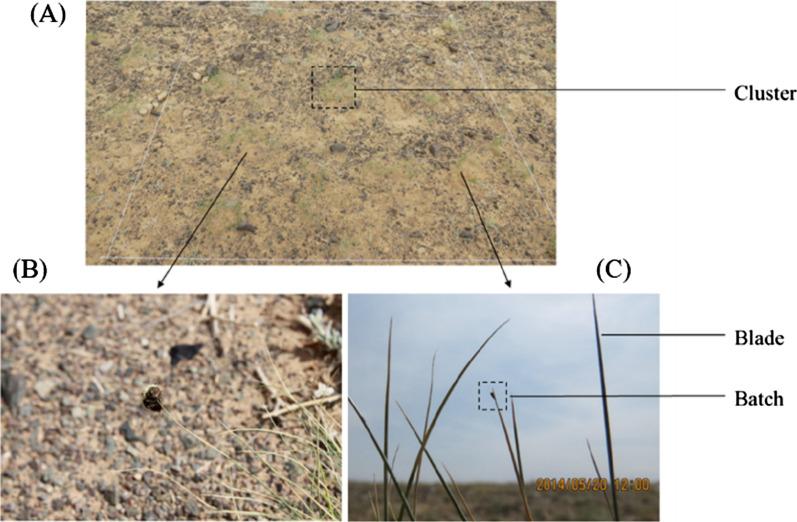
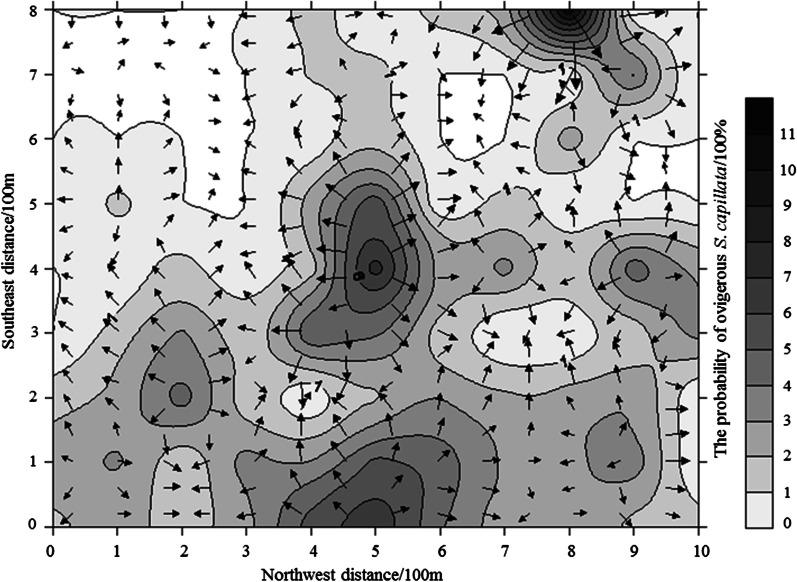
Eggs were found in 99 quadrats (63.1%) and 187 clusters (1.5%) of Stipa caucasica on the steppe. The mean oviposition count of a cluster was 3.8 ± 1.6. Three-eggs is the mode of which females oviposit on each ovigerous S. caucasica (22.0%). Semivariogram analysis revealed that the distance of spatial dependence for eggs was 921 m, 1233 m and 1097 m for transect 1, transect 2 and grid methods, respectively, while spatial continuity was 62%, 77% and 57.0% for transect 1, transect 2 and grid, respectively. The eggs showed a patchy, aggregated distribution pattern. This suggested the spherical model is most applicable. The proportion of ovigerous S. caucasica was significantly correlated with the distance from water resources (r = - 0.382, p = 0).
CONCLUSION
Our findings indicated that diversification of G. pecorum oviposition was a new adaptative strategy for its survival in the desert steppe ecological niche. This made it more efficient at infecting hosts in the local environment. Areas surrounding water resources, especially around the drinking paths of equids (500 m radius surrounding the water), were concentrated epidemic areas. It is suggested that more attention to be paid to the ecological characteristics of G. pecorum in order to develop control measures that would reduce the infection risk for Przewalski's horses.
背景
在荒漠草原(中国新疆)占主导地位的胃蝇属物种胃蝇(Gasterophilus pecorum)对重新引入的普氏野马构成了严重威胁。我们于 2017 年 6 月调查了胃蝇(Gasterophilus pecorum)卵的分布模式。
方法
使用了两种采样方法,即截距和网格,并通过半方差分析进行了地统计学分析。巢方格用于确定最佳方格大小。
结果
在草原上的高加索针茅(Stipa caucasica)中,99 个方格(63.1%)和 187 个簇(1.5%)中发现了卵。每个簇的平均产卵数为 3.8±1.6。三卵是雌性在每个有产卵能力的高加索针茅(22.0%)上产卵的模式。半方差分析显示,卵的空间依赖距离分别为截距 1、截距 2 和网格方法的 921 m、1233 m 和 1097 m,而空间连续性分别为截距 1、截距 2 和网格方法的 62%、77%和 57.0%。卵表现出斑块状、聚集分布模式。这表明球状模型最适用。有产卵能力的高加索针茅的比例与距水源的距离显著相关(r=-0.382,p=0)。
结论
我们的研究结果表明,胃蝇(Gasterophilus pecorum)产卵的多样化是其在荒漠草原生态位中生存的一种新的适应性策略。这使其更有效地感染宿主。水资源周围的区域,特别是马属动物饮水路径周围(500 m 半径范围内的水源),是集中流行的区域。建议更多地关注胃蝇(Gasterophilus pecorum)的生态特征,以便制定减少普氏野马感染风险的控制措施。




 Zotero 插件