Key Laboratory of Non-Invasive Research Technology for Endangered Species, School of Ecology and Nature Conservation, Beijing Forestry University, Beijing, 100083, China.
Chongqing Academy of Environmental Science, Chongqing, 401147, China.
Parasit Vectors. 2021 Mar 1;14(1):129. doi: 10.1186/s13071-021-04623-7.
The departure of the mature larvae of the horse stomach bot fly from the host indicates the beginning of a new infection period. Gasterophilus pecorum is the dominant bot fly species in the desert steppe of the Kalamaili Nature Reserve (KNR) of northwest China as a result of its particular biological characteristics. The population dynamics of G. pecorum were studied to elucidate the population development of this species in the arid desert steppe.
Larvae in the freshly excreted feces of tracked Przewalski's horses (Equus przewalskii) were collected and recorded. The larval pupation experiments were carried out under natural conditions.
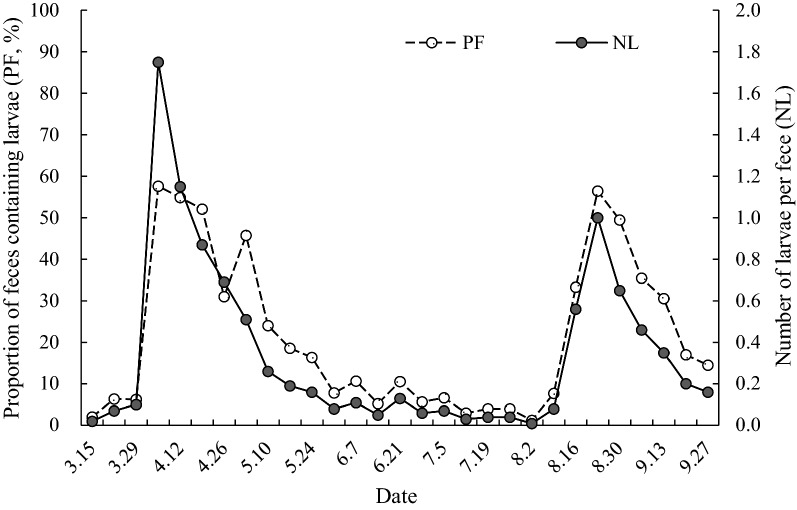
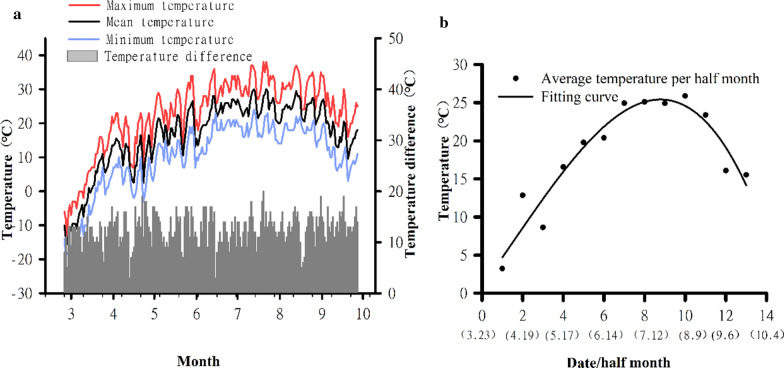
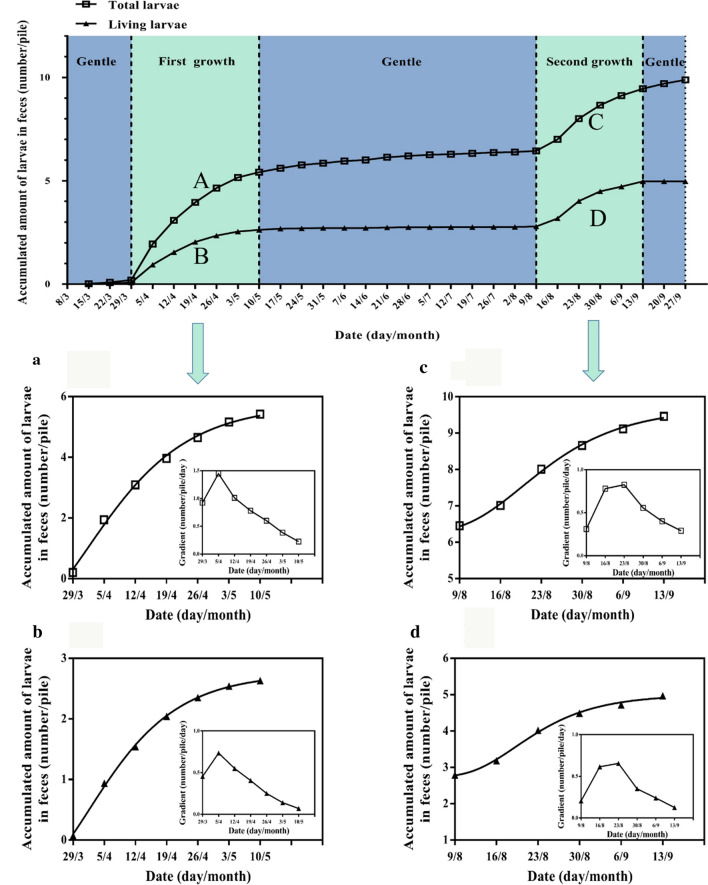
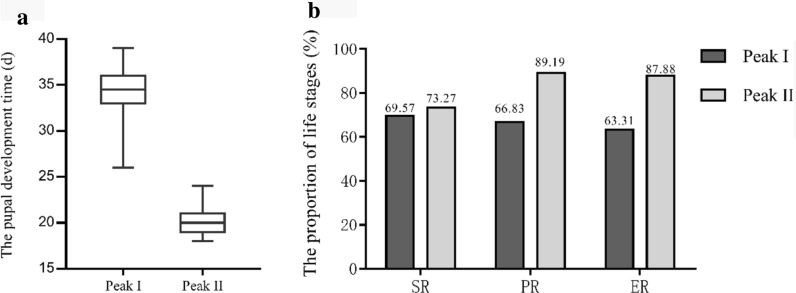
There was a positive correlation between the survival rate and the number of larvae expelled (r = 0.630, p < 0.01); the correlation indicated that the species had characteristic peaks of occurrence. The main periods during which mature larvae were expelled in the feces were from early April to early May (peak I) and from mid-August to early September (peak II); the larval population curve showed a sudden increase and gradual decrease at both peaks. Under the higher temperatures of peak II, the adults developing from the larvae had a higher survival rate, higher pupation rate, higher emergence rate and shorter eclosion period than those developing from peak I larvae. Although G. pecorum has only one generation per year, its occurrence peaked twice annually, i.e. the studied population has a bimodal distribution, which doubles parasitic pressure on the local host. This phenomenon is very rarely recorded in studies on insect life history, and especially in those on parasite epidemiology.
The period during which G. pecorum larvae are naturally expelled from the host exceeds 7 months in KNR, which indicates that there is potentially a long period during which hosts can become infected with this parasite. The phenomenon of two annual peaks of larvae expelled in feces is important as it provides one explanation for the high rate of equine myiasis in KNR.
马胃蝇成熟幼虫离开宿主表明新的感染期开始。由于其特殊的生物学特性,牛皮蝇(Gasterophilus pecorum)是中国西北卡拉麦里自然保护区(Kalamaili Nature Reserve,KNR)荒漠草原的主要蝇种。本研究旨在阐明该物种在干旱荒漠草原的种群动态。
采集并记录跟踪普氏野马(Equus przewalskii)新鲜排出粪便中的幼虫。在自然条件下进行幼虫化蛹实验。
幼虫成活率与排出幼虫数量呈正相关(r = 0.630,p < 0.01);这表明该物种具有特征性的发生高峰。粪便中成熟幼虫排出的主要时期是 4 月初至 5 月初(高峰 I)和 8 月中旬至 9 月初(高峰 II);幼虫种群曲线在两个高峰处均呈突然增加和逐渐减少的趋势。在高峰 II 的较高温度下,由幼虫发育而来的成虫的成活率、化蛹率、羽化率和出壳期均高于由高峰 I 幼虫发育而来的成虫。尽管牛皮蝇每年只有一代,但每年出现两次高峰,即研究种群呈双峰分布,这使当地宿主的寄生虫寄生压力增加了一倍。这种现象在昆虫生活史研究中很少被记录,特别是在寄生虫流行病学研究中。
在 KNR,牛皮蝇幼虫自然从宿主排出的时间超过 7 个月,这表明宿主可能有很长一段时间容易感染这种寄生虫。粪便中排出幼虫每年出现两次高峰的现象非常重要,因为它为 KNR 中马蝇蛆病高发率提供了一种解释。