State Key Laboratory of Cancer Biology, Fourth Military Medical University, Xi'an, Shaanxi, China.
Department of Hepatobiliary Surgery, Xijing Hospital, Fourth Military Medical University, Xi'an, Shaanxi, China.
J Immunother Cancer. 2021 Sep;9(9). doi: 10.1136/jitc-2021-002787.
A better understanding of the molecular mechanisms that manifest in the immunosuppressive tumor microenvironment (TME) is crucial for developing more efficacious immunotherapies for hepatocellular carcinoma (HCC), which has a poor response to current immunotherapies. Regulatory T (Treg) cells are key mediators of HCC-associated immunosuppression. We investigated the selective mechanism exploited by HCC that lead to Treg cells expansion and to find more efficacious immunotherapies.
We used matched tumor tissues and blood samples from 150 patients with HCC to identify key factors of Treg cells expansion. We used mass cytometry (CyTOF) and orthotopic cancer mouse models to analyze overall immunological changes after growth differentiation factor 15 (GDF15) gene ablation in HCC. We used flow cytometry, coimmunoprecipitation, RNA sequencing, mass spectrum, chromatin immunoprecipitation and , OT-I and GFP transgenic mice to demonstrate the effects of GDF15 on Treg cells and related molecular mechanism. We used hybridoma technology to generate monoclonal antibody to block GDF15 and evaluate its effects on HCC-associated immunosuppression.
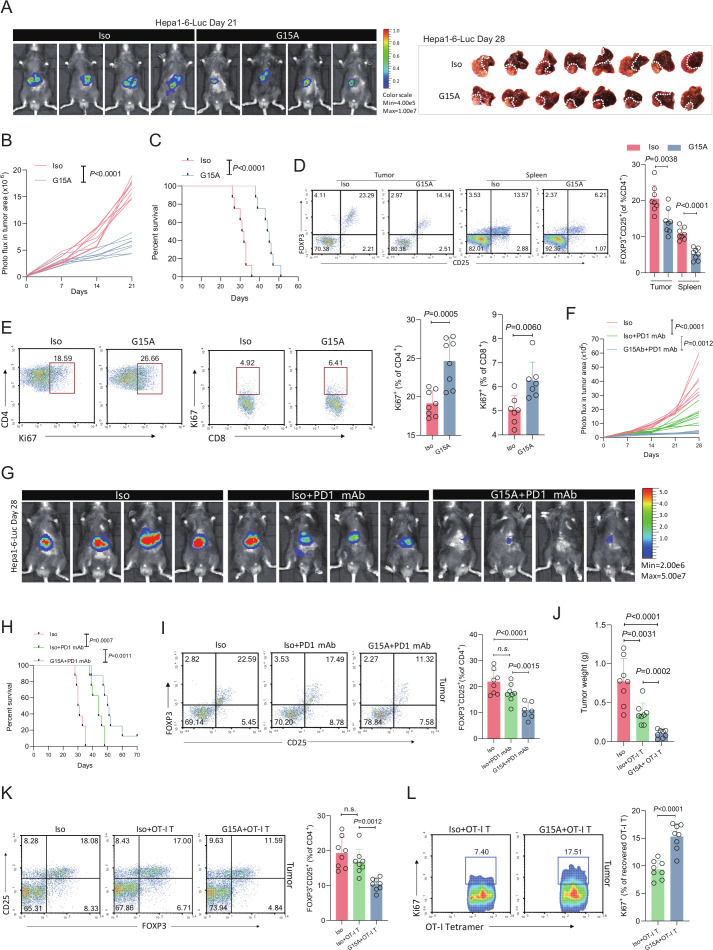
GDF15 is positively associated with the elevation of Treg cell frequencies in patients wih HCC. Gene ablation of GDF15 in HCC can convert an immunosuppressive TME to an inflammatory state. GDF15 promotes the generation of peripherally derived inducible Treg (iTreg) cells and enhances the suppressive function of natural Treg (nTreg) cells by interacting with a previously unrecognized receptor CD48 on T cells and thus downregulates STUB1, an E3 ligase that mediates forkhead box P3 (FOXP3) protein degradation. GDF15 neutralizing antibody effectively eradicates HCC and augments the antitumor immunity in mouse.
Our results reveal the generation and function enhancement of Treg cells induced by GDF15 is a new mechanism for HCC-related immunosuppression. CD48 is the first discovered receptor of GDF15 in the immune system which provide the possibility to solve the molecular mechanism of the immunomodulatory function of GDF15. The therapeutic GDF15 blockade achieves HCC clearance without obvious adverse events.
更好地了解在免疫抑制性肿瘤微环境(TME)中表现出来的分子机制对于开发更有效的肝细胞癌(HCC)免疫疗法至关重要,因为目前的免疫疗法对 HCC 反应不佳。调节性 T(Treg)细胞是 HCC 相关免疫抑制的关键介质。我们研究了 HCC 利用的选择性机制,导致 Treg 细胞扩增,并找到更有效的免疫疗法。
我们使用来自 150 名 HCC 患者的匹配肿瘤组织和血液样本来鉴定 Treg 细胞扩增的关键因素。我们使用质谱流式细胞术(CyTOF)和原位癌症小鼠模型来分析 HCC 中生长分化因子 15(GDF15)基因缺失后整体免疫变化。我们使用流式细胞术、共免疫沉淀、RNA 测序、质谱、染色质免疫沉淀和 OT-I 和 GFP 转基因小鼠来证明 GDF15 对 Treg 细胞的影响及其相关分子机制。我们使用杂交瘤技术生成单克隆抗体来阻断 GDF15 并评估其对 HCC 相关免疫抑制的影响。
GDF15 与 HCC 患者 Treg 细胞频率升高呈正相关。HCC 中 GDF15 的基因缺失可以将免疫抑制性 TME 转化为炎症状态。GDF15 通过与 T 细胞上以前未被识别的受体 CD48 相互作用,促进外周诱导性 Treg(iTreg)细胞的生成,并增强天然 Treg(nTreg)细胞的抑制功能,从而下调 STUB1,一种介导叉头框 P3(FOXP3)蛋白降解的 E3 连接酶。GDF15 中和抗体可有效根除 HCC 并增强小鼠的抗肿瘤免疫。
我们的结果揭示了 GDF15 诱导的 Treg 细胞的生成和功能增强是 HCC 相关免疫抑制的新机制。CD48 是 GDF15 在免疫系统中的第一个发现的受体,为解决 GDF15 免疫调节功能的分子机制提供了可能性。GDF15 阻断治疗在没有明显不良反应的情况下实现 HCC 清除。