Department of Cardiology, State Key Laboratory of Cardiovascular Disease, Fuwai Hospital, National Center for Cardiovascular Diseases, Chinese Academy of Medical Sciences and Peking Union Medical College, Beijing, China.
Department of Cardiology, Institute of Vascular Medicine, Peking University Third Hospital, Key Laboratory of Molecular Cardiovascular Science, Ministry of Education, Beijing, China.
Front Endocrinol (Lausanne). 2021 Aug 19;12:710240. doi: 10.3389/fendo.2021.710240. eCollection 2021.
The triglyceride-glucose index (TyG index) is a valuable marker for predicting adverse cardiovascular events in diabetic patients. However, for nondiabetic patients, whether the TyG index is independently related to poor prognosis remains unclear. This cohort study assessed the association of the TyG index with future cardiovascular risk in nondiabetic subjects who received percutaneous coronary intervention (PCI).
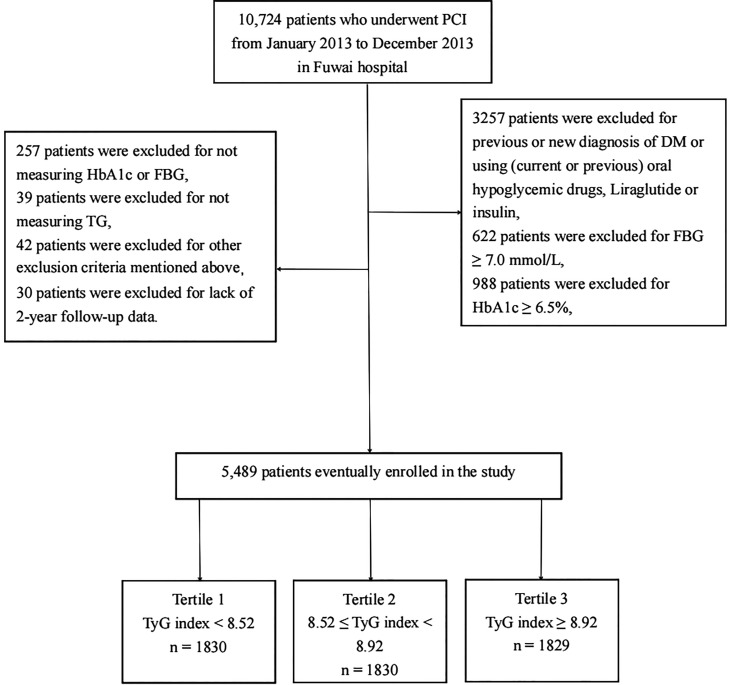
We consecutively enrolled 5,489 nondiabetic patients who underwent PCI. All experimental subjects were divided into three groups based on their TyG index, which was determined by the equation ln (fasting triglyceride (mg/dl) × fasting blood glucose (mg/dl)/2). The primary endpoint was major adverse cardiovascular and cerebrovascular events (MACCE), including all-cause death, nonfatal myocardial infarction (MI), nonfatal stroke, and target vessel revascularization (TVR).
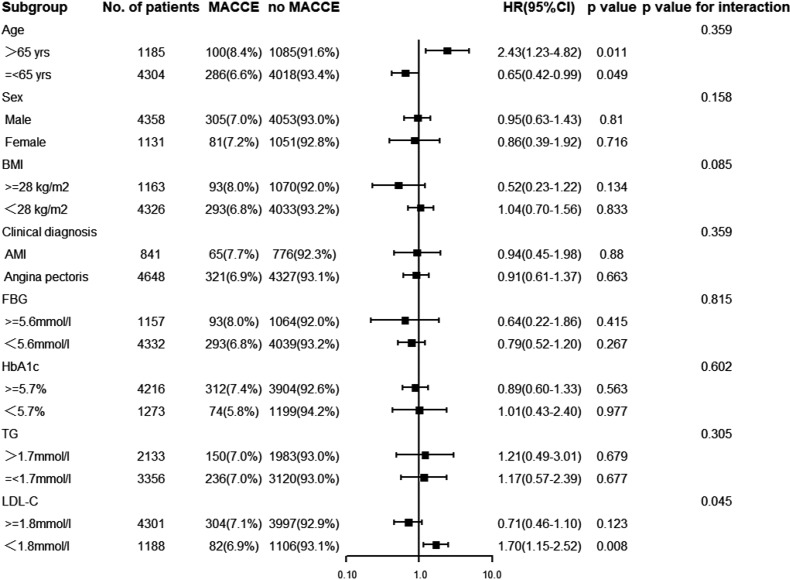
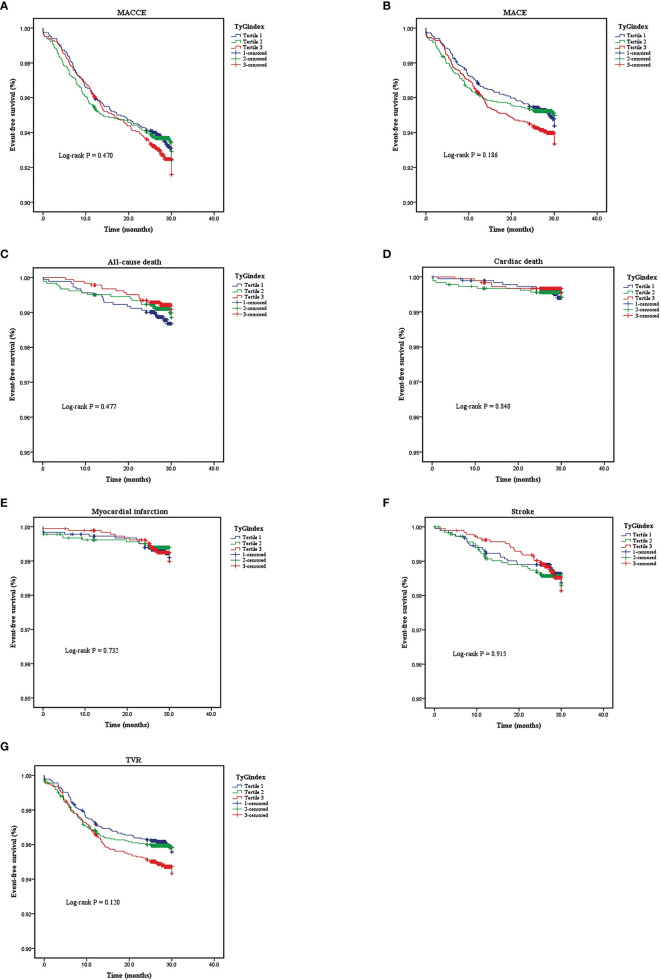
A total of 386 MACCE were documented during a median 29-month follow-up. The Kaplan-Meier survival results indicated that among the three groups, there was no obvious difference in any endpoints. Further Cox regression analyses suggested that the TyG index was not independently related to adverse cardiovascular outcomes for nondiabetic patients who underwent PCI (HR: 0.77, 95% CI 0.56-1.16, = 0.210 for MACCE). Subgroup analysis suggested that the TyG index was independently relevant to MACCE for patients with low-density lipoprotein cholesterol (LDL-C) lower than 1.8 mmol/L.
The TyG index is not an effective predictive factor for adverse cardiovascular prognosis in nondiabetic patients who underwent PCI. However, in subjects with LDL-C lower than 1.8mmol/L, it may predict future cardiovascular risk.
三酰甘油-葡萄糖指数(TyG 指数)是预测糖尿病患者不良心血管事件的有价值标志物。然而,对于非糖尿病患者,TyG 指数是否与不良预后独立相关尚不清楚。本队列研究评估了 TyG 指数与接受经皮冠状动脉介入治疗(PCI)的非糖尿病患者未来心血管风险的相关性。
我们连续纳入了 5489 名接受 PCI 的非糖尿病患者。所有实验对象均根据 TyG 指数(通过方程 ln(空腹三酰甘油(mg/dl)×空腹血糖(mg/dl)/2)确定)分为三组。主要终点是主要不良心血管和脑血管事件(MACCE),包括全因死亡、非致死性心肌梗死(MI)、非致死性卒中和靶血管血运重建(TVR)。
在中位数为 29 个月的随访期间,共记录到 386 例 MACCE。Kaplan-Meier 生存结果表明,在三组中,任何终点均无明显差异。进一步的 Cox 回归分析表明,TyG 指数与接受 PCI 的非糖尿病患者不良心血管结局无关(HR:0.77,95%CI 0.56-1.16,=0.210 用于 MACCE)。亚组分析表明,对于 LDL-C 低于 1.8mmol/L 的患者,TyG 指数与 MACCE 独立相关。
TyG 指数不是预测接受 PCI 的非糖尿病患者不良心血管预后的有效预测因子。然而,在 LDL-C 低于 1.8mmol/L 的患者中,它可能预测未来的心血管风险。