Hooton Steven P T, Pritchard Alexander C W, Asiani Karishma, Gray-Hammerton Charlotte J, Stekel Dov J, Crossman Lisa C, Millard Andrew D, Hobman Jon L
School of Biosciences, University of Nottingham, Sutton Bonington Campus, Sutton Bonington, United Kingdom.
Department of Genetics and Genome Biology, University of Leicester, Leicester, United Kingdom.
Front Microbiol. 2021 Aug 19;12:723322. doi: 10.3389/fmicb.2021.723322. eCollection 2021.
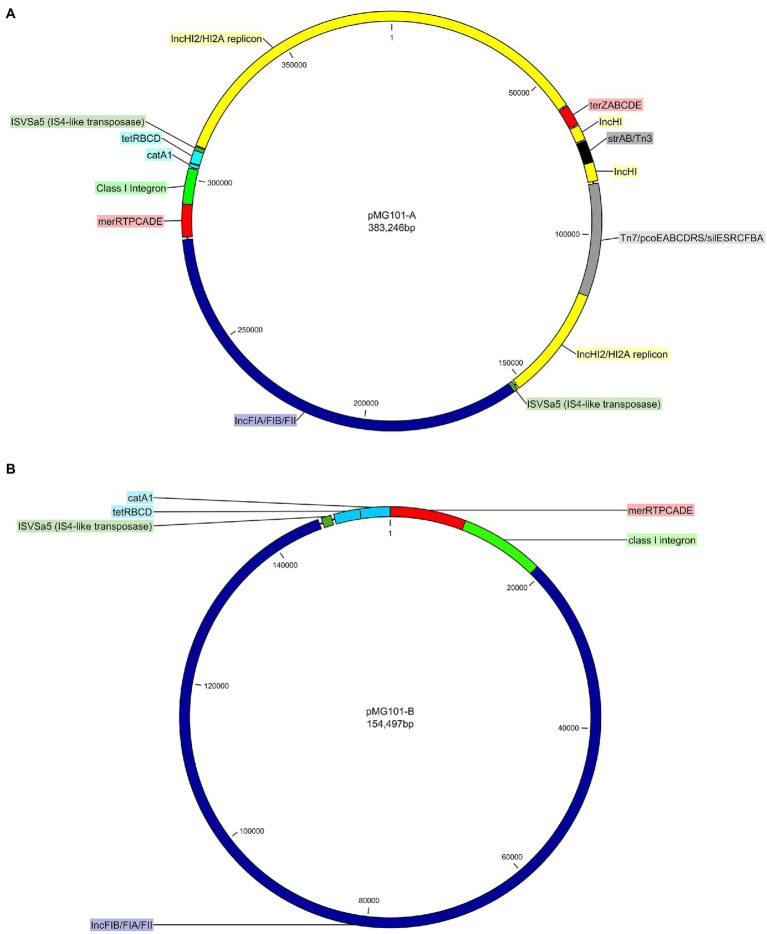
Typhimurium carrying the multidrug resistance (MDR) plasmid pMG101 was isolated from three burns patients in Boston United States in 1973. pMG101 was transferrable into other spp. and hosts and carried what was a novel and unusual combination of AMR genes and silver resistance. Previously published short-read DNA sequence of pMG101 showed that it was a 183.5Kb IncHI plasmid, where a Tn-mediated transposition of / resistance genes into the chromosome of the K-12 J53 host strain had occurred. We noticed differences in streptomycin resistance and plasmid size between two stocks of K-12 J53 pMG101 we possessed, which had been obtained from two different laboratories (pMG101-A and pMG101-B). Long-read sequencing (PacBio) of the two strains unexpectedly revealed plasmid and chromosomal rearrangements in both. pMG101-A is a non-transmissible 383Kb closed-circular plasmid consisting of an IncHI2 plasmid sequence fused to an IncFI/FIIA plasmid. pMG101-B is a mobile closed-circular 154 Kb IncFI/FIIA plasmid. Sequence identity of pMG101-B with the fused IncFI/IncFIIA region of pMG101-A was >99%. Assembled host sequence reads of pMG101-B showed Tn-mediated transposition of / into the J53 chromosome between and . Long read sequence data in combination with laboratory experiments have demonstrated large scale changes in pMG101. Loss of conjugation function and movement of resistance genes into the chromosome suggest that even under long-term laboratory storage, mobile genetic elements such as transposons and insertion sequences can drive the evolution of plasmids and host. This study emphasises the importance of utilising long read sequencing technologies of plasmids and host strains at the earliest opportunity.
1973年,从美国波士顿的三名烧伤患者身上分离出携带多重耐药(MDR)质粒pMG101的鼠伤寒沙门氏菌。pMG101可转移到其他菌种和宿主中,并携带了一种新颖且不同寻常的抗微生物耐药性(AMR)基因与银抗性组合。先前发表的pMG101短读长DNA序列显示,它是一个183.5Kb的IncHI质粒,其中发生了Tn介导的/抗性基因转座到K-12 J53宿主菌株染色体中的情况。我们注意到我们拥有的两株K-12 J53 pMG101(分别从两个不同实验室获得,即pMG101-A和pMG101-B)在链霉素抗性和质粒大小方面存在差异。对这两株菌株进行的长读长测序(PacBio)意外地揭示了两者都存在质粒和染色体重排。pMG101-A是一个不可转移的383Kb闭环质粒,由一个与IncFI/FIIA质粒融合的IncHI2质粒序列组成。pMG101-B是一个可移动的闭环154 Kb IncFI/FIIA质粒。pMG101-B与pMG101-A的融合IncFI/IncFIIA区域的序列同一性>99%。pMG101-B的组装宿主序列读数显示,Tn介导的/在和之间转座到J53染色体中。长读长序列数据与实验室实验相结合,证明了pMG101发生了大规模变化。接合功能的丧失以及抗性基因向染色体的移动表明,即使在长期实验室保存条件下,转座子和插入序列等可移动遗传元件也能推动质粒和宿主的进化。本研究强调了尽早利用质粒和宿主菌株的长读长测序技术的重要性。