Human Genetics Division, Medical Biotechnology Department, National Institute of Genetics Engineering and Biotechnology (NIGEB), Tehran, Iran.
Faculty of Nursing, HRH Princess Chulabhorn College of Medical Science, Chulabhorn Royal Academy, Bangkok, Thailand.
Front Immunol. 2021 Aug 20;12:699746. doi: 10.3389/fimmu.2021.699746. eCollection 2021.
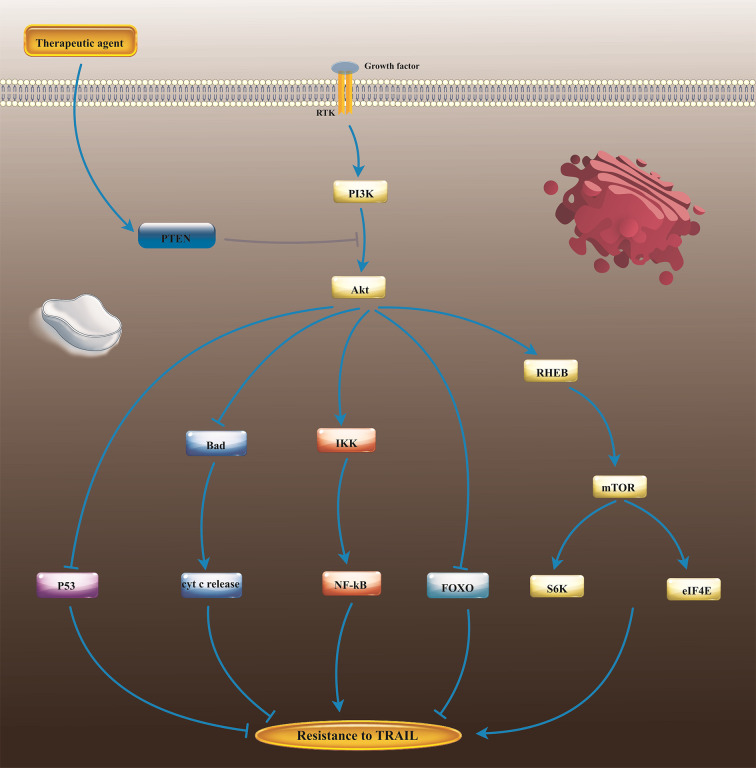
The immune cytokine tumor necrosis factor-related apoptosis-inducing ligand (TRAIL) has attracted rapidly evolving attention as a cancer treatment modality because of its competence to selectively eliminate tumor cells without instigating toxicity . TRAIL has revealed encouraging promise in preclinical reports in animal models as a cancer treatment option; however, the foremost constraint of the TRAIL therapy is the advancement of TRAIL resistance through a myriad of mechanisms in tumor cells. Investigations have documented that improvement of the expression of anti-apoptotic proteins and survival or proliferation involved signaling pathways concurrently suppressing the expression of pro-apoptotic proteins along with down-regulation of expression of TRAILR1 and TRAILR2, also known as death receptor 4 and 5 (DR4/5) are reliable for tumor cells resistance to TRAIL. Therefore, it seems that the development of a therapeutic approach for overcoming TRAIL resistance is of paramount importance. Studies currently have shown that combined treatment with anti-tumor agents, ranging from synthetic agents to natural products, and TRAIL could result in induction of apoptosis in TRAIL-resistant cells. Also, human mesenchymal stem/stromal cells (MSCs) engineered to generate and deliver TRAIL can provide both targeted and continued delivery of this apoptosis-inducing cytokine. Similarly, nanoparticle (NPs)-based TRAIL delivery offers novel platforms to defeat barricades to TRAIL therapeutic delivery. In the current review, we will focus on underlying mechanisms contributed to inducing resistance to TRAIL in tumor cells, and also discuss recent findings concerning the therapeutic efficacy of combined treatment of TRAIL with other antitumor compounds, and also TRAIL-delivery using human MSCs and NPs to overcome tumor cells resistance to TRAIL.
肿瘤坏死因子相关凋亡诱导配体(TRAIL)是一种免疫细胞因子,由于能够选择性地消除肿瘤细胞而不会引起毒性,因此作为一种癌症治疗方法引起了人们的极大关注。TRAIL 在动物模型的临床前报告中显示出令人鼓舞的治疗潜力,然而,TRAIL 治疗的最主要限制是肿瘤细胞通过多种机制发展出对 TRAIL 的耐药性。研究表明,提高抗凋亡蛋白的表达和涉及存活或增殖的信号通路,同时抑制促凋亡蛋白的表达,以及下调 TRAILR1 和 TRAILR2 的表达(也称为死亡受体 4 和 5(DR4/5)),是肿瘤细胞对 TRAIL 产生耐药性的可靠机制。因此,开发克服 TRAIL 耐药性的治疗方法似乎至关重要。目前的研究表明,联合使用抗肿瘤药物,从合成药物到天然产物,以及 TRAIL,可导致 TRAIL 耐药细胞发生凋亡。此外,经过基因工程改造以产生和递送 TRAIL 的人间质/基质干细胞(MSCs)可以为这种凋亡诱导细胞因子提供靶向和持续的递送。同样,基于纳米颗粒(NPs)的 TRAIL 递送为克服 TRAIL 治疗递送的障碍提供了新的平台。在当前的综述中,我们将重点讨论导致肿瘤细胞对 TRAIL 产生耐药性的潜在机制,并讨论关于联合使用 TRAIL 与其他抗肿瘤化合物治疗以及使用人 MSCs 和 NPs 递送 TRAIL 以克服肿瘤细胞对 TRAIL 耐药性的最新发现。