Département d'Oncologie Médicale, Gustave Roussy, Université Paris Saclay, Villejuif, France.
Division of Clinical Studies, Institute of Cancer Research & Sarcoma Unit of the Royal Marsden NHS Foundation Trust, London, United Kingdom.
Front Immunol. 2021 Aug 20;12:715727. doi: 10.3389/fimmu.2021.715727. eCollection 2021.
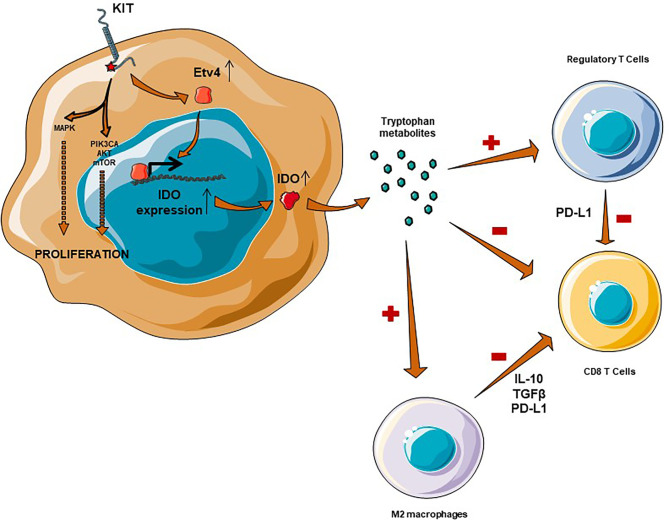
Gastrointestinal stromal tumors (GISTs) are a subtype of soft tissue sarcoma (STS), and have become a concept of oncogenic addiction and targeted therapies.The large majority of these tumors develop after a mutation in or platelet derived growth factor receptor α (), resulting in uncontrolled proliferation. GISTs are highly sensitive to imatinib. GISTs are immune infiltrated tumors with a predominance of tumor-associated macrophages (TAMs) and T-cells, including many CD8+ T-cells, whose numbers are prognostic. The genomic expression profile is that of an inhibited Th1 response and the presence of tertiary lymphoid structures and B cell signatures, which are known as predictive to response to ICI. However, the microtumoral environment has immunosuppressive attributes, with immunosuppressive M2 macrophages, overexpression of indoleamine 2,3-dioxygenase (IDO) or PD-L1, and loss of major histocompatibility complex type 1. In addition to inhibiting the oncogene, imatinib appears to act by promoting cytotoxic T-cell activity, interacting with natural killer cells, and inhibiting the expression of PD-L1. Paradoxically, imatinib also appears to induce M2 polarization of macrophages. There have been few immunotherapy trials with anti-CTLA-4 or anti-PD-L1drugs and available clinical data are not very promising. Based on this comprehensive analysis of TME, we believe three immunotherapeutic strategies must be underlined in GIST. First, patients included in clinical trials must be better selected, based on the identified driver mutation (such as D842V mutation), the presence of tertiary lymphoid structures (TLS) or PD-L1 expression. Moreover, innovative immunotherapeutic agents also provide great interest in GIST, and there is a strong rationale for exploring IDO targeting after disease progression during imatinib therapy. Finally and most importantly, there is a strong rationale to combine of inhibition with immune checkpoint inhibitors.
胃肠道间质瘤(GIST)是一种软组织肉瘤(STS)的亚型,已经成为致癌基因成瘾和靶向治疗的概念。这些肿瘤大多数是由于 或血小板衍生生长因子受体α()突变引起的,导致不受控制的增殖。GIST 对伊马替尼高度敏感。GIST 是免疫浸润性肿瘤,以肿瘤相关巨噬细胞(TAMs)和 T 细胞为主,包括许多 CD8+T 细胞,其数量具有预后意义。基因组表达谱为抑制性 Th1 反应,存在三级淋巴结构和 B 细胞特征,这些特征被认为对 ICI 反应有预测性。然而,微肿瘤环境具有免疫抑制特性,存在免疫抑制性 M2 巨噬细胞、吲哚胺 2,3-双加氧酶(IDO)或 PD-L1 的过表达,以及主要组织相容性复合体 1 的缺失。除了抑制 致癌基因外,伊马替尼似乎还通过促进细胞毒性 T 细胞活性、与自然杀伤细胞相互作用以及抑制 PD-L1 的表达来发挥作用。矛盾的是,伊马替尼似乎也会诱导巨噬细胞的 M2 极化。抗 CTLA-4 或抗 PD-L1 药物的免疫治疗试验很少,现有的临床数据并不十分乐观。基于对 TME 的全面分析,我们认为在 GIST 中必须强调三种免疫治疗策略。首先,必须根据已确定的驱动突变(如 D842V 突变)、三级淋巴结构(TLS)或 PD-L1 表达,更好地选择纳入临床试验的患者。此外,创新的免疫治疗药物也为 GIST 提供了极大的兴趣,在伊马替尼治疗期间疾病进展后探索 IDO 靶向具有很强的理论依据。最后,也是最重要的,有充分的理由将 抑制与免疫检查点抑制剂联合使用。