Duijzer Daniël, de Winter Maria A, Nijkeuter Mathilde, Tuinenburg Anton E, Westerink Jan
Department of Vascular Medicine, University Medical Center Utrecht, Utrecht, Netherlands.
Department of Acute Internal Medicine, University Medical Center Utrecht, Utrecht, Netherlands.
Front Cardiovasc Med. 2021 Aug 18;8:698336. doi: 10.3389/fcvm.2021.698336. eCollection 2021.
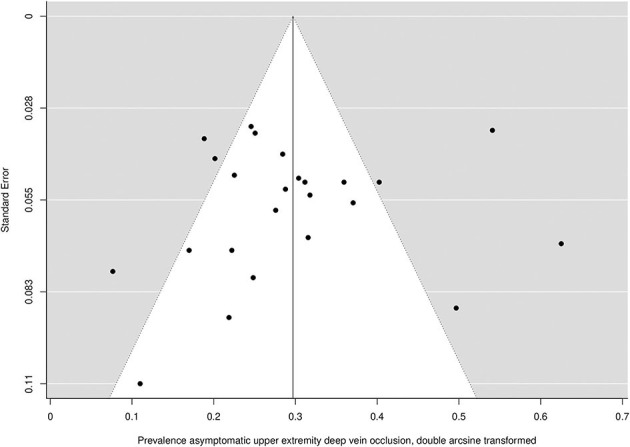
The presence of transvenous leads for cardiac device therapy may increase the risk of venous thromboembolisms. The epidemiology of these complications has not yet been determined systematically. Therefore, this study aims to determine (I) the incidence of symptomatic upper extremity deep vein thrombosis (UEDVT) and (II) the prevalence of asymptomatic upper extremity vein occlusion in patients with transvenous leads, both after the initial 2 months following lead implantation. PubMed, EMBASE, and Cochrane Library were searched until March 31, 2020 to identify studies reporting incidence of UEDVT and prevalence of asymptomatic vein occlusion after the initial 2 months after implantation in adult patients with transvenous leads. Incidence per 100 patient years of follow-up (PY) and proportions (%) were calculated to derive pooled estimates of incidence and prevalence. Search and selection yielded 20 and 24 studies reporting on UEDVT and asymptomatic vein occlusion, respectively. The overall pooled incidence of UEDVT was 0.9 (95% CI 0.5-1.4) per 100PY after 2 months after lead implantation. High statistical heterogeneity was present among studies (I = 82.4%; = < 0.001) and only three studies considered to be at low risk of bias. The overall pooled prevalence of asymptomatic upper extremity vein occlusion was 8.6% (95% CI 6.0-11.5) with high heterogeneity (I = 81.4%; = <0.001). Meta-regression analysis showed more leads to be associated with a higher risk of UEDVT. Transvenous leads are an important risk factor for symptomatic UEDVT, which may occur up to multiple years after initial lead implantation. Existing data on UEDVT after lead implantation is mostly of poor quality, which emphasizes the need for high quality prospective research. Asymptomatic vein occlusion is present in a substantial proportion of patients and may complicate any future lead addition. (URL: https://www.crd.york.ac.uk/prospero/display_record.php?ID=CRD42020178136, Identifier: PROSPERO 2020 CRD42020178136).
心脏设备治疗中经静脉导线的存在可能会增加静脉血栓栓塞的风险。这些并发症的流行病学尚未得到系统确定。因此,本研究旨在确定:(I)有症状的上肢深静脉血栓形成(UEDVT)的发生率,以及(II)在植入导线后的最初2个月后,经静脉导线患者无症状上肢静脉闭塞的患病率。检索了PubMed、EMBASE和Cochrane图书馆,直至2020年3月31日,以识别报告成年经静脉导线患者植入后最初2个月后UEDVT发生率和无症状静脉闭塞患病率的研究。计算每100患者年随访(PY)的发生率和比例(%),以得出发生率和患病率的汇总估计值。检索和筛选分别产生了20项和24项关于UEDVT和无症状静脉闭塞的研究。导线植入后2个月,UEDVT的总体汇总发生率为每100PY 0.9(95%CI 0.5 - 1.4)。研究之间存在高度统计学异质性(I = 82.4%;P = < 0.001),只有三项研究被认为偏倚风险较低。无症状上肢静脉闭塞的总体汇总患病率为8.6%(95%CI 6.0 - 11.5),异质性较高(I = 81.4%;P = <0.001)。Meta回归分析表明,更多的导线与UEDVT的更高风险相关。经静脉导线是有症状UEDVT的重要危险因素,可能在最初植入导线后的多年内发生。关于导线植入后UEDVT的现有数据大多质量较差,这强调了高质量前瞻性研究的必要性。相当一部分患者存在无症状静脉闭塞,这可能会使未来的任何导线添加复杂化。(网址:https://www.crd.york.ac.uk/prospero/display_record.php?ID=CRD42020178136,标识符:PROSPERO 2020 CRD42020178136)