Fred Hutchinson Cancer Research Center, 1100 Fairview Ave N, Seattle, WA, 98109-1024, USA.
Princess Margaret Cancer Centre, Toronto, ON, Canada.
J Hematol Oncol. 2021 Sep 8;14(1):140. doi: 10.1186/s13045-021-01144-9.
In the absence of randomized studies directly comparing chimeric antigen receptor T cell therapies, this study used matching-adjusted indirect comparisons (MAIC) to evaluate the comparative efficacy and safety of lisocabtagene maraleucel (liso-cel) versus axicabtagene ciloleucel (axi-cel) in patients with relapsed or refractory large B cell lymphoma (LBCL).
Primary data sources included individual patient data from the TRANSCEND NHL 001 study (TRANSCEND [NCT02631044]; N = 256 for efficacy set, N = 269 for safety set) for liso-cel and summary-level data from the ZUMA-1 study (NCT02348216; N = 101 for efficacy set, N = 108 for safety set) for axi-cel. Inter-study differences in design, eligibility criteria, baseline characteristics, and outcomes were assessed and aligned to the extent feasible. Clinically relevant prognostic factors were adjusted in a stepwise fashion by ranked order. Since bridging therapy was allowed in TRANSCEND but not ZUMA-1, the initial efficacy and safety analyses included bridging therapy use as a matching factor (TRANSCEND patients who received bridging therapy were removed). Subsequent sensitivity analyses excluded this matching factor.
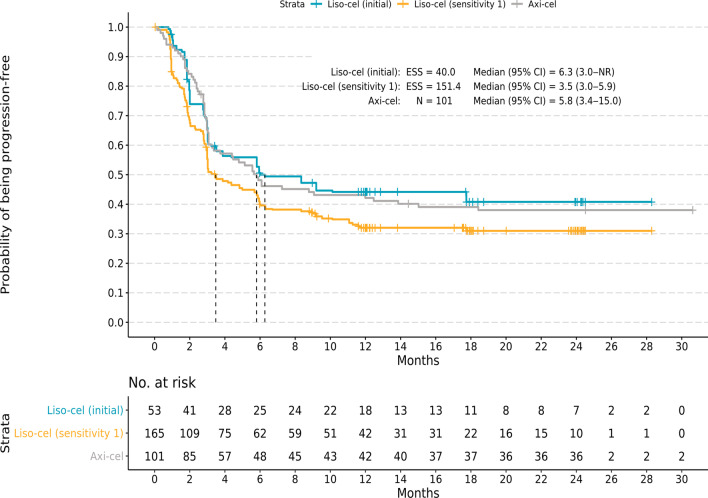
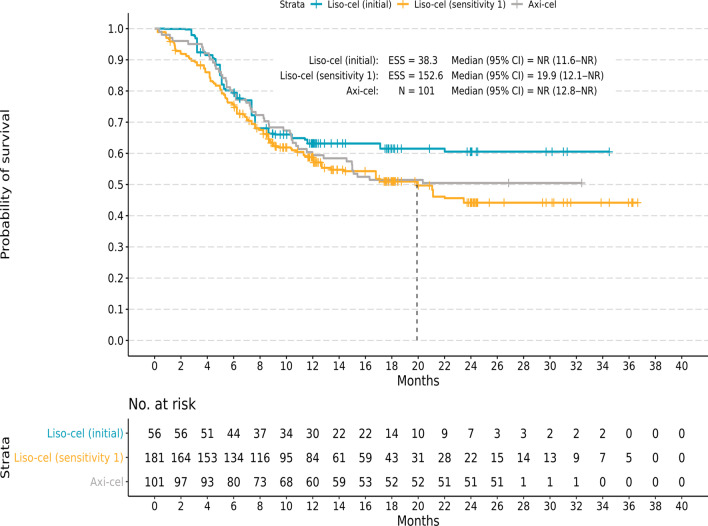
The initial analysis showed similar MAIC-weighted efficacy outcomes between TRANSCEND and ZUMA-1 for overall and complete response rates (odds ratio [95% confidence interval (CI)], 1.40 [0.56-3.49] and 1.21 [0.56-2.64], respectively) and for overall survival and progression-free survival (hazard ratio [95% CI], 0.81 [0.44-1.49] and 0.95 [0.58-1.57], respectively). MAIC-weighted safety outcomes favored liso-cel, with significantly lower odds of all-grade and grade ≥ 3 cytokine release syndrome (odds ratio [95% CI], 0.03 [0.01-0.07] and 0.08 [0.01-0.67], respectively) and study-specific neurological events (0.16 [0.08-0.33] and 0.05 [0.02-0.15], respectively). Efficacy and safety outcomes remained similar in sensitivity analyses, which did not include use of bridging therapy as a matching factor.
After matching and adjusting for clinically relevant prognostic factors, liso-cel demonstrated comparable efficacy and a more favorable safety profile compared with axi-cel in patients with third- or later-line relapsed or refractory LBCL.
NCT02631044 and NCT02348216.
由于缺乏直接比较嵌合抗原受体 T 细胞疗法的随机研究,本研究使用匹配调整间接比较(MAIC)来评估在复发或难治性大 B 细胞淋巴瘤(LBCL)患者中,lisocabtagene maraleucel(liso-cel)与 axi-cel 的疗效和安全性。
主要数据来源包括 TRANSCEND NHL 001 研究(TRANSCEND [NCT02631044];疗效集 N=256,安全性集 N=269)中 liso-cel 的个体患者数据,以及 ZUMA-1 研究(NCT02348216)中汇总数据;疗效集 N=101,安全性集 N=108)。评估并尽可能调整研究之间在设计、入选标准、基线特征和结局方面的差异。通过按等级顺序逐步调整临床相关预后因素。由于 TRANSCEND 中允许桥接治疗,但 ZUMA-1 中不允许,因此初始疗效和安全性分析将桥接治疗的使用作为匹配因素(TRANSCEND 中接受桥接治疗的患者被排除在外)。随后的敏感性分析排除了这一匹配因素。
初始分析显示,TRANSCEND 和 ZUMA-1 之间的 MAIC 加权疗效结果相似,总反应率和完全缓解率(优势比[95%置信区间(CI)],分别为 1.40[0.56-3.49]和 1.21[0.56-2.64])和总生存期和无进展生存期(风险比[95%CI],分别为 0.81[0.44-1.49]和 0.95[0.58-1.57])。MAIC 加权安全性结果对 liso-cel 有利,所有等级和等级≥3 细胞因子释放综合征的可能性显著降低(优势比[95%CI],分别为 0.03[0.01-0.07]和 0.08[0.01-0.67])和特定于研究的神经事件(0.16[0.08-0.33]和 0.05[0.02-0.15])。敏感性分析结果相似,安全性结果也相似,这些分析未将桥接治疗的使用作为匹配因素。
在匹配和调整临床相关预后因素后,liso-cel 在第三线或更后线复发或难治性 LBCL 患者中的疗效与 axi-cel 相当,且安全性更好。
NCT02631044 和 NCT02348216。