From the Department of Neurology (K.J.N., N.M.v.d.V., J.J.G.M.V., E.H.N.), Duchenne Center Netherlands (K.J.N., M.v.d.H., N.M.v.d.V., I.J.M.d.G., J.J.G.M.V., H.E.K., E.H.N.)Department of Orthopedics, Rehabilitation and Physiotherapy (M.v.d.H.), and Department of Biomedical Data Sciences (E.W.v.Z.), Leiden University Medical Center; and Department of Rehabilitation (I.J.M.d.G.), Radboud University Medical Center, Nijmegen, the Netherlands.
Neurology. 2021 Oct 26;97(17):e1737-e1742. doi: 10.1212/WNL.0000000000012724. Epub 2021 Sep 7.
To study the potential of quantitative MRI (qMRI) fat fraction (FF) as a biomarker in nonambulant patients with Duchenne muscular dystrophy (DMD), we assessed the additive predictive value of elbow flexor FF to age at loss of hand-to-mouth movement.
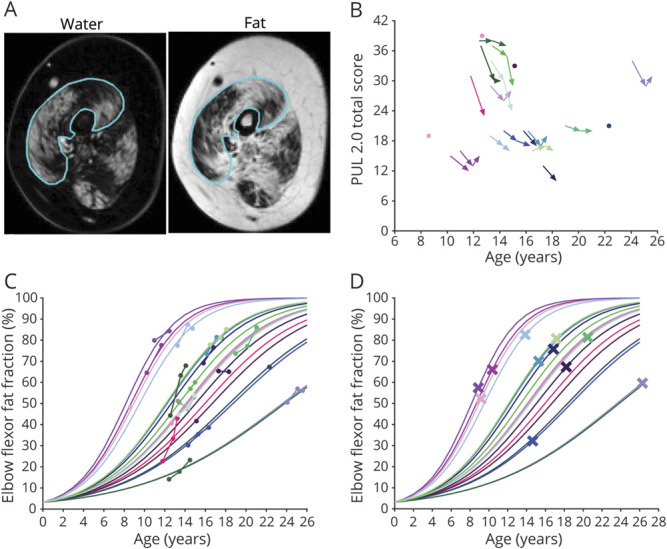
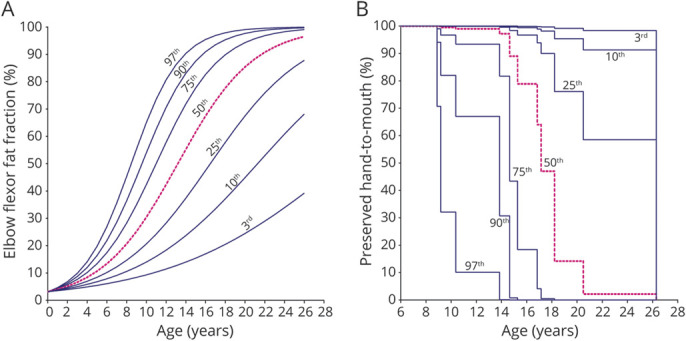
Nonambulant patients with DMD (age ≥8 years) were included. Four-point Dixon MRI scans of the right upper arm were performed at baseline and at the 12-, 18-, or 24-month follow-up. Elbow flexor FFs were determined from 5 central slices. Loss of hand-to-mouth movement was determined at study visits and by phone calls every 4 months. FFs were fitted to a sigmoidal curve by use of a mixed model with random slope to predict individual trajectories. The added predictive value of elbow flexor FF to age at loss of hand-to-mouth movement was calculated from a Cox model with the predicted FF as a time-varying covariate, yielding a hazard ratio.
Forty-eight MRIs of 20 patients with DMD were included. The hazard ratio of a percent-point increase in elbow flexor FF for the time to loss of hand-to-mouth movement was 1.12 (95% confidence interval 1.04-1.21; = 0.002). This corresponded to a 3.13-fold increase in the instantaneous risk of loss of hand-to-mouth movement in patients with a 10-percent points higher elbow flexor FF at any age.
In this prospective study, elbow flexor FF predicted loss of hand-to-mouth movement independently of age. qMRI-measured elbow flexor FF can be used as a surrogate endpoint or stratification tool for clinical trials in nonambulant patients with DMD.
This study provides Class II evidence that qMRI FF of elbow flexor muscles in patients with DMD predicts loss of hand-to-mouth movement independently of age.
为了研究定量 MRI(qMRI)脂肪分数(FF)作为杜氏肌营养不良症(DMD)非卧床患者生物标志物的潜力,我们评估了肱二头肌 FF 对丧失手到口运动年龄的附加预测价值。
纳入了年龄≥8 岁的非卧床 DMD 患者。在基线和 12、18 或 24 个月的随访时进行右上肢四点 Dixon MRI 扫描。从 5 个中心切片确定肱二头肌 FF。在研究就诊时以及每 4 个月通过电话确定丧失手到口运动。使用混合模型拟合 sigmoidal 曲线,随机斜率确定个体轨迹。使用 Cox 模型计算肱二头肌 FF 对丧失手到口运动年龄的附加预测价值,预测 FF 作为时变协变量,产生危害比。
纳入了 20 例 DMD 患者的 48 次 MRI。肱二头肌 FF 每增加 1 个百分点,丧失手到口运动的时间的危害比为 1.12(95%置信区间 1.04-1.21; = 0.002)。这相当于在任何年龄时,肱二头肌 FF 增加 10 个百分点的患者丧失手到口运动的即时风险增加了 3.13 倍。
在这项前瞻性研究中,肱二头肌 FF 独立于年龄预测丧失手到口运动。qMRI 测量的肱二头肌 FF 可作为非卧床 DMD 患者临床试验的替代终点或分层工具。
本研究提供了 II 级证据,表明 DMD 患者肱二头肌 qMRI FF 可独立于年龄预测丧失手到口运动。