Division of Nephrology and Immunology, Department of Medicine, University of Alberta, Edmonton, AB, Canada.
Division of Nephrology and Hypertension, University of Cape Town, Cape Town, South Africa.
Transplantation. 2022 Jun 1;106(6):1113-1122. doi: 10.1097/TP.0000000000003943. Epub 2022 Sep 7.
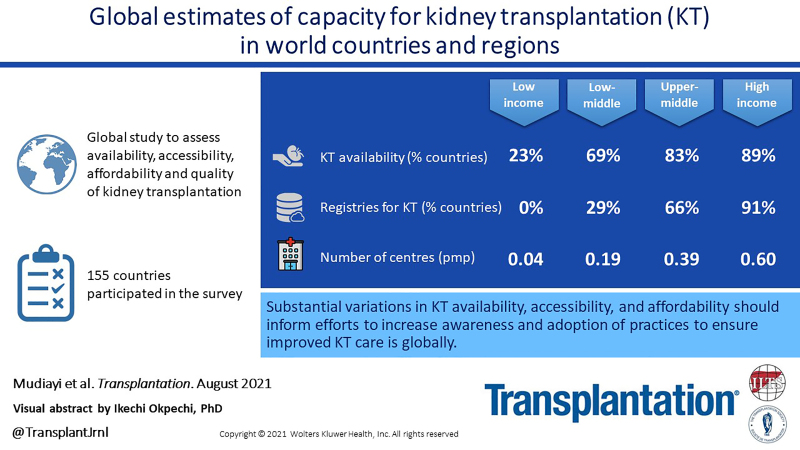
Kidney transplantation (KT) is the optimal treatment for kidney failure and is associated with better quality of life and survival relative to dialysis. However, knowledge of the current capacity of countries to deliver KT is limited. This study reports on findings from the 2018 International Society of Nephrology Global Kidney Health Atlas survey, specifically addressing the availability, accessibility, and quality of KT across countries and regions.
Data were collected from published online sources, and a survey was administered online to key stakeholders. All country-level data were analyzed by International Society of Nephrology region and World Bank income classification.
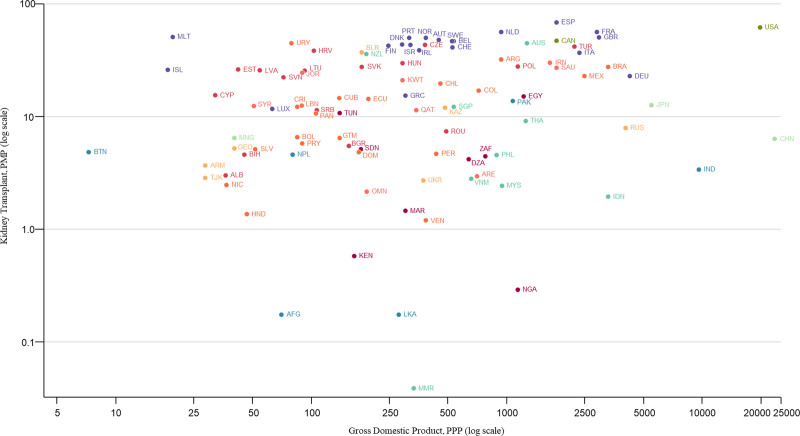
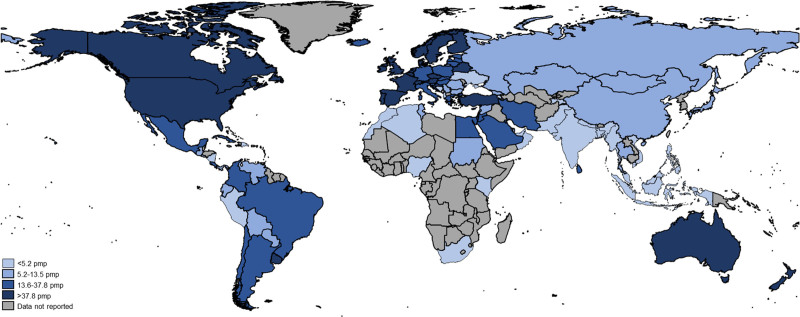
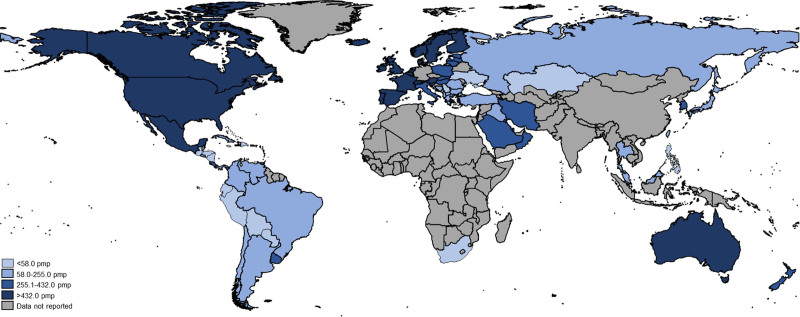
Data were collected via a survey in 182 countries, of which 155 answered questions pertaining to KT. Of these, 74% stated that KT was available, with a median incidence of 14 per million population (range: 0.04-70) and median prevalence of 255 per million population (range: 3-693). Accessibility of KT varied widely; even within high-income countries, it was disproportionately lower for ethnic minorities. Universal health coverage of all KT treatment costs was available in 31%, and 57% had a KT registry.
There are substantial variations in KT incidence, prevalence, availability, accessibility, and quality worldwide, with the lowest rates evident in low- and lower-middle income countries. Understanding these disparities will inform efforts to increase awareness and the adoption of practices that will ensure high-quality KT care is provided around the world.
肾移植(KT)是治疗肾衰竭的最佳方法,与透析相比,它能提高生活质量和存活率。然而,各国提供 KT 的能力的相关知识有限。本研究报告了 2018 年国际肾脏病学会全球肾脏健康地图集调查的结果,该调查专门针对各国和地区 KT 的可用性、可及性和质量。
从已发表的在线资源中收集数据,并对主要利益攸关方进行在线调查。所有国家层面的数据均按国际肾脏病学会区域和世界银行收入分类进行分析。
通过在 182 个国家进行调查收集数据,其中 155 个国家回答了与 KT 相关的问题。其中,74%的国家表示 KT 是可用的,每百万人口的发病率中位数为 14(范围:0.04-70),每百万人口的患病率中位数为 255(范围:3-693)。KT 的可及性差异很大;即使在高收入国家,少数民族的 KT 获得率也不成比例地较低。31%的国家提供了所有 KT 治疗费用的全民健康覆盖,57%的国家有 KT 登记处。
全球范围内 KT 的发病率、患病率、可用性、可及性和质量存在很大差异,中低收入国家的比率最低。了解这些差异将有助于提高认识,并采取确保在全球范围内提供高质量 KT 护理的实践。