School of Basic Medical Sciences, Zhejiang Chinese Medical University, Zhejiang, 310053, Hangzhou, China.
College of Traditional Chinese Medicine, China Three Gorges University & Yichang Hospital of Traditional Chinese Medicine, Yichang, 443003, Hubei, China.
Trials. 2021 Jul 24;22(1):485. doi: 10.1186/s13063-021-05399-y.
Insomnia is a common but frequently overlooked sleep disorder after stroke, and there are limited effective therapies for insomnia following stroke. Traditional Chinese medicine (TCM), including acupuncture and the Chinese herbal medication (CHM) Suanzaoren decoction (SZRD), has been reported as an alternative option for insomnia relief after stroke in China for thousands of years. Here, this study aims to investigate the efficacy and safety of electroacupuncture (EA) in combination with SZRD in the treatment of insomnia following stroke.
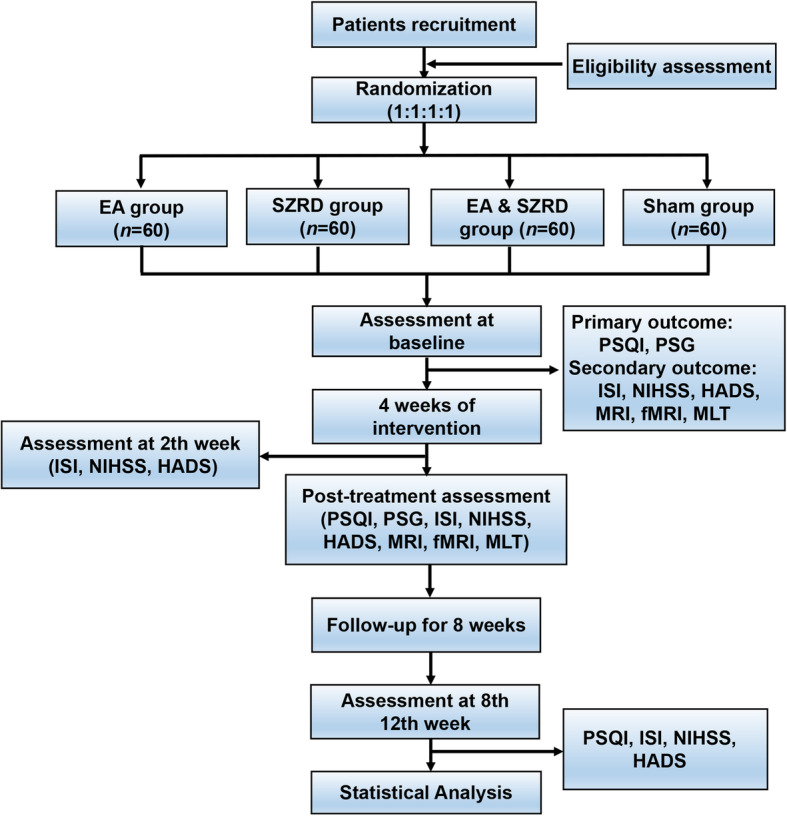
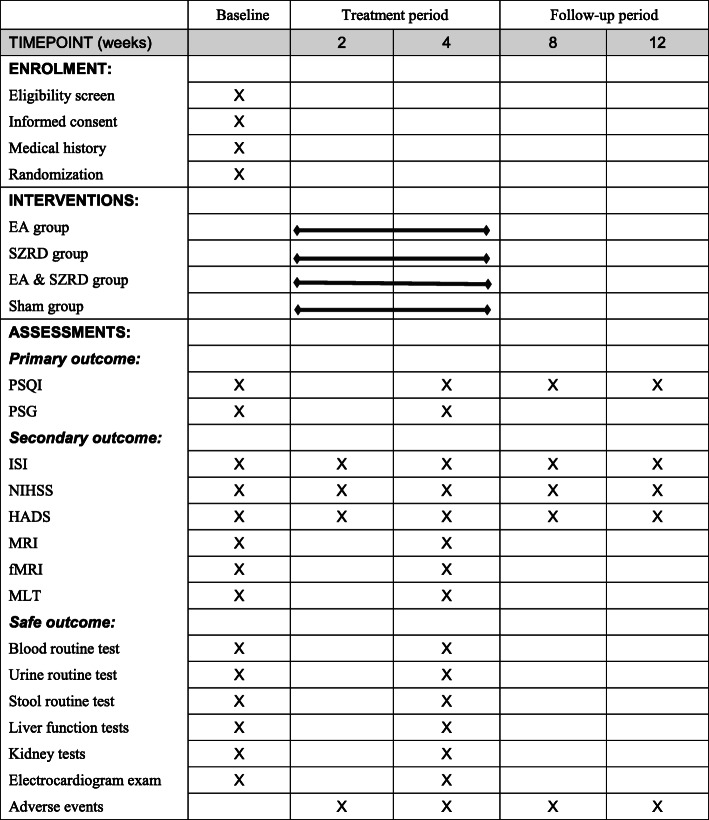
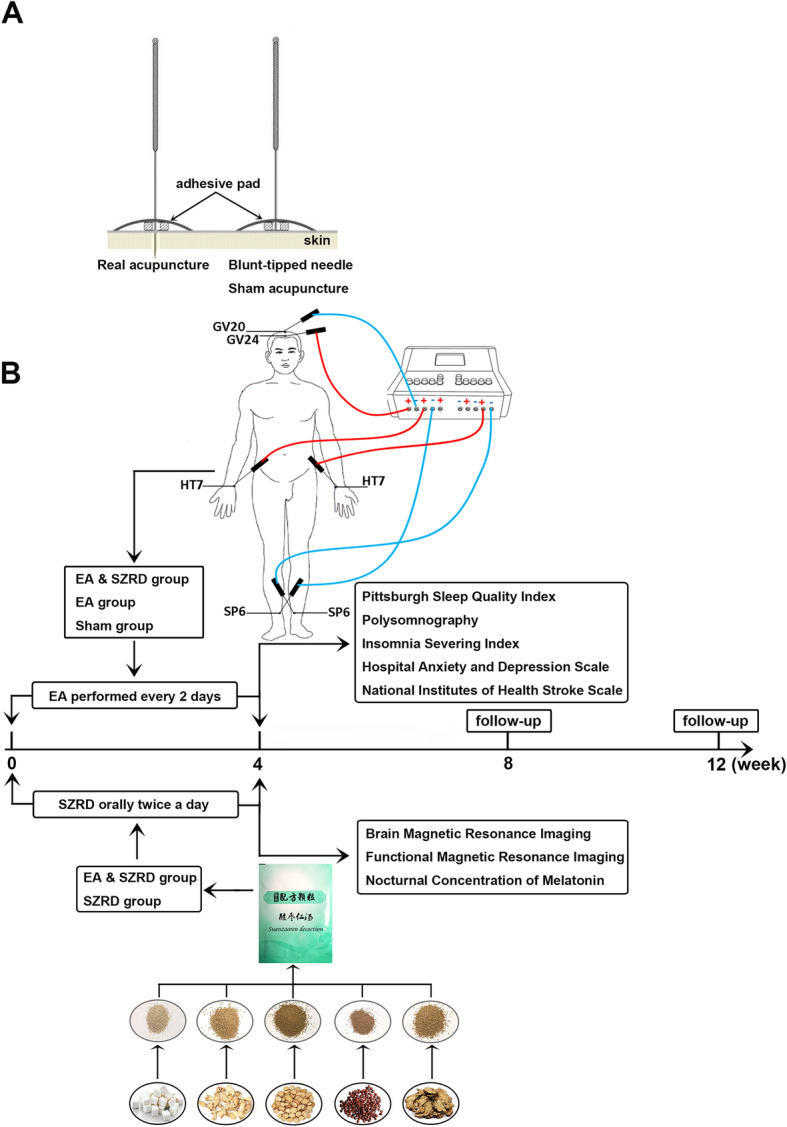
A total of 240 patients with post-stroke insomnia will be included and randomized into four groups: the EA group, SZRD group, EA & SZRD group, and sham group. The same acupoints (GV20, GV24, HT7, and SP6) will be used in the EA group, EA & SZRD group, and sham group, and these patients will receive the EA treatment or sham manipulation every other day for 4 consecutive weeks. SZRD treatments will be given to participants in the SZRD group and EA & SZRD group twice a day for 4 consecutive weeks. The primary outcome measures include Pittsburgh Sleep Quality Index scores and polysomnography. Secondary outcome measures include the Insomnia Severity Index, the National Institutes of Health Stroke Scale, the Hospital Anxiety and Depression Scale, brain magnetic resonance imaging, functional magnetic resonance imaging, and nocturnal melatonin concentrations. The primary and secondary outcomes will be assessed at baseline (before treatment), during the 2nd and 4th weeks of the intervention, and at the 8th and 12th weeks of follow-up. Safety assessments will be evaluated at baseline and during the 4th week of the intervention.
This study will contribute to assessing whether the combination of these two therapies is more beneficial for post-stroke insomnia than their independent use, and the results of this clinical trial will improve our understanding of the possible mechanisms underlying the effects of combination therapies.
Chinese Clinical Trials Register ChiCTR2000031413 . Registered on March 30, 2020.
失眠是中风后常见但常被忽视的睡眠障碍,而对于中风后的失眠,目前有效的治疗方法有限。几千年来,包括针灸和中药酸枣仁汤(SZRD)在内的中医(TCM)一直被报道为中风后缓解失眠的一种替代选择。在这里,这项研究旨在探讨电针对中风后失眠的疗效和安全性。
共纳入 240 例中风后失眠患者,随机分为四组:电针组、SZRD 组、电针+SZRD 组和假针组。电针组、电针+SZRD 组和假针组将使用相同的穴位(GV20、GV24、HT7 和 SP6),每两天接受一次电针治疗,共连续 4 周。SZRD 组和电针+SZRD 组将每天接受两次 SZRD 治疗,共连续 4 周。主要结局指标包括匹兹堡睡眠质量指数评分和多导睡眠图。次要结局指标包括失眠严重程度指数、国立卫生研究院卒中量表、医院焦虑抑郁量表、脑磁共振成像、功能磁共振成像和夜间褪黑素浓度。主要和次要结局将在基线(治疗前)、干预的第 2 周和第 4 周以及随访的第 8 周和第 12 周进行评估。安全性评估将在基线和干预的第 4 周进行。
这项研究将有助于评估这两种疗法的联合使用是否比单独使用更有益于中风后失眠,并且这项临床试验的结果将提高我们对联合治疗作用机制的理解。
中国临床试验注册中心 ChiCTR2000031413。注册于 2020 年 3 月 30 日。