NORMENT, Institute of Clinical Medicine, University of Oslo and Division of Mental Health and Addiction, Oslo University Hospital, 0407, Oslo, Norway.
Psychosis Studies, Institute of Psychiatry, Psychology and Neurosciences, King's College London, London, UK.
Transl Psychiatry. 2021 Sep 8;11(1):466. doi: 10.1038/s41398-021-01576-4.
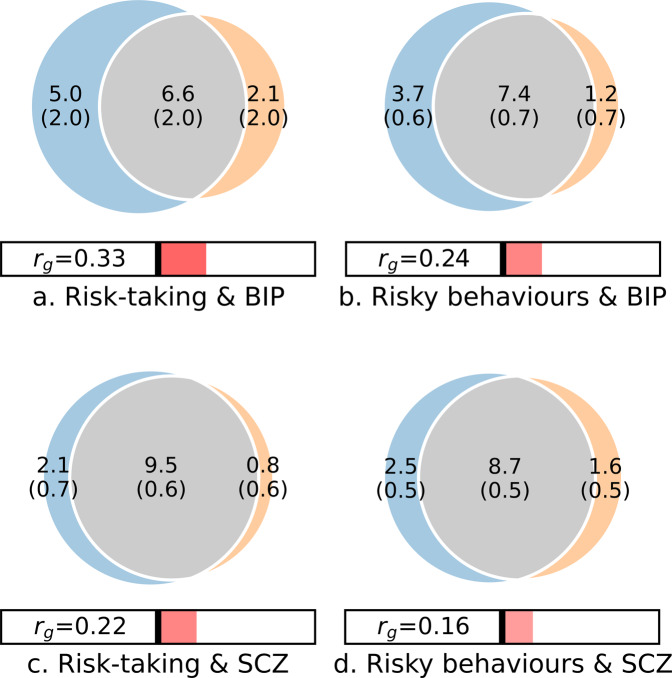
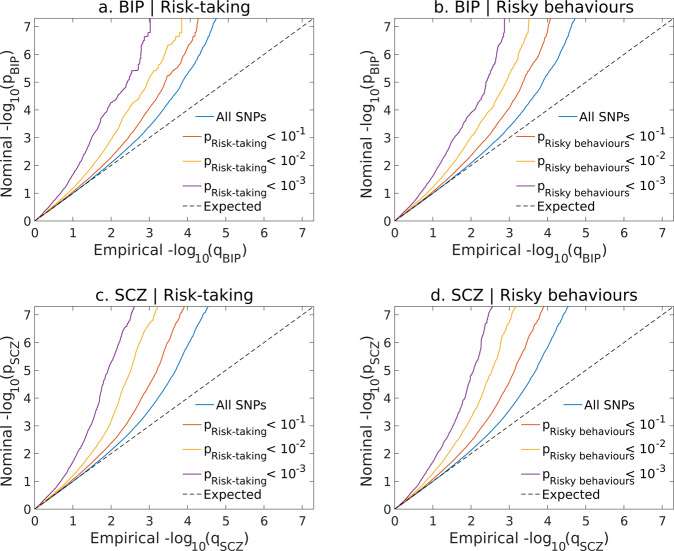
Increased risk-taking is a central component of bipolar disorder (BIP) and is implicated in schizophrenia (SCZ). Risky behaviours, including smoking and alcohol use, are overrepresented in both disorders and associated with poor health outcomes. Positive genetic correlations are reported but an improved understanding of the shared genetic architecture between risk phenotypes and psychiatric disorders may provide insights into underlying neurobiological mechanisms. We aimed to characterise the genetic overlap between risk phenotypes and SCZ, and BIP by estimating the total number of shared variants using the bivariate causal mixture model and identifying shared genomic loci using the conjunctional false discovery rate method. Summary statistics from genome wide association studies of SCZ, BIP, risk-taking and risky behaviours were acquired (n = 82,315-466,751). Genomic loci were functionally annotated using FUMA. Of 8.6-8.7 K variants predicted to influence BIP, 6.6 K and 7.4 K were predicted to influence risk-taking and risky behaviours, respectively. Similarly, of 10.2-10.3 K variants influencing SCZ, 9.6 and 8.8 K were predicted to influence risk-taking and risky behaviours, respectively. We identified 192 loci jointly associated with SCZ and risk phenotypes and 206 associated with BIP and risk phenotypes, of which 68 were common to both risk-taking and risky behaviours and 124 were novel to SCZ or BIP. Functional annotation implicated differential expression in multiple cortical and sub-cortical regions. In conclusion, we report extensive polygenic overlap between risk phenotypes and BIP and SCZ, identify specific loci contributing to this shared risk and highlight biologically plausible mechanisms that may underlie risk-taking in severe psychiatric disorders.
冒险行为增加是双相情感障碍(BIP)的一个核心组成部分,并且与精神分裂症(SCZ)有关。这两种疾病中都存在吸烟和饮酒等冒险行为,并且与健康状况不佳有关。已经报道了阳性的遗传相关性,但对风险表型和精神障碍之间共享遗传结构的更好理解可能会深入了解潜在的神经生物学机制。我们旨在通过使用双变量因果混合模型估计共享变体的总数,以及通过使用联合假发现率方法识别共享基因组座,来描述风险表型与 SCZ 和 BIP 之间的遗传重叠。我们获取了 SCZ、BIP、冒险行为和冒险行为的全基因组关联研究的汇总统计数据(n = 82315-466751)。使用 FUMA 对基因组座进行了功能注释。在预测会影响 BIP 的 8.6-8.7 K 个变体中,有 6.6 K 和 7.4 K 个变体分别被预测会影响冒险行为和冒险行为。同样,在影响 SCZ 的 10.2-10.3 K 个变体中,有 9.6 和 8.8 K 个变体分别被预测会影响冒险行为和冒险行为。我们确定了 192 个与 SCZ 和风险表型共同相关的基因座和 206 个与 BIP 和风险表型相关的基因座,其中 68 个是冒险行为和冒险行为共有的,124 个是 SCZ 或 BIP 特有的。功能注释表明,在多个皮质和皮质下区域存在差异表达。总之,我们报告了风险表型与 BIP 和 SCZ 之间广泛的多基因重叠,确定了对这种共同风险有贡献的特定基因座,并强调了可能是严重精神障碍冒险行为基础的生物学上合理的机制。