Department of Pharmacology and Center for Biomedical Neuroscience, University of Texas Health Science Center at San Antonio, San Antonio, TX, USA.
South Texas Veterans Health Care System, San Antonio, TX, USA.
Neuropsychopharmacology. 2022 Jan;47(2):507-515. doi: 10.1038/s41386-021-01171-7. Epub 2021 Sep 8.
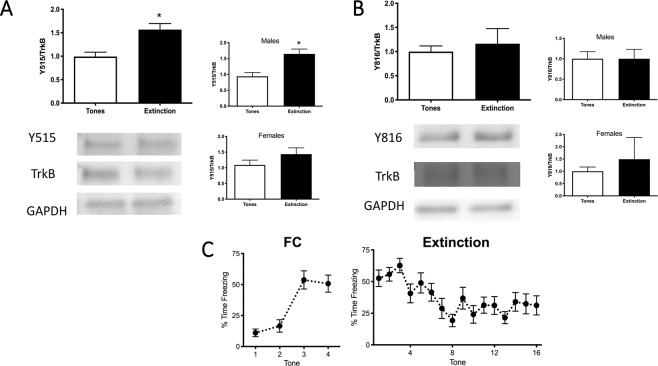
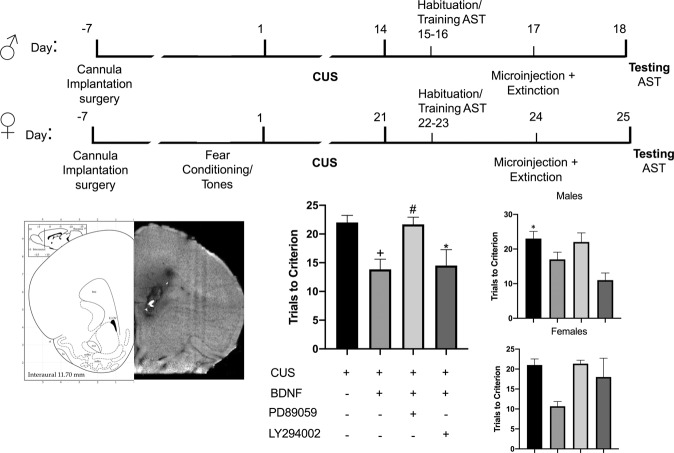
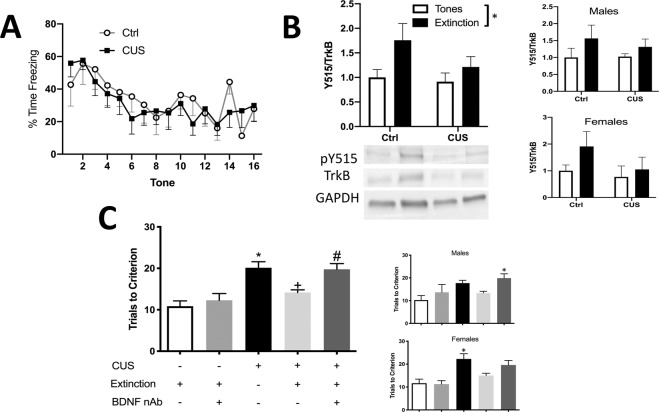
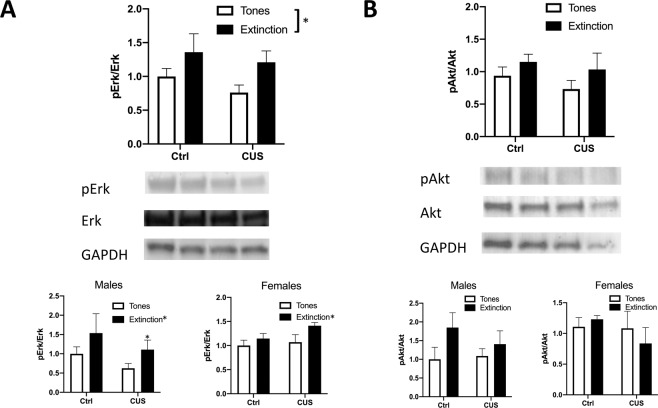
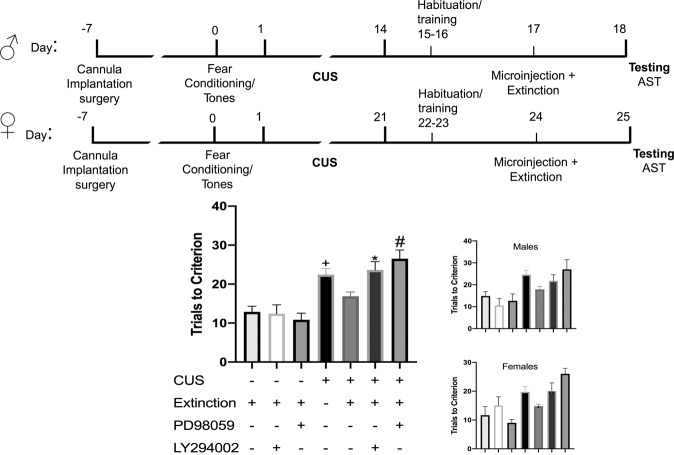
Current pharmacotherapies for posttraumatic stress disorder (PTSD) and major depressive disorder (MDD) are ineffective for many patients, and often do not restore cognitive dysfunction associated with these disorders. Behavioral therapies, such as exposure therapy, can be effective for treatment-resistant patients. The mechanisms underlying exposure therapy are not well-understood. Fear extinction as an intervention after chronic stress can model the beneficial effects of exposure therapy in rats. Extinction requires neuronal activity and protein synthesis in the infralimbic (IL) cortex for its beneficial effects. We hypothesized that extinction requires Brain-Derived Neurotrophic Factor (BDNF) activity in the IL cortex to reverse stress-induced cognitive flexibility impairments. Extinction learning reversed set-shifting deficits induced by Chronic Unpredictable Stress (CUS), tested 24 h after extinction. Blocking BDNF signaling in the IL cortex during extinction by local administration of a neutralizing antibody prevented the beneficial effects of extinction on set shifting after stress. Extinction induced activation of the BDNF TrkB receptor, and signaling pathways associated with BDNF (Akt and Erk). Administration of exogenous BDNF into IL cortex in the absence of extinction was sufficient to reverse the effects of stress on set shifting. The effects of extinction were prevented by blocking either Erk or Akt signaling in the IL cortex, whereas the effects of exogenous BDNF were dependent on Erk, but not Akt, signaling. Our observations suggest that BDNF-Erk signaling induced by extinction underlies plastic changes that can reverse or counteract the effects of chronic stress in the IL cortex.
目前,用于治疗创伤后应激障碍(PTSD)和重度抑郁症(MDD)的药物治疗对许多患者无效,而且通常无法恢复与这些疾病相关的认知功能障碍。暴露疗法等行为疗法对治疗抵抗的患者可能有效。暴露疗法的机制尚不清楚。慢性应激后进行恐惧消退作为一种干预措施,可以模拟暴露疗法在大鼠中的有益作用。消退需要杏仁核下皮质(IL)中的神经元活动和蛋白质合成才能发挥其有益作用。我们假设,消退需要 IL 皮层中的脑源性神经营养因子(BDNF)活性来逆转应激引起的认知灵活性障碍。消退学习可逆转慢性不可预测应激(CUS)引起的转换缺陷,在消退后 24 小时进行测试。在消退过程中,通过局部给予中和抗体阻断 IL 皮质中的 BDNF 信号,可防止消退对应激后转换的有益作用。消退诱导了 BDNF-TrkB 受体的激活,以及与 BDNF 相关的信号通路(Akt 和 Erk)。在没有消退的情况下,将外源性 BDNF 注入 IL 皮质即可逆转应激对转换的影响。在 IL 皮质中阻断 Erk 或 Akt 信号均可阻止消退的作用,而外源性 BDNF 的作用则依赖于 Erk,而不依赖于 Akt 信号。我们的观察结果表明,消退诱导的 BDNF-Erk 信号转导是可塑性变化的基础,这种变化可以逆转或抵消慢性应激在 IL 皮质中的作用。