Azinheira Nobrega Cruz Nayara, Gonçalves de Oliveira Lilian Caroline, Tedesco Silva Junior Helio, Osmar Medina Pestana Jose, Casarini Dulce Elena
Nephrology Division, Department of Medicine, Escola Paulista de Medicina, Universidade Federal de São Paulo, São Paulo, Brazil.
Front Physiol. 2021 Aug 23;12:700220. doi: 10.3389/fphys.2021.700220. eCollection 2021.
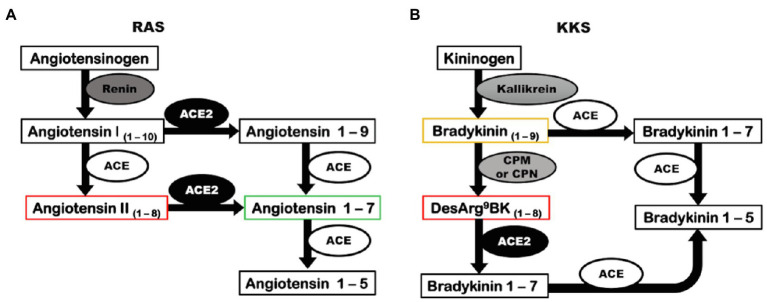
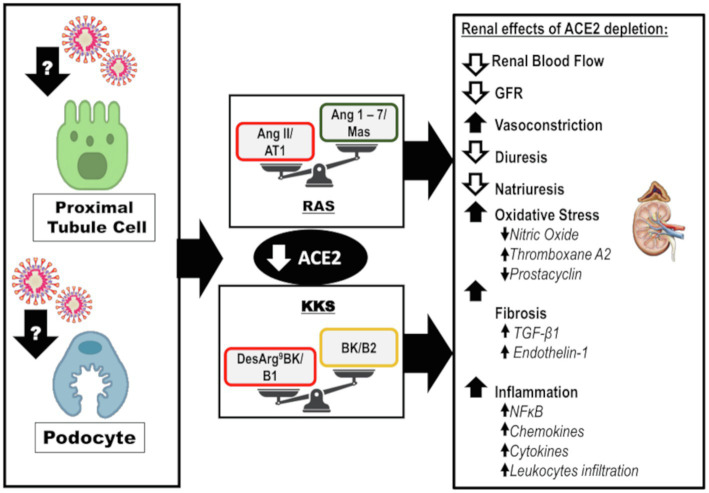
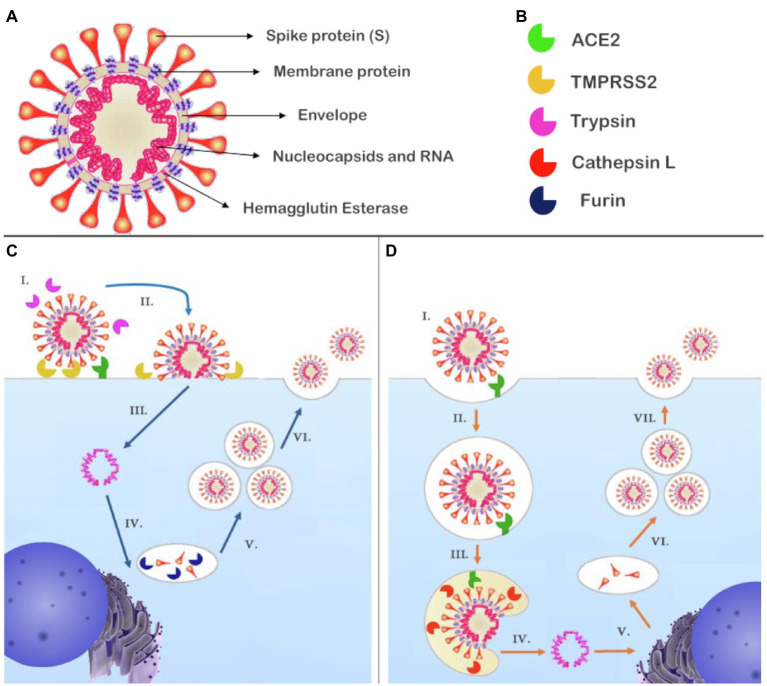
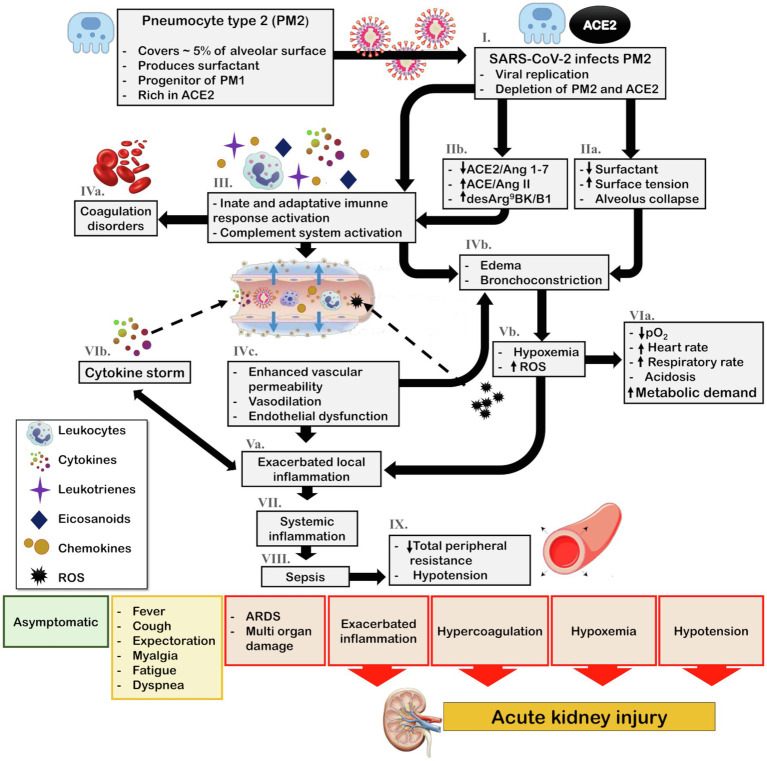
Coronavirus disease 2019 (COVID-19) was first reported in late December 2019 in Wuhan, China. The etiological agent of this disease is severe acute respiratory syndrome coronavirus 2 (SARS-CoV-2), and the high transmissibility of the virus led to its rapid global spread and a major pandemic (ongoing at the time of writing this review). The clinical manifestations of COVID-19 can vary widely from non-evident or minor symptoms to severe acute respiratory syndrome and multi-organ damage, causing death. Acute kidney injury (AKI) has been recognized as a common complication of COVID-19 and in many cases, kidney replacement therapy (KRT) is required. The presence of kidney abnormalities on hospital admission and the development of AKI are related to a more severe presentation of COVID-19 with higher mortality rate. The high transmissibility and the broad spectrum of clinical manifestations of COVID-19 are in part due to the high affinity of SARS-CoV-2 for its receptor, angiotensin (Ang)-converting enzyme 2 (ACE2), which is widely expressed in human organs and is especially abundant in the kidneys. A debate on the role of ACE2 in the infectivity and pathogenesis of COVID-19 has emerged: Does the high expression of ACE2 promotes higher infectivity and more severe clinical manifestations or does the interaction of SARS-CoV-2 with ACE2 reduce the bioavailability of the enzyme, depleting its biological activity, which is closely related to two important physiological systems, the renin-angiotensin system (RAS) and the kallikrein-kinin system (KKS), thereby further contributing to pathogenesis. In this review, we discuss the dual role of ACE2 in the infectivity and pathogenesis of COVID-19, highlighting the effects of COVID-19-induced ACE2 depletion in the renal physiology and how it may lead to kidney injury. The ACE2 downstream regulation of KKS, that usually receives less attention, is discussed. Also, a detailed discussion on how the triad of symptoms (respiratory, inflammatory, and coagulation symptoms) of COVID-19 can indirectly promote renal injury is primary aborded.
2019年冠状病毒病(COVID-19)于2019年12月下旬在中国武汉首次报告。该疾病的病原体是严重急性呼吸综合征冠状病毒2(SARS-CoV-2),病毒的高传播性导致其在全球迅速传播并引发了一场重大的大流行(在撰写本综述时仍在持续)。COVID-19的临床表现差异很大,从无明显症状或轻微症状到严重急性呼吸综合征和多器官损伤,甚至导致死亡。急性肾损伤(AKI)已被认为是COVID-19的常见并发症,在许多情况下,需要进行肾脏替代治疗(KRT)。入院时肾脏异常的存在以及AKI的发生与COVID-19更严重的表现及更高的死亡率相关。COVID-19的高传播性和广泛的临床表现部分归因于SARS-CoV-2对其受体血管紧张素(Ang)转换酶2(ACE2)的高亲和力,ACE2在人体器官中广泛表达,在肾脏中尤其丰富。关于ACE2在COVID-19的感染性和发病机制中的作用出现了一场争论:ACE2的高表达是否促进了更高的感染性和更严重的临床表现,还是SARS-CoV-2与ACE2的相互作用降低了该酶的生物利用度,耗尽了其生物活性,而这与肾素-血管紧张素系统(RAS)和激肽释放酶-激肽系统(KKS)这两个重要的生理系统密切相关,从而进一步促成发病机制。在本综述中,我们讨论了ACE2在COVID-19的感染性和发病机制中的双重作用,强调了COVID-19诱导的ACE2耗竭对肾脏生理学的影响以及它如何导致肾损伤。还讨论了通常较少受到关注的ACE2对KKS的下游调节。此外,还初步详细讨论了COVID-19的三联征症状(呼吸、炎症和凝血症状)如何间接促进肾损伤。