Arce Anibal, Guzman Chavez Fernando, Gandini Chiara, Puig Juan, Matute Tamara, Haseloff Jim, Dalchau Neil, Molloy Jenny, Pardee Keith, Federici Fernán
ANID - Millennium Science Initiative Program - Millennium Institute for Integrative Biology (iBio), Santiago, Chile.
Schools of Engineering, Institute for Biological and Medical Engineering, Medicine and Biological Sciences, Pontificia Universidad Católica de Chile, Santiago, Chile.
Front Bioeng Biotechnol. 2021 Aug 23;9:727584. doi: 10.3389/fbioe.2021.727584. eCollection 2021.
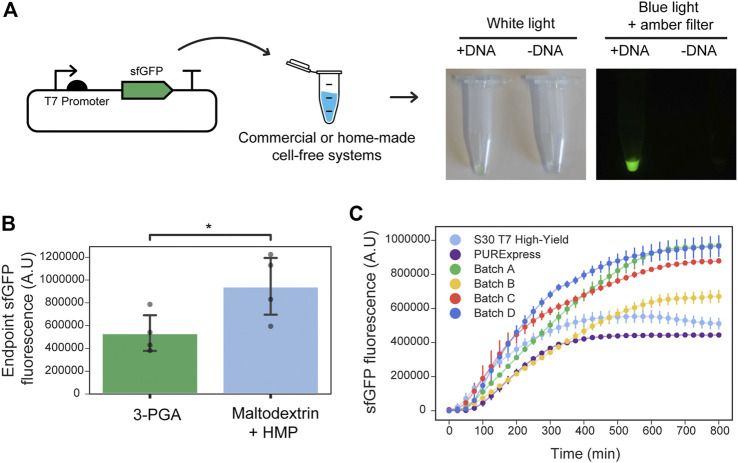
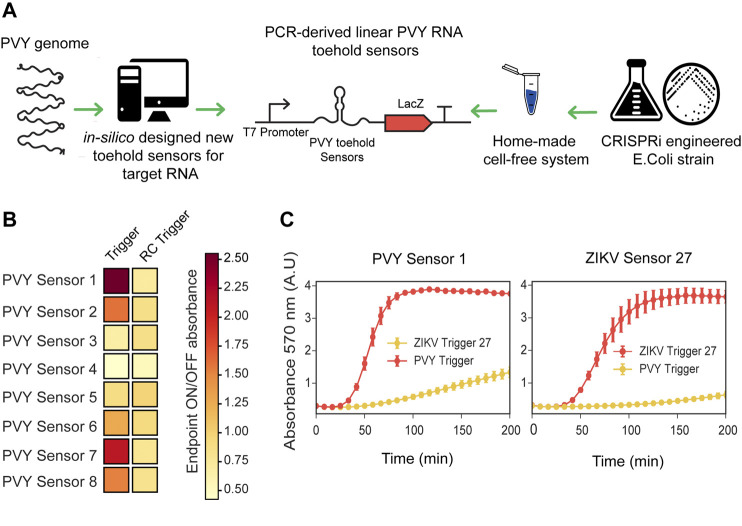
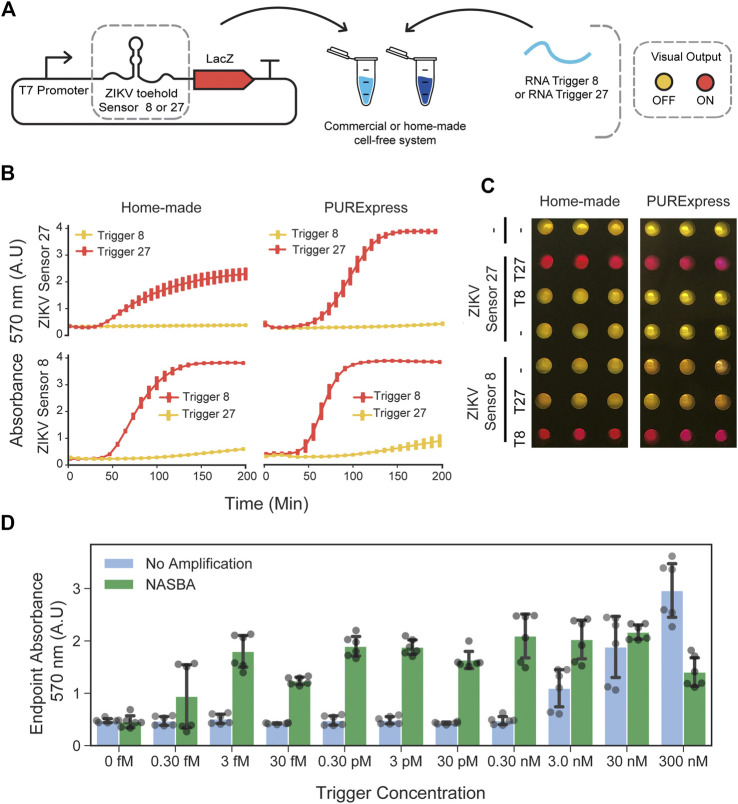
Cell-free gene expression systems have emerged as a promising platform for field-deployed biosensing and diagnostics. When combined with programmable toehold switch-based RNA sensors, these systems can be used to detect arbitrary RNAs and freeze-dried for room temperature transport to the point-of-need. These sensors, however, have been mainly implemented using reconstituted PURE cell-free protein expression systems that are difficult to source in the Global South due to their high commercial cost and cold-chain shipping requirements. Based on preliminary demonstrations of toehold sensors working on lysates, we describe the fast prototyping of RNA toehold switch-based sensors that can be produced locally and reduce the cost of sensors by two orders of magnitude. We demonstrate that these in-house cell lysates provide sensor performance comparable to commercial PURE cell-free systems. We further optimize these lysates with a CRISPRi strategy to enhance the stability of linear DNAs by knocking-down genes responsible for linear DNA degradation. This enables the direct use of PCR products for fast screening of new designs. As a proof-of-concept, we develop novel toehold sensors for the plant pathogen Potato Virus Y (PVY), which dramatically reduces the yield of this important staple crop. The local implementation of low-cost cell-free toehold sensors could enable biosensing capacity at the regional level and lead to more decentralized models for global surveillance of infectious disease.
无细胞基因表达系统已成为一种很有前景的用于现场部署生物传感和诊断的平台。当与基于可编程的toehold开关的RNA传感器相结合时,这些系统可用于检测任意RNA,并可冻干以便在室温下运输到需求点。然而,这些传感器主要是使用重组的无细胞PURE蛋白质表达系统实现的,由于其高昂的商业成本和冷链运输要求,在全球南方地区很难获得。基于toehold传感器在裂解物上工作的初步演示,我们描述了基于RNA toehold开关的传感器的快速原型制作,该传感器可以在当地生产,并将传感器成本降低两个数量级。我们证明,这些自制的细胞裂解物提供的传感器性能与商业无细胞PURE系统相当。我们进一步用CRISPRi策略优化这些裂解物,通过敲除负责线性DNA降解的基因来提高线性DNA的稳定性。这使得能够直接使用PCR产物快速筛选新设计。作为概念验证,我们开发了用于植物病原体马铃薯Y病毒(PVY)的新型toehold传感器,该病毒会大幅降低这种重要主食作物的产量。低成本无细胞toehold传感器的本地应用可以在区域层面实现生物传感能力,并导致更分散的全球传染病监测模式。