Department of Genetics and Pathology, International Hereditary Cancer Center, Pomeranian Medical University, Szczecin, Poland.
Department of Urology and Oncological Urology Clinic, Pomeranian Medical University, Szczecin, Poland.
PLoS One. 2021 Sep 9;16(9):e0257132. doi: 10.1371/journal.pone.0257132. eCollection 2021.
The purpose of this study was to compare the clinical characteristics and the survival of CHEK2 mutation positive and CHEK2 mutation negative patients diagnosed with bladder or kidney cancer.
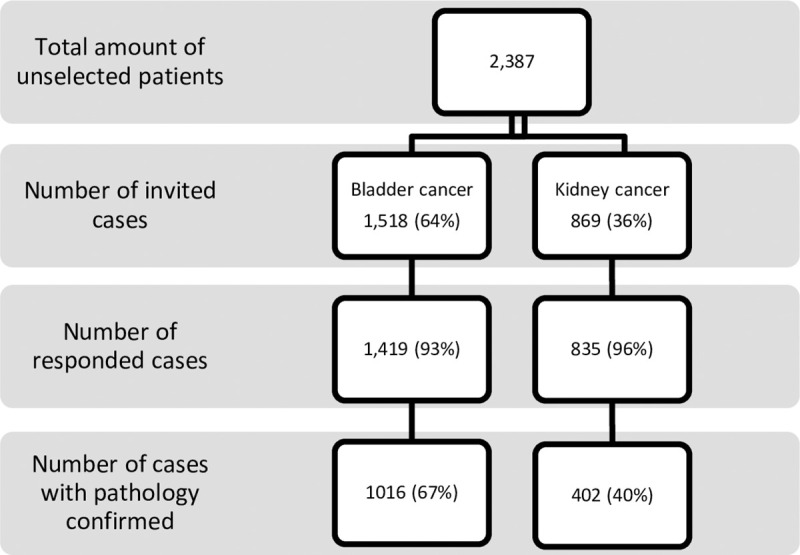
1016 patients with bladder and 402 cases with kidney cancer and 8302 controls were genotyped for four CHEK2 variants: 1100delC, del5395, IVS2+1G>A and I157T. Predictors of survival were determined among CHEK2 pathogenic variant carriers using the Cox proportional hazards model. The median follow-up was 17.5 years. Covariates included age (≤60; >61 years), sex (female; male), clinical characteristics (stage: TNM, grade, histopathological type), smoking status (non-smoking; smoking) and cancer family history (negative; positive).
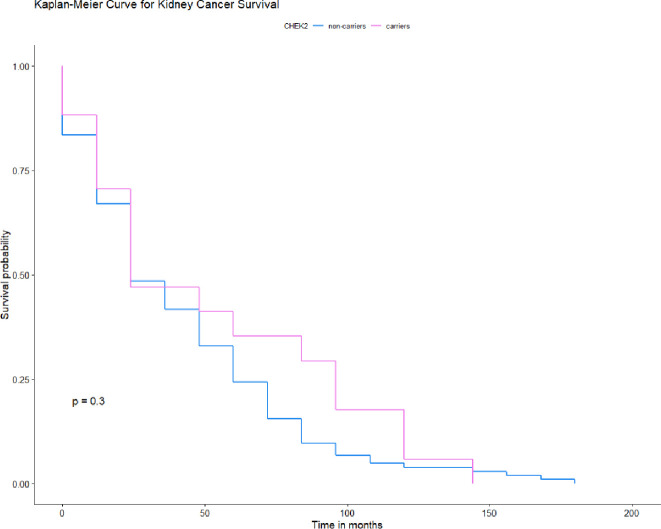
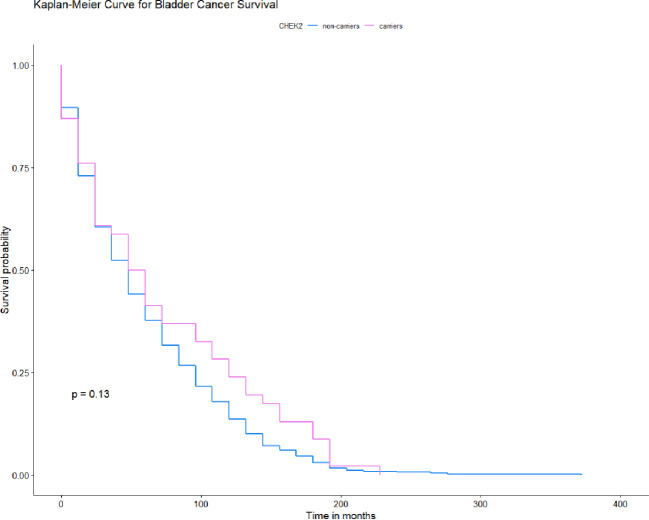
We found no impact of CHEK2 mutations on bladder or kidney cancer survival. However, we observed a possible increased survival in the subgroup of patients with stage T1 bladder cancer with CHEK2 mutations but this did not meet statistical significance (HR = 0.14; 95% CI 0.02-1.04; p = 0.055). Moreover, we observed that the missense mutations were more frequent in the low grade invasive bladder cancer patient group (OR = 7.9; 95% CI 1.50-42.1; p = 0.04) and in patients with bladder cancer with stage Ta (OR = 2.4; 95% CI 1.30-4.55; p = 0.006). The different results where missense mutations occurs less often we observed among patients with high grade invasive bladder cancer (OR = 0.12; 95% CI 0.02-0.66; p = 0.04) and those with stage T1 disease (OR = 0.2; 95% CI 0.07-0.76; p = 0.01). Our investigations revealed that any mutation in CHEK2 occurs more often among patients with stage Ta bladder cancer (OR = 2.0; 95% CI 1.19-3.47; p = 0.01) and less often in patients with stage T1 disease (OR = 0.31; 95% CI 0.12-0.78; p = 0.01). In the kidney cancer patients, truncating mutations were present more often in the group with clear cell carcinoma GII (OR = 8.0; 95% CI 0.95-67.7; p = 0.05). The 10-year survival for all CHEK2 mutation carriers with bladder cancer was 33% and for non-carriers 11% (p = 0.15). The 10-year survival for CHEK2 mutation carriers with kidney cancer 34% and for non-carriers 20% (p = 0.5).
CHEK2 mutations were not associated with any change in bladder or kidney cancer survival regardless of their age, sex, smoking status and family history. We observed a potentially protective effect of CHEK2 mutations on survival for patients with stage T1 bladder cancer. CHEK2 missense mutations were more common among patients with low grade invasive bladder cancer and in patients with stage Ta diease. The frequencies of the I157T CHEK2 pathogenic variant were less in patients with high grade invasive bladder cancer and those with stage T1 disease. Among patients with bladder cancer with stage Ta disease, the OR for any mutation in CHEK2 was 2.0 but for those with stage T1 disease, the OR was 0.3. We observed truncating CHEK2 mutations were associated with kidney cancer patients with GII clear cell carcinoma.
本研究旨在比较 CHEK2 突变阳性和阴性的膀胱癌或肾癌患者的临床特征和生存情况。
对 1016 例膀胱癌和 402 例肾癌患者以及 8302 名对照者进行了四种 CHEK2 变体的基因分型:1100delC、del5395、IVS2+1G>A 和 I157T。使用 Cox 比例风险模型确定 CHEK2 致病性变异携带者的生存预测因素。中位随访时间为 17.5 年。协变量包括年龄(≤60 岁;>61 岁)、性别(女性;男性)、临床特征(TNM 分期、分级、组织病理学类型)、吸烟状况(非吸烟;吸烟)和癌症家族史(阴性;阳性)。
我们没有发现 CHEK2 突变对膀胱癌或肾癌生存的影响。然而,我们观察到 CHEK2 突变的患者在 T1 期膀胱癌亚组中可能存在生存获益,但这并未达到统计学意义(HR=0.14;95%CI 0.02-1.04;p=0.055)。此外,我们观察到错义突变在低级别浸润性膀胱癌患者组中更为常见(OR=7.9;95%CI 1.50-42.1;p=0.04),并且在 Ta 期膀胱癌患者中更为常见(OR=2.4;95%CI 1.30-4.55;p=0.006)。我们观察到,在高级别浸润性膀胱癌患者(OR=0.12;95%CI 0.02-0.66;p=0.04)和 T1 期疾病患者(OR=0.2;95%CI 0.07-0.76;p=0.01)中,错义突变的发生率较低。我们的研究表明,任何 CHEK2 突变在 Ta 期膀胱癌患者中更为常见(OR=2.0;95%CI 1.19-3.47;p=0.01),而在 T1 期疾病患者中则较少见(OR=0.31;95%CI 0.12-0.78;p=0.01)。在肾癌患者中,截断突变在透明细胞癌 GII 组中更为常见(OR=8.0;95%CI 0.95-67.7;p=0.05)。所有膀胱癌 CHEK2 突变携带者的 10 年生存率为 33%,而非携带者为 11%(p=0.15)。肾癌 CHEK2 突变携带者的 10 年生存率为 34%,而非携带者为 20%(p=0.5)。
无论年龄、性别、吸烟状况和家族史如何,CHEK2 突变与膀胱癌或肾癌的生存均无任何改变。我们观察到 CHEK2 突变对 T1 期膀胱癌患者的生存有潜在的保护作用。CHEK2 错义突变在低级别浸润性膀胱癌患者和 Ta 期疾病患者中更为常见。I157T CHEK2 致病性变异在高级别浸润性膀胱癌患者和 T1 期疾病患者中的频率较低。在 Ta 期膀胱癌患者中,任何 CHEK2 突变的 OR 为 2.0,但在 T1 期疾病患者中,OR 为 0.3。我们观察到截断的 CHEK2 突变与 GII 型透明细胞癌的肾癌患者有关。