Environmental Simulation and Pollution Control State Key Joint Laboratory, State Environmental Protection Key Laboratory of Microorganism Application and Risk Control (SMARC), School of Environment, Tsinghua University, Room 524, Beijing 100084, PR China; Beijing Laboratory for Environmental Frontier Technologies, Beijing 100084, PR China.
Environmental Simulation and Pollution Control State Key Joint Laboratory, State Environmental Protection Key Laboratory of Microorganism Application and Risk Control (SMARC), School of Environment, Tsinghua University, Room 524, Beijing 100084, PR China; Beijing Laboratory for Environmental Frontier Technologies, Beijing 100084, PR China.
Water Res. 2021 Oct 1;204:117606. doi: 10.1016/j.watres.2021.117606. Epub 2021 Aug 27.
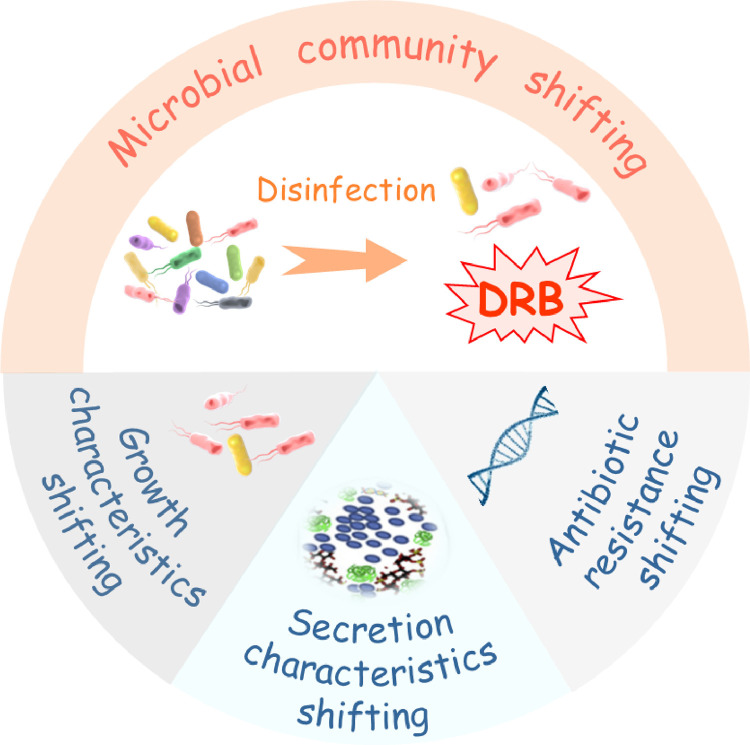
The epidemic of COVID-19 has aroused people's particular attention to biosafety. A growing number of disinfection products have been consumed during this period. However, the flaw of disinfection has not received enough attention, especially in water treatment processes. While cutting down the quantity of microorganisms, disinfection processes exert a considerable selection effect on bacteria and thus reshape the microbial community structure to a great extent, causing the problem of disinfection-residual-bacteria (DRB). These systematic and profound changes could lead to the shift in regrowth potential, bio fouling potential, as well as antibiotic resistance level and might cause a series of potential risks. In this review, we collected and summarized the data from the literature in recent 10 years about the microbial community structure shifting of natural water or wastewater in full-scale treatment plants caused by disinfection. Based on these data, typical DRB with the most reporting frequency after disinfection by chlorine-containing disinfectants, ozone disinfection, and ultraviolet disinfection were identified and summarized, which were the bacteria with a relative abundance of over 5% in the residual bacteria community and the bacteria with an increasing rate of relative abundance over 100% after disinfection. Furthermore, the phylogenic relationship and potential risks of these typical DRB were also analyzed. Twelve out of fifteen typical DRB genera contain pathogenic strains, and many were reported of great secretion ability. Pseudomonas and Acinetobacter possess multiple disinfection resistance and could be considered as model bacteria in future studies of disinfection. We also discussed the growth, secretion, and antibiotic resistance characteristics of DRB, as well as possible control strategies. The DRB phenomenon is not limited to water treatment but also exists in the air and solid disinfection processes, which need more attention and more profound research, especially in the period of COVID-19.
新冠疫情爆发后,人们对生物安全问题尤为关注,这段时期大量消毒产品被消耗。然而,消毒的缺陷并没有得到足够的重视,尤其是在水处理过程中。消毒在削减微生物数量的同时,对细菌产生了相当大的选择作用,从而极大地重塑了微生物群落结构,导致消毒残留菌(DRB)问题。这些系统性和深刻的变化可能导致再生潜力、生物污垢潜力以及抗生素耐药水平的转变,并可能引发一系列潜在风险。在本综述中,我们收集并总结了近 10 年来有关含氯消毒剂、臭氧消毒和紫外线消毒对大型处理厂中自然水或废水的微生物群落结构变化的文献数据。基于这些数据,确定并总结了典型的 DRB,这些细菌是指经含氯消毒剂、臭氧消毒和紫外线消毒后,在残留细菌群落中相对丰度超过 5%的细菌,以及相对丰度增加率超过 100%的细菌。此外,还分析了这些典型 DRB 的系统发育关系和潜在风险。15 个典型 DRB 中有 12 个属含有致病菌株,其中许多都具有较强的分泌能力。假单胞菌和不动杆菌具有多种消毒抗性,可被视为未来消毒研究的模式细菌。我们还讨论了 DRB 的生长、分泌和抗生素耐药特性以及可能的控制策略。DRB 现象不仅限于水处理,在空气和固体消毒过程中也存在,这需要更多的关注和更深入的研究,尤其是在 COVID-19 期间。