Song Xiaozong, Wang Xiaorong, Wang Shun, Liu Shengkai, Ge Shundong
School of Mechanical and Electronical Engineering, Lanzhou University of Technology, Lanzhou 730050, China.
Materials (Basel). 2021 Sep 2;14(17):5014. doi: 10.3390/ma14175014.
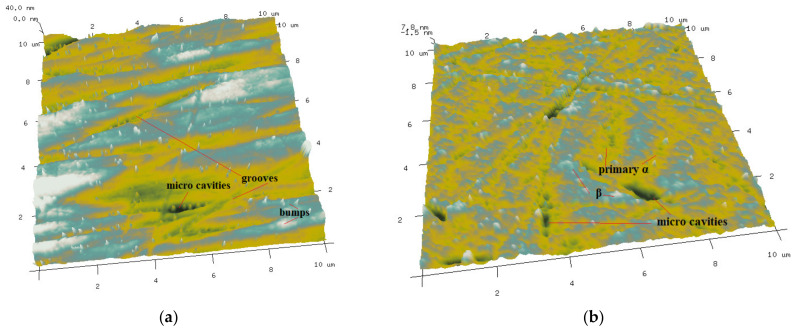
Ti-6Al-4V is widely used in various fields of modern industry, but it is difficult to obtain an ultra-smooth surface of Ti-6Al-4V due to its poor machinability. In this article, ultraviolet-induced (UV-induced) nanoparticle colloid jet machining was utilized to carry out ultra-precision polishing of Ti-6Al-4V to improve the surface quality. The results of infrared differential spectroscopy before and after polishing show that new chemical bonds such as Ti-O-Ti (Al-O-Ti and V-O-Ti) appear on the Ti-6Al-4V workpiece surface, which indicates that the material of Ti-6Al-4V workpiece is removed through the chemical interaction between TiO nanoparticles and workpiece surface in the process of UV-induced nanoparticle colloid jet machining. The comparison of metallographic structure of Ti-6Al-4V before and after polishing shows that the chemical activity and material removal rate of the primary α phase in Ti-6Al-4V is higher than that of the remnant β phase in UV-induced nanoparticle colloid jet machining, which lead to the well-distributed nano-scale surface peaks and valleys at regular intervals on the polished Ti-6Al-4V workpiece surface. After polishing, the longitudinal residual stress on the surface of Ti-6Al-4V workpiece decreases from 75 MPa to 67 MPa and the transverse stress decreases from 13 MPa to 3 MPa. The surface roughness of Ti-6Al-4V workpiece is reduced from Sa 76.7 nm to Sa 2.87 nm by UV-induced nanoparticle colloid jet machining.
Ti-6Al-4V在现代工业的各个领域中广泛应用,但由于其可加工性差,难以获得超光滑的Ti-6Al-4V表面。在本文中,利用紫外诱导(UV诱导)纳米颗粒胶体喷射加工对Ti-6Al-4V进行超精密抛光,以提高表面质量。抛光前后的红外差分光谱结果表明,Ti-6Al-4V工件表面出现了Ti-O-Ti(Al-O-Ti和V-O-Ti)等新的化学键,这表明在UV诱导纳米颗粒胶体喷射加工过程中,TiO纳米颗粒与工件表面之间的化学相互作用使Ti-6Al-4V工件材料被去除。Ti-6Al-4V抛光前后金相组织的比较表明,在UV诱导纳米颗粒胶体喷射加工中,Ti-6Al-4V中初生α相的化学活性和材料去除率高于残余β相,这导致抛光后的Ti-6Al-4V工件表面出现规则间隔分布良好的纳米级表面峰谷。抛光后,Ti-6Al-4V工件表面的纵向残余应力从75 MPa降至67 MPa,横向应力从13 MPa降至3 MPa。通过UV诱导纳米颗粒胶体喷射加工,Ti-6Al-4V工件的表面粗糙度从Sa 76.7 nm降低到Sa 2.87 nm。