Insenser María, Vilarrasa Nuria, Vendrell Joan, Escobar-Morreale Héctor F
Diabetes, Obesity and Human Reproduction Research Group, Instituto Ramón y Cajal de Investigación Sanitaria (IRYCIS), Hospital Universitario Ramón y Cajal, Universidad de Alcalá, E-28034 Madrid, Spain.
Centro de Investigación Biomédica en Red Diabetes y Enfermedades Metabólicas Asociadas (CIBERDEM), E-28029 Madrid, Spain.
J Clin Med. 2021 Aug 28;10(17):3879. doi: 10.3390/jcm10173879.
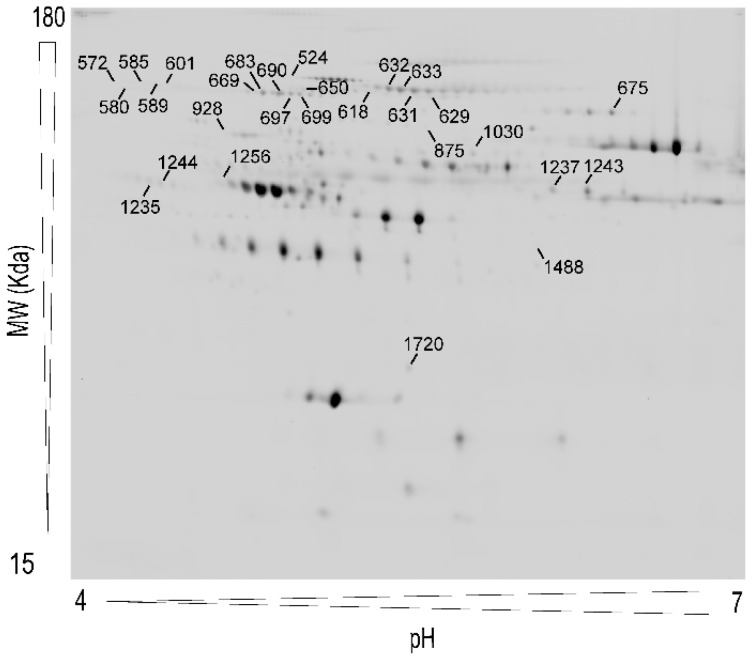
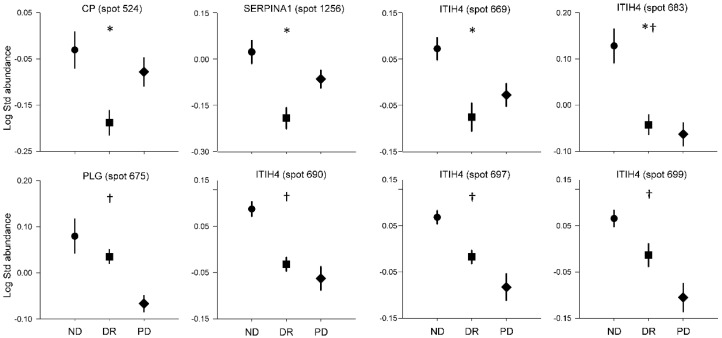
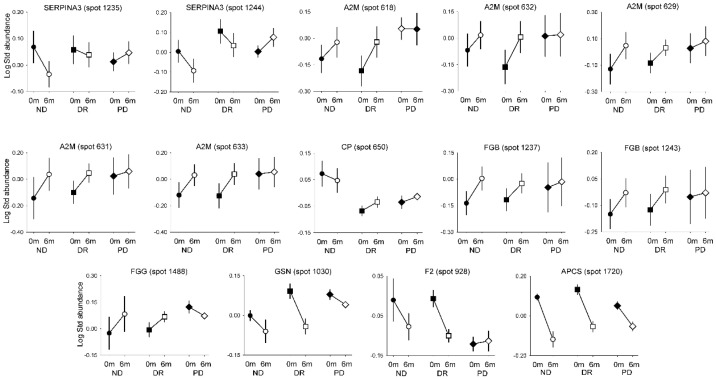
Bariatric surgery restores glucose tolerance in many, but not all, severely obese subjects with type 2 diabetes (T2D). We aimed to evaluate the plasma protein profiles associated with the T2D remission after obesity surgery. We recruited seventeen women with severe obesity submitted to bariatric procedures, including six non-diabetic patients and eleven patients with T2D. After surgery, diabetes remitted in 7 of the 11 patients with T2D. Plasma protein profiles at baseline and 6 months after bariatric surgery were analyzed by two-dimensional differential gel electrophoresis (2D-DIGE) and matrix-assisted laser desorption/ionization-time-of-flight/time-of-flight coupled to mass spectrometry (MALDI-TOF/TOF MS). Remission of T2D following bariatric procedures was associated with changes in alpha-1-antichymotrypsin (SERPINA 3, < 0.05), alpha-2-macroglobulin (A2M, < 0.005), ceruloplasmin (CP, < 0.05), fibrinogen beta chain (FBG, < 0.05), fibrinogen gamma chain (FGG, < 0.05), gelsolin (GSN, < 0.05), prothrombin (F2, < 0.05), and serum amyloid p-component (APCS, < 0.05). The resolution of diabetes after bariatric surgery is associated with specific changes in the plasma proteomic profiles of proteins involved in acute-phase response, fibrinolysis, platelet degranulation, and blood coagulation, providing a pathophysiological basis for the study of their potential use as biomarkers of the surgical remission of T2D in a larger series of severely obese patients.
减肥手术可使许多(但并非所有)重度肥胖的2型糖尿病(T2D)患者恢复糖耐量。我们旨在评估与肥胖手术后T2D缓解相关的血浆蛋白谱。我们招募了17名接受减肥手术的重度肥胖女性,其中包括6名非糖尿病患者和11名T2D患者。术后,11名T2D患者中有7名糖尿病缓解。通过二维差异凝胶电泳(2D-DIGE)和基质辅助激光解吸/电离飞行时间/飞行时间串联质谱(MALDI-TOF/TOF MS)分析减肥手术前和术后6个月的血浆蛋白谱。减肥手术后T2D的缓解与α-1-抗糜蛋白酶(SERPINA 3,<0.05)、α-2-巨球蛋白(A2M,<0.005)、铜蓝蛋白(CP,<0.05)、纤维蛋白原β链(FBG,<0.05)、纤维蛋白原γ链(FGG,<0.05)、凝溶胶蛋白(GSN,<0.05)、凝血酶原(F2,<0.05)和血清淀粉样P成分(APCS,<0.05)的变化有关。减肥手术后糖尿病的缓解与急性期反应、纤维蛋白溶解、血小板脱颗粒和血液凝固相关蛋白的血浆蛋白质组学谱的特定变化有关,为在更多重度肥胖患者中研究它们作为T2D手术缓解生物标志物的潜在用途提供了病理生理学基础。