Department of Population Health Sciences, Virginia Tech Carilion Research Institute, Riverside Circle, Roanoke, VA 24016, USA.
Department of Public Health and Healthcare Leadership, Radford University Carilion, 101 Elm Avenue, SE, Roanoke, VA 24013, USA.
Int J Environ Res Public Health. 2021 Aug 24;18(17):8908. doi: 10.3390/ijerph18178908.
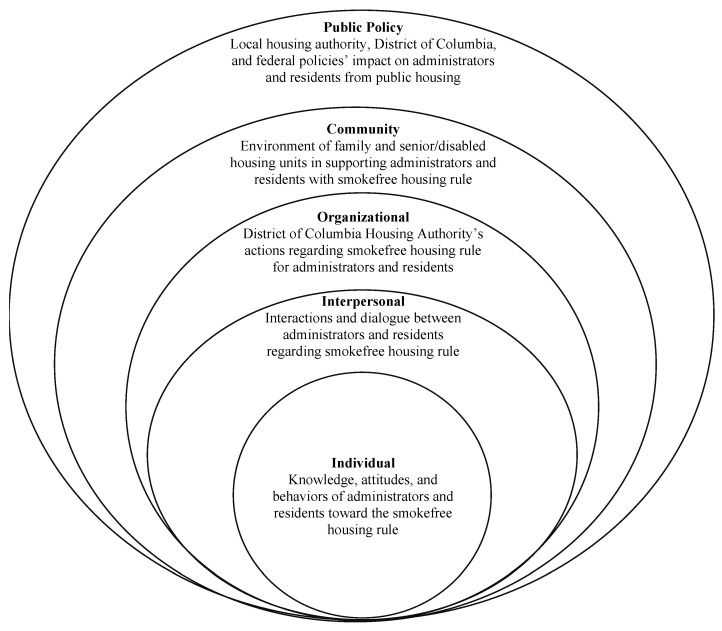
In July 2018, the United States Department of Housing and Urban Development (HUD) implemented a mandatory smoke-free rule in public housing. This study assessed administrator and resident perceptions of rule implementation during its initial year in the District of Columbia Housing Authority (DCHA). Assessment included nine focus groups ( = 69) with residents and in-depth interviews with administrators ( = 7) and residents ( = 26) from 14 DCHA communities (family = 7 and senior/disabled = 7). Semi-structured discussion guides based on the multi-level socio-ecological framework captured dialogue that was recorded, transcribed verbatim, and coded inductively. Emerging major themes for each socio-ecological framework level included: (1) Individual: the rule was supported due to perceived health benefits, with stronger support among non-smokers; (2) Interpersonal: limiting secondhand smoke exposure was perceived as a positive for vulnerable residents; (3) Organizational: communication, signage, and cessation support was perceived as a need; (4) Community: residents perceived mobility, disability, weather, and safety-related issues as barriers; and (5) Public Policy: lease amendments were perceived as enablers of rule implementation but expressed confusion about violations and enforcement. A majority of administrators and residents reported favorable implications of the mandated HUD rule. The novel application of a socio-ecological framework, however, detected implementation nuances that required improvements on multiple levels, including more signage, cessation support, clarification of enforcement roles, and addressing safety concerns.
2018 年 7 月,美国住房和城市发展部(HUD)在公共住房中实施了强制性禁烟令。本研究评估了哥伦比亚特区住房管理局(DCHA)在该禁烟令实施的初始一年内,管理人员和居民对该规定的看法。评估包括与居民进行的 9 个焦点小组(=69)和与管理人员(=7)以及来自 14 个 DCHA 社区的居民(=26)的深入访谈(家庭=7,老年/残疾=7)。基于多层次社会生态框架的半结构化讨论指南,记录了讨论内容,并进行了逐字转录和归纳编码。每个社会生态框架层面出现的主要主题包括:(1)个体:由于认为对健康有益,该规定得到了支持,不吸烟者的支持力度更强;(2)人际间:限制二手烟暴露被认为对弱势居民有益;(3)组织:沟通、标志和戒烟支持被认为是必要的;(4)社区:居民认为行动不便、残疾、天气和安全相关问题是障碍;(5)公共政策:租约修正案被认为是实施规定的推动者,但对违规和执法表示困惑。大多数管理人员和居民报告说,强制实施 HUD 规定带来了有利影响。然而,社会生态框架的新颖应用检测到了在多个层面上需要改进的实施细节,包括增加标志、戒烟支持、明确执法角色以及解决安全问题。