Musculoskeletal Research Group-NIME, Department of Physical Therapy, Federal University of Juiz de Fora, Governador Valadares 35010-180, Brazil.
Musculoskeletal Research Unit-UIM, Department of Physical Therapy, University Center for Assistance, Teaching and Research-CUADI, Universidad del Gran Rosario-UGR, Rosario C1021AAH, Argentina.
Int J Environ Res Public Health. 2021 Sep 2;18(17):9251. doi: 10.3390/ijerph18179251.
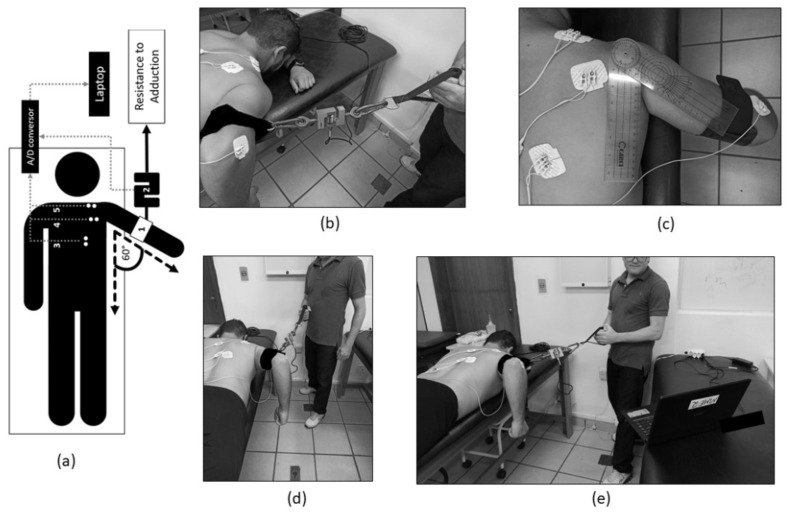
Exercises for lower trapezius (LT) often use overhead positions, causing compressive forces to the subacromial space. Scapular retraction would be an alternative to activate LT muscle. The present study aimed to assess the excitation levels of infraspinatus, upper trapezius, and lower trapezius muscles during a scapular retraction exercise under progressive adduction loads in subjects with and without painful shoulder. Electromyography of infraspinatus (IS), upper trapezius (UT), and LT was recorded during scapular retraction under progressive adduction loads of 42 participants, divided into two groups: with (SP, = 26) and without shoulder pain (nSP, = 16). The adduction loads of 20%, 30%, 40%, and 50% of the maximal voluntary contraction (MVC) were applied using a load cell. Normalized electromyography and the ratio between UT and LT (UT:LT) were used for statistical analysis. No differences were observed between groups, but a condition effect occurred for all muscles: UT showed higher values at 50% vs. 20% of MVC ( = 0.004); LT showed higher values on 40% and 50% of MVC ( = 0.001; 0.006). Higher values for IS were noted at 40% of MVC (vs. 20% of MVC; = 0.04) and at 50% of MVC (vs. 20% of MVC; = 0.001, vs. 30% of MVC, = 0.001; vs. 40% of MVC; = 0.001). UT:LT showed lower values at 50% of MVC (vs. 20% of MVC; = 0.001 and vs. 30% of MVC; = 0.016). Scapular retraction with adduction loads at 40-50% is an alternative to overhead exercises aiming to activate the LT and the IS muscles. The exercise ensures higher levels of LT and IS excitation without increasing UT excitation.
肩胛回缩运动常用于激活下斜方肌(LT),但常采用过头位,易导致肩峰下间隙受压。肩胛后缩是一种替代过头位的激活 LT 肌肉的方法。本研究旨在评估在有和无肩部疼痛的受试者中,肩胛回缩运动在逐渐增加的内收负荷下,对肩胛下肌(IS)、上斜方肌(UT)和下斜方肌(LT)的兴奋水平。42 名参与者被分为两组:有肩部疼痛组(SP,n=26)和无肩部疼痛组(nSP,n=16),每组进行肩胛回缩运动,同时记录 IS、UT 和 LT 的肌电图。通过负载细胞施加 20%、30%、40%和 50%最大自主收缩(MVC)的内收负荷。使用归一化肌电图和 UT 与 LT 的比值(UT:LT)进行统计分析。两组之间没有差异,但所有肌肉都存在条件效应:与 20% MVC 相比,UT 在 50% MVC 时的数值更高( = 0.004);与 20% MVC 相比,LT 在 40%和 50% MVC 时的数值更高( = 0.001;0.006)。IS 的数值在 40% MVC 时高于 20% MVC( = 0.04)和 50% MVC( = 0.001,与 30% MVC 相比, = 0.001;与 40% MVC 相比, = 0.001)。与 20% MVC 相比,UT:LT 在 50% MVC 时的数值更低( = 0.001 和 30% MVC; = 0.016)。在 40-50% MVC 的内收负荷下进行肩胛回缩运动是一种替代过头运动的方法,旨在激活 LT 和 IS 肌肉。该运动在不增加 UT 兴奋的情况下,确保 LT 和 IS 肌肉得到更高水平的兴奋。