National Institutes of Health, Bethesda, MD 20892, USA.
Int J Mol Sci. 2021 Aug 26;22(17):9248. doi: 10.3390/ijms22179248.
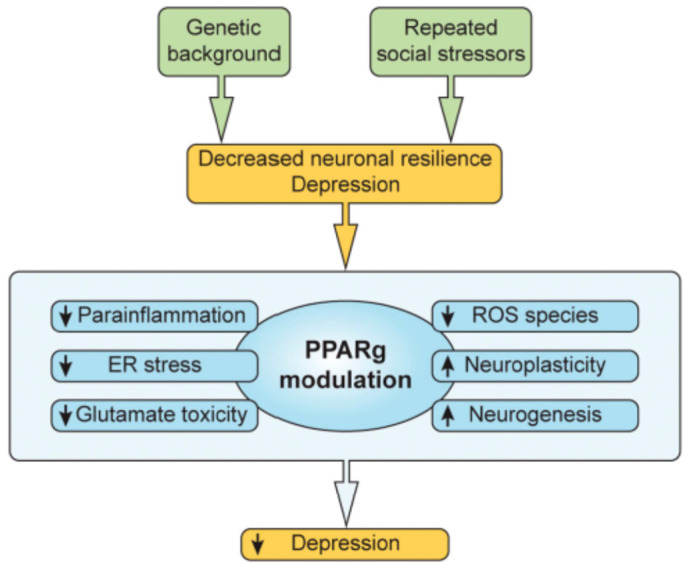
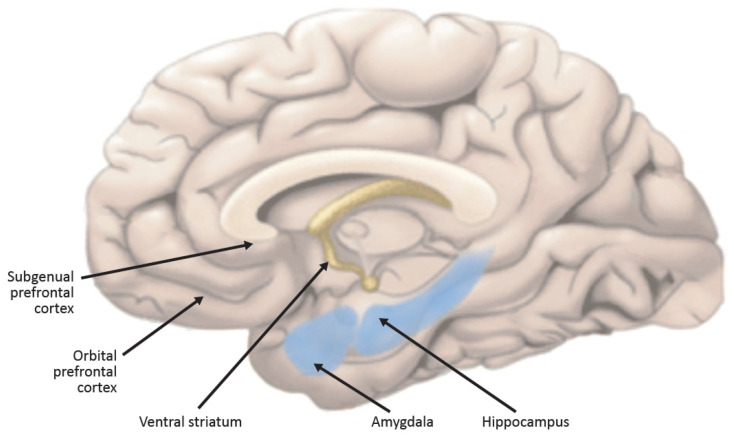
To an exceptional degree, and through multiple mechanisms, the PPARg system rapidly senses cellular stress, and functions in the CNS in glial cells, neurons, and cerebrovascular endothelial cell in multiple anti-inflammatory and neuroprotective ways. We now know that depression is associated with neurodegeneration in the subgenual prefrontal cortex and hippocampus, decreased neuroplasticity, and defective neurogenesis. Brain-derived neurotrophic factor (BDNF) is markedly depleted in these areas, and is thought to contribute to the neurodegeneration of the subgenual prefrontal cortex and the hippocampus. The PPARg system strongly increases BDNF levels and activity in these brain areas. The PPARg system promotes both neuroplasticity and neurogenesis, both via effects on BDNF, and through other mechanisms. Ample evidence exists that these brain areas transduce many of the cardinal features of depression, directly or through their projections to sites such as the amygdala and nucleus accumbens. Behaviorally, these include feelings of worthlessness, anxiety, dread of the future, and significant reductions in the capacity to anticipate and experience pleasure. Physiologically, these include activation of the CRH and noradrenergic system in brain and the sympathetic nervous system and hypothalamic-pituitary-adrenal axis in the periphery. Patients with depression are also insulin-resistant. The PPARg system influences each of these behavioral and physiological in ways that would ameliorate the manifestations of depressive illness. In addition to the cognitive and behavioral manifestations of depression, depressive illness is associated with the premature onsets of coronary artery disease, stroke, diabetes, and osteoporosis. As a consequence, patients with depressive illness lose approximately seven years of life. Inflammation and insulin resistance are two of the predominant processes that set into motion these somatic manifestations. PPARg agonists significantly ameliorate both pathological processes. In summary, PPARg augmentation can impact positively on multiple significant pathological processes in depression. These include loss of brain tissue, defective neuroplasticity and neurogenesis, widespread inflammation in the central nervous system and periphery, and insulin resistance. Thus, PPARg agonists could potentially have significant antidepressant effects.
PPARγ 系统通过多种机制,以非凡的方式迅速感知细胞应激,并在中枢神经系统中的神经胶质细胞、神经元和脑血管内皮细胞中发挥多种抗炎和神经保护作用。我们现在知道,抑郁症与脑区的神经退行性变有关,包括扣带回下前额皮质和海马体,这些脑区的神经可塑性和神经发生减少,以及神经发生缺陷。这些区域中的脑源性神经营养因子(BDNF)明显耗竭,并被认为导致扣带回下前额皮质和海马体的神经退行性变。PPARγ 系统强烈增加这些脑区的 BDNF 水平和活性。PPARγ 系统通过对 BDNF 的影响以及通过其他机制,促进神经可塑性和神经发生。有充分的证据表明,这些脑区通过其对杏仁核和伏隔核等部位的投射,直接或间接地传递抑郁症的许多主要特征。在行为上,这些包括无价值感、焦虑、对未来的恐惧,以及预期和体验愉悦的能力显著降低。在生理上,这些包括大脑中的促肾上腺皮质激素释放激素和去甲肾上腺素能系统以及外周的交感神经系统和下丘脑-垂体-肾上腺轴的激活。抑郁症患者也存在胰岛素抵抗。PPARγ 系统以改善抑郁症表现的方式影响这些行为和生理的每一方面。除了抑郁症的认知和行为表现外,抑郁症还与冠状动脉疾病、中风、糖尿病和骨质疏松症的过早发病有关。因此,患有抑郁症的患者会损失大约七年的寿命。炎症和胰岛素抵抗是引发这些躯体表现的两个主要过程。PPARγ 激动剂显著改善这两种病理过程。总之,PPARγ 增强可以对抑郁症中的多种重要病理过程产生积极影响。这些过程包括脑组织损失、神经可塑性和神经发生缺陷、中枢神经系统和外周的广泛炎症以及胰岛素抵抗。因此,PPARγ 激动剂可能具有显著的抗抑郁作用。