
TIF-Reg:具有 SE(3)中的变换不变特征的点云配准。
TIF-Reg: Point Cloud Registration with Transform-Invariant Features in SE(3).
机构信息
School of Automation, Central South University, Changsha 410083, China.
The Cheriton School of Computer Science, University of Waterloo, Waterloo, ON N2L 3G1, Canada.
出版信息
Sensors (Basel). 2021 Aug 27;21(17):5778. doi: 10.3390/s21175778.
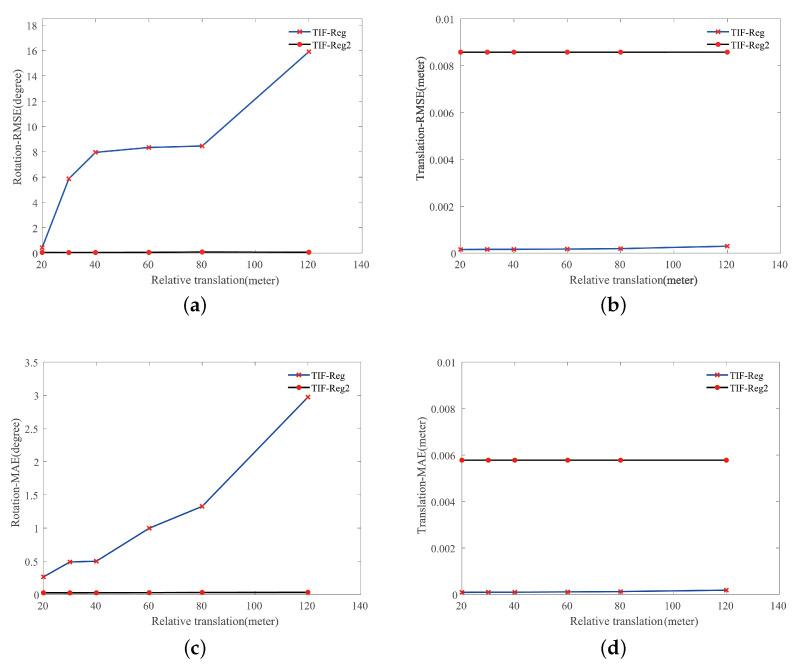
Three-dimensional point cloud registration (PCReg) has a wide range of applications in computer vision, 3D reconstruction and medical fields. Although numerous advances have been achieved in the field of point cloud registration in recent years, large-scale rigid transformation is a problem that most algorithms still cannot effectively handle. To solve this problem, we propose a point cloud registration method based on learning and transform-invariant features (TIF-Reg). Our algorithm includes four modules, which are the transform-invariant feature extraction module, deep feature embedding module, corresponding point generation module and decoupled singular value decomposition (SVD) module. In the transform-invariant feature extraction module, we design TIF in SE(3) (which means the 3D rigid transformation space) which contains a triangular feature and local density feature for points. It fully exploits the transformation invariance of point clouds, making the algorithm highly robust to rigid transformation. The deep feature embedding module embeds TIF into a high-dimension space using a deep neural network, further improving the expression ability of features. The corresponding point cloud is generated using an attention mechanism in the corresponding point generation module, and the final transformation for registration is calculated in the decoupled SVD module. In an experiment, we first train and evaluate the TIF-Reg method on the ModelNet40 dataset. The results show that our method keeps the root mean squared error (RMSE) of rotation within 0.5∘ and the RMSE of translation error close to 0 m, even when the rotation is up to [-180∘, 180∘] or the translation is up to [-20 m, 20 m]. We also test the generalization of our method on the TUM3D dataset using the model trained on Modelnet40. The results show that our method's errors are close to the experimental results on Modelnet40, which verifies the good generalization ability of our method. All experiments prove that the proposed method is superior to state-of-the-art PCReg algorithms in terms of accuracy and complexity.
三维点云配准(PCReg)在计算机视觉、3D 重建和医学领域有着广泛的应用。尽管近年来点云配准领域取得了许多进展,但大规模刚体变换仍然是大多数算法无法有效处理的问题。为了解决这个问题,我们提出了一种基于学习和变换不变特征(TIF-Reg)的点云配准方法。我们的算法包括四个模块,分别是变换不变特征提取模块、深度特征嵌入模块、对应点生成模块和解耦奇异值分解(SVD)模块。在变换不变特征提取模块中,我们在 SE(3)(即 3D 刚体变换空间)中设计了包含三角形特征和局部密度特征的 TIF 用于点云。它充分利用了点云的变换不变性,使算法对刚体变换具有高度的鲁棒性。深度特征嵌入模块使用深度神经网络将 TIF 嵌入到高维空间中,进一步提高了特征的表达能力。在对应点生成模块中使用注意力机制生成对应点云,在解耦 SVD 模块中计算配准的最终变换。在实验中,我们首先在 ModelNet40 数据集上训练和评估 TIF-Reg 方法。结果表明,即使旋转范围达到[-180∘, 180∘]或平移范围达到[-20 m, 20 m],我们的方法也能将旋转的均方根误差(RMSE)保持在 0.5∘以内,平移误差的 RMSE 接近 0 m。我们还使用在 Modelnet40 上训练的模型在 TUM3D 数据集上测试了我们方法的泛化能力。结果表明,我们方法的误差与在 Modelnet40 上的实验结果接近,验证了我们方法的良好泛化能力。所有实验都证明,与最先进的 PCReg 算法相比,我们的方法在准确性和复杂性方面具有优势。


 Zotero 插件