Mussi Vinicius O, Simão Thatiana L B V, Almeida Fabrício M, Machado Edson, de Carvalho Luciana D, Calixto Sanderson D, Sales Guilherme A M, Carvalho Eulógio C Q, Vasconcellos Sidra E G, Catanho Marcos, Suffys Philip N, Lasunskaia Elena B
Laboratory of Biology of Recognition, State University of North Fluminense, Campos, Brazil.
Laboratory of Molecular Biology Applied to Mycobacteria, Oswaldo Cruz Institute, Fiocruz, Rio de Janeiro, Brazil.
Front Microbiol. 2021 Aug 24;12:718477. doi: 10.3389/fmicb.2021.718477. eCollection 2021.
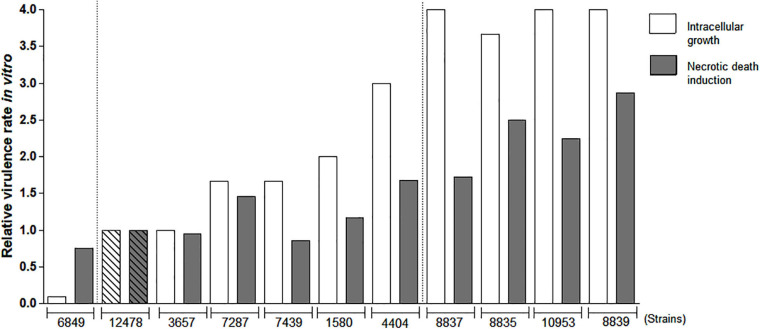
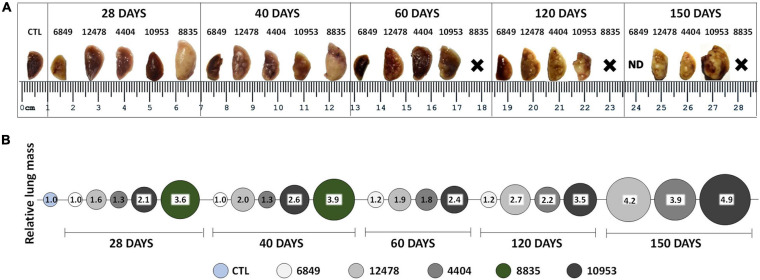
Among non-tuberculous mycobacteria, is one of the most pathogenic, able to cause pulmonary disease indistinguishable from tuberculosis in immunocompetent susceptible adults. The lack of animal models that reproduce human-like lung disease, associated with the necrotic lung pathology, impairs studies of virulence and pathogenicity. In this study, we examined the ability of the C57BL/6 mice, intratracheally infected with highly virulent strains, to produce a chronic infection and necrotic lung pathology. As a first approach, we evaluated ten strains isolated from Brazilian patients with pulmonary disease and the reference strain ATCC 12478 for virulence-associated features in macrophages infected ; five of these strains differing in virulence were selected for analysis. Highly virulent isolates induced progressive lung disease in mice, forming large encapsulated caseous granulomas in later stages (120-150 days post-infection), while the low-virulent strain was cleared from the lungs by day 40. Two strains demonstrated increased virulence, causing premature death in the infected animals. These data demonstrate that C57BL/6 mice are an excellent candidate to investigate the virulence of isolates. We observed considerable heterogeneity in the virulence profile of these strains, in which the presence of highly virulent strains allowed us to establish a clinically relevant animal model. Comparing public genomic data between Brazilian isolates and isolates from other geographic regions worldwide demonstrated that at least some of the highly pathogenic strains isolated in Brazil display remarkable genomic similarities with the ATCC strain 12478 isolated in the United States 70 years ago (less than 100 SNPs of difference), as well as with some recent European clinical isolates. These data suggest that few pathogenic clones have been widely spread within population around the world.
在非结核分枝杆菌中,[具体菌名]是最具致病性的菌株之一,能够在免疫功能正常的易感成年人中引发与肺结核难以区分的肺部疾病。缺乏能够再现类似人类肺部疾病且伴有肺部坏死病理特征的动物模型,阻碍了对[具体菌名]毒力和致病性的研究。在本研究中,我们检测了经气管内感染高毒力[具体菌名]菌株的C57BL/6小鼠产生慢性感染和肺部坏死病理特征的能力。作为第一步,我们评估了从巴西肺部疾病患者中分离出的10株[具体菌名]菌株以及参考菌株ATCC 12478在感染巨噬细胞中的毒力相关特征;选择其中5株毒力不同的菌株进行[具体分析内容]分析。高毒力分离株在小鼠中引发进行性肺部疾病,在感染后期(感染后120 - 150天)形成大的包膜性干酪样肉芽肿,而低毒力菌株在第40天时从肺部清除。两株菌株表现出毒力增强,导致感染动物过早死亡。这些数据表明C57BL/6小鼠是研究[具体菌名]分离株毒力的极佳候选对象。我们观察到这些菌株的毒力谱存在相当大的异质性,其中高毒力菌株的存在使我们能够建立一个具有临床相关性的动物模型。比较巴西分离株与全球其他地理区域分离株的公开基因组数据表明,巴西分离出的至少一些高致病性菌株与70年前在美国分离出的ATCC菌株12478(差异小于100个单核苷酸多态性)以及一些近期欧洲临床分离株显示出显著的基因组相似性。这些数据表明,少数致病克隆已在全球[具体菌名]种群中广泛传播。