Domènech Marta, Muñoz Marmol Ana M, Mate Jose Luis, Estival Anna, Moran Teresa, Cucurull Marc, Saigi Maria, Hernandez Ainhoa, Sanz Carolina, Hernandez-Gallego Alba, Urbizu Aintzane, Martinez-Cardus Anna, Bernat Adrià, Carcereny Enric
Medical Oncology Department, Catalan Institute of Oncology Badalona, Germans Trias i Pujol Hospital, Badalona, Barcelona, Spain.
Badalona Applied Research Group in Oncology (BARGO), Institut d'Investigació en Ciències de la Salut Germans Trias i Pujol (IGTP), Badalona, Barcelona, Spain.
Oncotarget. 2021 Aug 31;12(18):1802-1810. doi: 10.18632/oncotarget.28045.
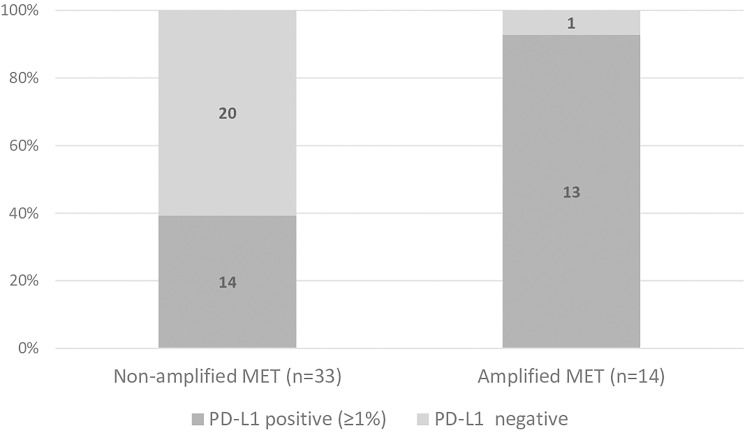
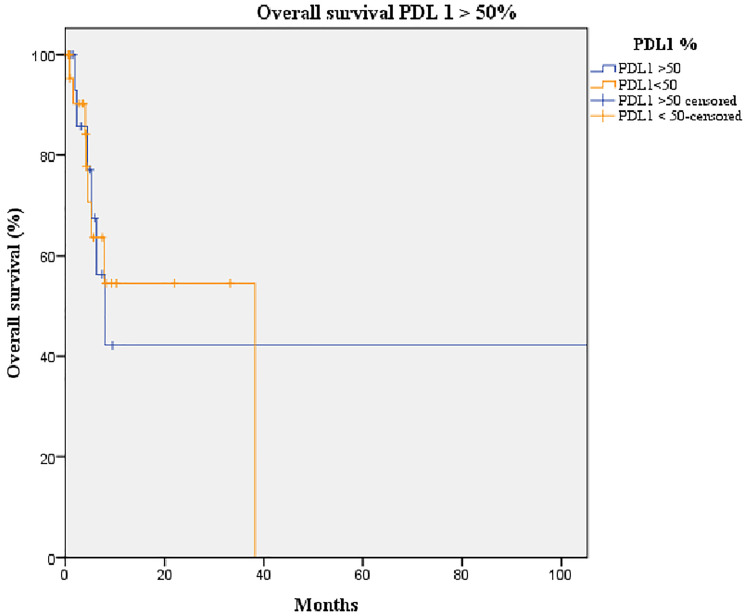
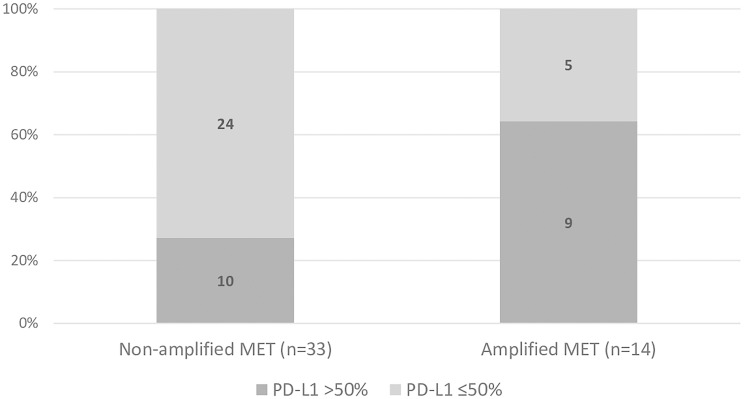
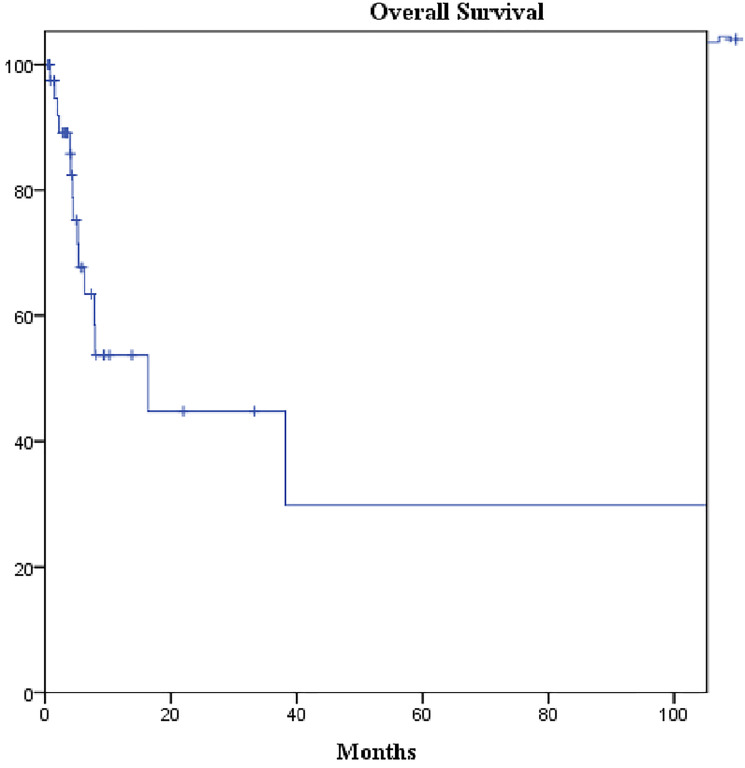
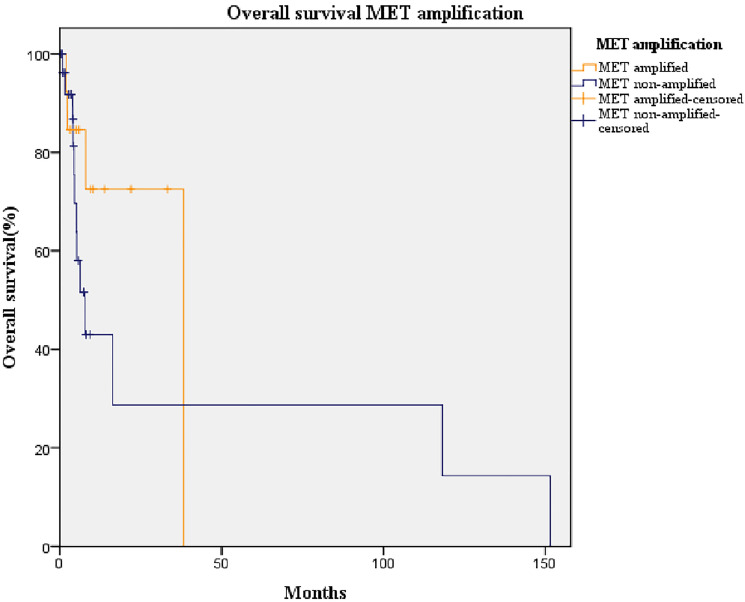
Non-small cell lung cancers (NSCLC) are the most common type of lung cancer and can be classified according to the presence of mutually exclusive oncogenic drivers. The majority of NSCLC patients present a non-actionable oncogenic driver, and treatment resistance through the amplification of the () or the expression of programmed cell death protein 1 ligand (PD-L1) is common. Herein, we investigated the relation between gene amplification and PD-L1 expression in patients with advanced NSCLC and no other actionable oncogenic driver (i.e., , , ). Our retrospective observational study analyzed data from 48 patients (78% men, median age 66 years) admitted to the Germans Trias i Pujol Hospital, Spain, between July 2015 and February 2019. Patients presenting amplification showed a higher proportion of PD-L1 expression (93% vs. 39%; < 0.001) and overexpression (64% vs. 27%; = 0.020) than those with non-amplified . PD-L1 expression was not significantly different when analyzed by sex ( = 0.624), smoking history ( = 0.429), and Eastern Cooperative Oncology Group Performance Status ( = 0.597) Overall survival rates were not significantly affected by amplification (high and intermediate amplification vs low amplification and non-amplificated) ( = 0.252) nor PD-L1 expression (> vs =< 50%) ( = 0.893). In conclusion, a positive correlation was found between gene amplification and PD-L1 expression and highly expressed (above 50%) in patients with NSCLC and no other actionable oncogenic driver. It could be translated as new guided-treatment oportunities for these patients.
非小细胞肺癌(NSCLC)是最常见的肺癌类型,可根据互斥致癌驱动因素的存在进行分类。大多数NSCLC患者存在不可靶向治疗的致癌驱动因素,通过()扩增或程序性细胞死亡蛋白1配体(PD-L1)表达导致的治疗耐药很常见。在此,我们研究了晚期NSCLC且无其他可靶向治疗致癌驱动因素(即,,)患者中基因扩增与PD-L1表达之间的关系。我们的回顾性观察性研究分析了2015年7月至2019年2月期间入住西班牙德国人特里亚斯-普尤尔医院的48例患者(78%为男性,中位年龄66岁)的数据。与未扩增的患者相比,呈现基因扩增的患者PD-L1表达比例更高(93%对39%;<0.001)且过表达比例更高(64%对27%;=0.020)。按性别(=0.624)、吸烟史(=0.429)和东部肿瘤协作组体能状态(=0.597)分析时,PD-L1表达无显著差异。总体生存率不受基因扩增(高扩增和中等扩增与低扩增和未扩增)(=0.252)或PD-L1表达(>对<=50%)(=0.893)的显著影响。总之,在无其他可靶向治疗致癌驱动因素的NSCLC患者中,发现基因扩增与PD-L1表达之间呈正相关,且PD-L1高表达(高于50%)。这可为这些患者带来新的靶向治疗机会。