Department of Molecular Biology and Genetics, Cornell University, Ithaca, New York, United States of America.
State Key Laboratory for Conservation and Utilization of Bio-Resources and Center for Life Science, School of Life Sciences, Yunnan University, Kunming, Yunnan, China.
PLoS Genet. 2021 Sep 10;17(9):e1009432. doi: 10.1371/journal.pgen.1009432. eCollection 2021 Sep.
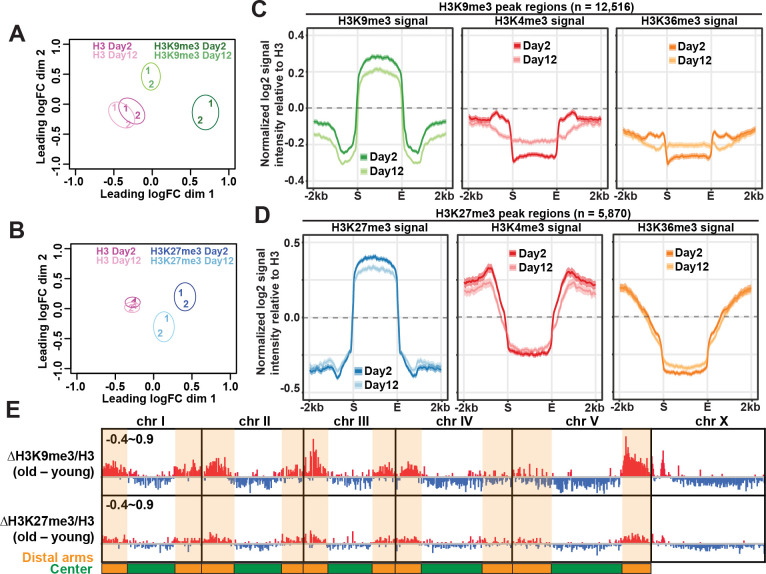
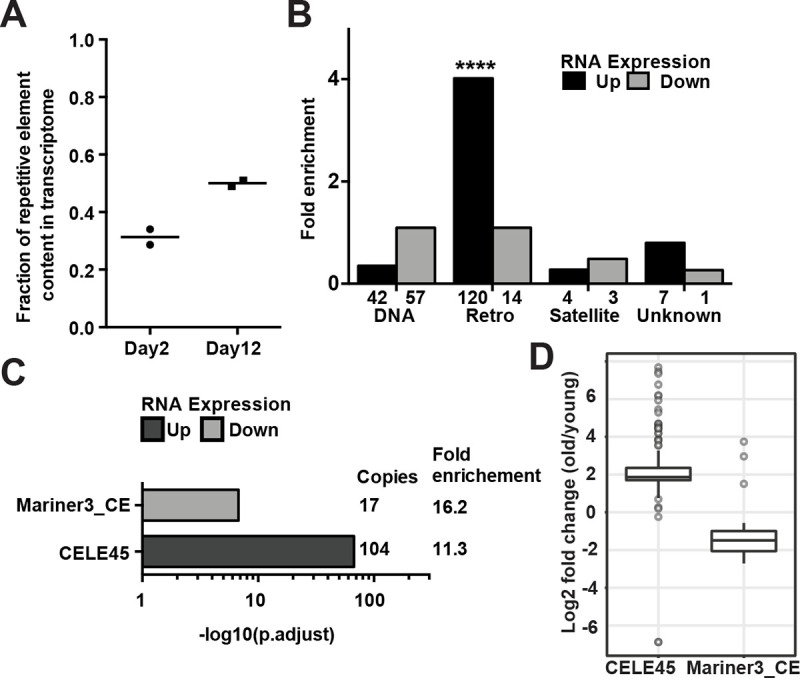
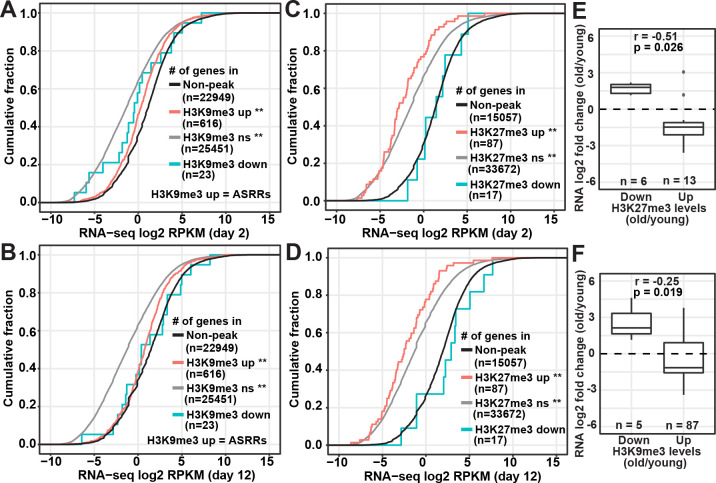
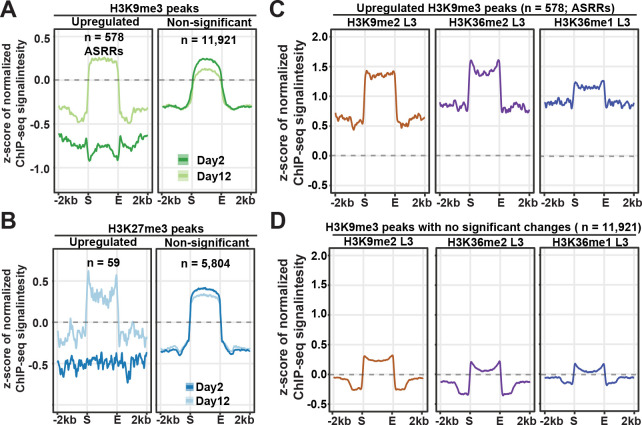
Epigenetic alterations occur as organisms age, and lead to chromatin deterioration, loss of transcriptional silencing and genomic instability. Dysregulation of the epigenome has been associated with increased susceptibility to age-related disorders. In this study, we aimed to characterize the age-dependent changes of the epigenome and, in turn, to understand epigenetic processes that drive aging phenotypes. We focused on the aging-associated changes in the repressive histone marks H3K9me3 and H3K27me3 in C. elegans. We observed region-specific gain and loss of both histone marks, but the changes are more evident for H3K9me3. We further found alteration of heterochromatic boundaries in aged somatic tissues. Interestingly, we discovered that the most statistically significant changes reflected H3K9me3-marked regions that are formed during aging, and are absent in developing worms, which we termed "aging-specific repressive regions" (ASRRs). These ASRRs preferentially occur in genic regions that are marked by high levels of H3K9me2 and H3K36me2 in larval stages. Maintenance of high H3K9me2 levels in these regions have been shown to correlate with a longer lifespan. Next, we examined whether the changes in repressive histone marks lead to de-silencing of repetitive DNA elements, as reported for several other organisms. We observed increased expression of active repetitive DNA elements but not global re-activation of silent repeats in old worms, likely due to the distributed nature of repetitive elements in the C. elegans genome. Intriguingly, CELE45, a putative short interspersed nuclear element (SINE), was greatly overexpressed at old age and upon heat stress. SINEs have been suggested to regulate transcription in response to various cellular stresses in mammals. It is likely that CELE45 RNAs also play roles in stress response and aging in C. elegans. Taken together, our study revealed significant and specific age-dependent changes in repressive histone modifications and repetitive elements, providing important insights into aging biology.
随着生物体的衰老,表观遗传改变发生,并导致染色质恶化、转录沉默丧失和基因组不稳定。表观基因组的失调与增加对与年龄相关的疾病的易感性有关。在这项研究中,我们旨在描述随年龄变化的表观基因组变化,并进而了解推动衰老表型的表观遗传过程。我们专注于秀丽隐杆线虫中与衰老相关的抑制性组蛋白标记 H3K9me3 和 H3K27me3 的变化。我们观察到这两种组蛋白标记的区域特异性获得和丧失,但 H3K9me3 的变化更为明显。我们还发现衰老体组织中异染色质边界的改变。有趣的是,我们发现最显著的统计学变化反映了在衰老过程中形成的 H3K9me3 标记区域,而在发育中的蠕虫中不存在,我们将这些区域称为“衰老特异性抑制区域”(ASRRs)。这些 ASRRs 优先发生在幼虫阶段 H3K9me2 和 H3K36me2 水平较高的基因区域。这些区域中高 H3K9me2 水平的维持已被证明与寿命延长相关。接下来,我们检查了抑制性组蛋白标记的变化是否导致重复 DNA 元件的去沉默,如其他几种生物体的报道。我们观察到活性重复 DNA 元件的表达增加,但在老蠕虫中沉默重复的整体重新激活没有增加,这可能是由于秀丽隐杆线虫基因组中重复元件的分布式性质。有趣的是,CELE45,一种假定的短散布核元件(SINE),在老年和热应激时大量过表达。SINE 已被提议在哺乳动物中响应各种细胞应激调节转录。CELE45 RNA 也很可能在秀丽隐杆线虫的应激反应和衰老中发挥作用。总之,我们的研究揭示了随年龄变化的抑制性组蛋白修饰和重复元件的显著和特异性变化,为衰老生物学提供了重要的见解。