Department of Public Health, College of Health and Human Sciences, Purdue University, West Lafayette, Indiana, USA.
Weldon School of Biomedical Engineering, College of Engineering, Purdue University, West Lafayette, Indiana, USA.
BMC Public Health. 2021 Sep 10;21(1):1657. doi: 10.1186/s12889-021-11687-8.
The COVID-19 pandemic laid bare some of the United States' most devastating health and social inequities faced by people experiencing homelessness. Homeless populations experience disproportionate rates of underlying health conditions, stigma and marginalization that often disenfranchise them from health and social services, and living conditions that potentiate the risk of COVID-19 transmission and adverse outcomes.
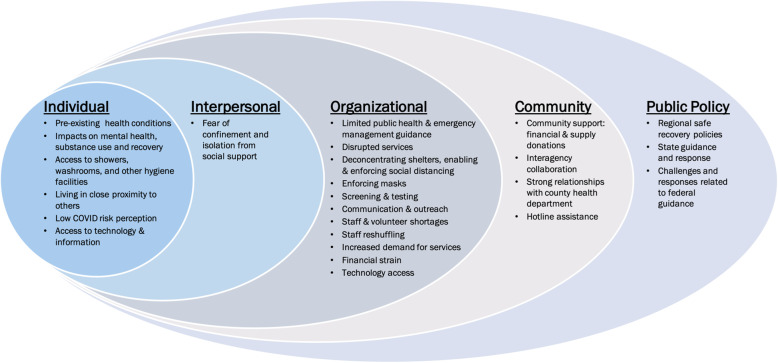
Guided by the socio-ecological model, this community-based participatory research study examined the impacts of the COVID-19 public health crisis on people experiencing homelessness in Tippecanoe County, Indiana, and the ways in which homeless service providers prepared for, experienced, and responded to the pandemic. Eighteen (18) semi-structured interviews were conducted with representatives of 15 community-based organizations, including shelters and other homeless service providers.
Qualitative content analysis revealed myriad challenges at the individual and interpersonal levels faced by people experiencing homelessness as a result of the pandemic, and multilevel responses for COVID-19 impact mitigation in this community. Many of the emergency measures put in place by homeless service providers in Tippecanoe County, Indiana created opportunities for innovative solutions to longstanding challenges faced by homeless populations that are informing better service delivery moving forward, even beyond the COVID-19 pandemic.
Community-based organizations, including homeless shelters, are uniquely qualified to inform pandemic response and disaster risk mitigation in order to respond appropriately to the specific needs of people experiencing homelessness. The lessons learned and shared by homeless service providers on the frontline during the COVID-19 pandemic have important implications to improve future disaster response for homeless and other vulnerable populations.
新冠疫情暴露出美国无家可归者所面临的一些最严重的健康和社会不平等问题。无家可归者群体患有基础疾病的比例过高,面临污名化和边缘化,这往往使他们无法获得医疗和社会服务,他们的生活条件也增加了 COVID-19 传播和不良后果的风险。
本社区参与性研究以社会生态学模型为指导,调查了印第安纳州蒂珀卡努县新冠疫情公共卫生危机对无家可归者的影响,以及无家可归服务提供者为应对疫情所做的准备、经历和应对方式。对 15 个社区组织的代表(包括收容所和其他无家可归者服务提供者)进行了 18 次半结构化访谈。
定性内容分析揭示了由于疫情,无家可归者在个人和人际层面上所面临的诸多挑战,以及该社区针对新冠疫情影响所采取的多层次应对措施。印第安纳州蒂珀卡努县的无家可归服务提供者采取的许多紧急措施为解决无家可归者长期面临的挑战提供了创新解决方案的机会,即使在新冠疫情之后,这些措施也将继续为改善服务提供提供信息。
社区组织,包括收容所,有资格为疫情应对和灾害风险缓解提供信息,以便针对无家可归者的具体需求做出适当的反应。无家可归服务提供者在新冠疫情期间在前线学到的经验教训对于改善未来针对无家可归者和其他弱势群体的灾害应对具有重要意义。