Alcendor Donald J, Juarez Paul D, Ramesh Aramandla, Brown Katherine Y, Tabatabai Mohammad, Matthews-Juarez Patricia
Department of Microbiology, Immunology and Physiology, Center for AIDS Health Disparities Research, School of Medicine, Meharry Medical College, 1005 Dr. D.B. Todd Jr. Blvd., Nashville, TN, 37208-3599, USA.
Center for AIDS Health Disparities Research, Department of Microbiology, Immunology, and Physiology, School of Medicine, Meharry Medical College, 1005 Dr. D.B. Todd Jr. Blvd., Nashville, TN, 37208-3599, USA.
Arch Intern Med Res. 2024;7(3):136-145. doi: 10.26502/aimr.0172. Epub 2024 Jul 29.
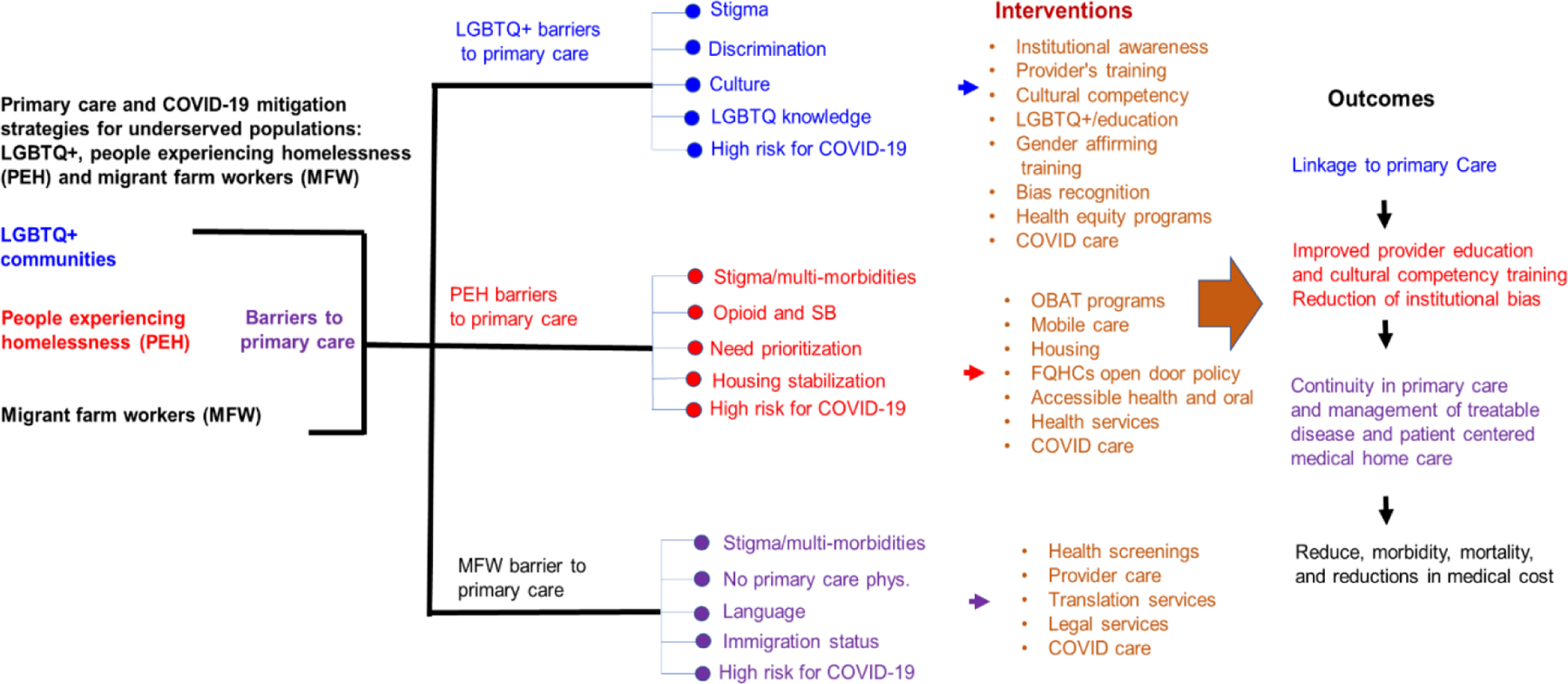
The goal of the National Center for Medical Education Development and Research Center (NCMEDR) is to support the education and training of medical students in the care of vulnerable populations. Access to primary care services in the US is fundamental to the health and wellness of all people regardless of their socioeconomic status. LGBQ+ persons, (lesbian, gay, bisexual, transgender, queer, and other sexual and gender minority), Persons Experiencing Homelessness (PEH), and Migrant Farm Workers (MFW) are among the most underserved, marginalized, and socially vulnerable groups in the US. NCMEDR in the Department of Family and Community Medicine at Meharry Medical College was established in part, with funding from the Department of Health and Human Services (DHHS) and the Health Resources and Services Administration (HRSA). NCMEDR was developed to provide educational pathways for transforming medical education and clinical practice in the US by ascertaining whether medical students were being trained to provide primary care, and behavioral health services to LGBTQ+ persons, PEH, and MFW. Here we focus on the impact of the COVID-19 pandemic on these specific populations because they represent marginalized groups that have been heavily impacted by the pandemic, have poor social determinants of health (SDOH), and are more likely to be uninsured, and are less likely to engage primary care providers outside of emergency room care.
In this study, a scoping literature review was conducted to assess the impact of COVID-19 on primary care of LQBTQ+ persons, PEH, and MFW.
The pandemic provided a serious health disparities gap for the defined vulnerable populations under review by the NCMEDR. The pandemic identified the need for transformative measures for clinical practices, medical education, and health care policies required for implementation to improve health care for vulnerable groups. We make recommendations for interventions with defined populations that may influence clinical, environmental health, and SDOH in the COVID era.
The COVID pandemic directed the need for medical schools, health care and social organizations to intervene in new and different ways in vulnerable and marginalized communities. The recommendations provide a model for advancing health equity, access, quality, utilization, care coordination, and treatment.
国家医学教育发展与研究中心(NCMEDR)的目标是支持医学生在照顾弱势群体方面的教育和培训。在美国,无论社会经济地位如何,获得初级保健服务对所有人的健康和福祉都至关重要。女同性恋、男同性恋、双性恋、跨性别、酷儿及其他性取向和性别少数群体(LGBQ+)、无家可归者(PEH)和流动农场工人(MFW)是美国服务最不足、最边缘化且社会最脆弱的群体之一。梅哈里医学院家庭与社区医学系的NCMEDR部分是在卫生与公众服务部(DHHS)和卫生资源与服务管理局(HRSA)的资助下设立的。NCMEDR的设立是为了通过确定医学生是否接受过为LGBQ+人群、PEH和MFW提供初级保健及行为健康服务的培训,来提供教育途径,以改变美国的医学教育和临床实践。在此,我们关注2019冠状病毒病(COVID-19)大流行对这些特定人群的影响,因为他们代表了受大流行严重影响、健康的社会决定因素(SDOH)较差、更可能未参保且除急诊室护理外不太可能与初级保健提供者接触的边缘化群体。
在本研究中,进行了一项范围综述,以评估COVID-19对LQBTQ+人群、PEH和MFW初级保健的影响。
大流行给NCMEDR所审查的特定弱势群体带来了严重的健康差距。大流行凸显了对临床实践、医学教育和医疗保健政策采取变革性措施的必要性,这些措施需要实施以改善弱势群体的医疗保健。我们针对特定人群提出干预建议,这些建议可能会影响COVID时代的临床、环境卫生和SDOH。
COVID大流行表明医学院校、医疗保健和社会组织需要以新的、不同的方式对弱势群体和边缘化社区进行干预。这些建议为促进健康公平、可及性、质量、利用率、护理协调和治疗提供了一个模式。