From the Strategic Information Unit, ICAP at Columbia University, New York, NY.
ICAP at Columbia University, Harare, Zimbabwe.
Sex Transm Dis. 2022 Feb 1;49(2):111-116. doi: 10.1097/OLQ.0000000000001553.
Syphilis increases human immunodeficiency virus (HIV) acquisition risk and impacts the immunologic and virologic response among people living with HIV (PLHIV). We assessed the prevalence of active or current syphilis and HIV/syphilis and their correlates among men who have sex with men (MSM), transwomen, and genderqueer (TGW/GQ) individuals in Zimbabwe.
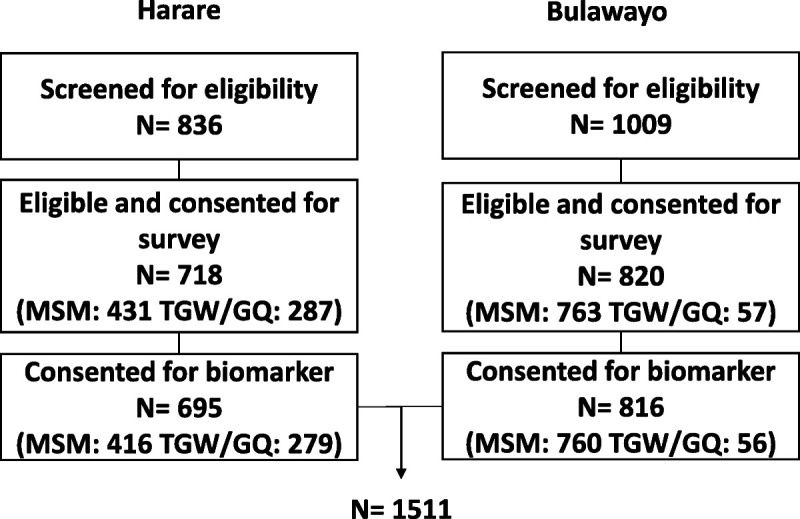
Among a respondent-driven sample of MSM and TGW/GQ who were tested for HIV and syphilis in Harare and Bulawayo, Zimbabwe in 2019 (n = 1511), multiple logistic regression was used to assess correlates of active syphilis. Unadjusted logistic regression was used among PLHIV (n = 340) due to small sample size. All analyses were unweighted as data did not reach convergence for HIV.
Prevalence of active syphilis overall and among PLHIV was 5.5% and 10.1%, respectively, in Harare, and 5.6% and 11.0%, respectively, in Bulawayo. Participants were more likely to have active syphilis if they were PLHIV (adjusted odds ratio [aOR], 2.2; 95% confidence interval [CI], 1.4-3.6), aged 25-34 years (aOR, 2.2 years; 95% CI, 1.3-3.8 years; reference, 18-24 years), or self-report sexually transmitted infection symptoms (aOR, 1.8; 95% CI, 1.1-3.0). Compared with Bulawayo TGW/GQ, MSM in Harare (aOR, 0.2; 95% CI, 0.1-0.5) and Bulawayo (aOR, 0.2; 95% CI, 0.1-0.4), and TGW/GQ in Harare (aOR, 0.2; 95% CI, 0.1-0.6) were less likely to have active syphilis. Among PLHIV, coinfection was 13.0% among TGW/GQ and 9.7% among MSM. Odds of coinfection were higher for those aged 25 to 34 years (OR, 3.7 years; 95% CI, 1.2-11.1 years) and lower among Harare MSM (OR, 0.2; 95% CI, 0.1-0.7), Bulawayo MSM (OR, 0.1; 95% CI, 0.0-0.4), and Harare TGW/GQ (OR, 0.1; 95% CI, 0.0-0.4) compared with Bulawayo TGW/GQ.
Findings highlight a high burden of syphilis among MSM and TGW/GQ and underscore the importance of HIV/syphilis detection and improved service delivery for these groups.
梅毒会增加人类免疫缺陷病毒(HIV)的感染风险,并影响 HIV 感染者(PLHIV)的免疫和病毒学反应。我们评估了津巴布韦男男性行为者(MSM)、跨性别女性(transwomen)和变性人(TGW/GQ)中现患或活动性梅毒以及 HIV/梅毒感染的流行率及其相关因素。
在 2019 年,我们对津巴布韦哈拉雷和布拉瓦约的 MSM 和 TGW/GQ 进行了 HIV 和梅毒检测,其中包括一个由受访者驱动的样本(n=1511)。我们使用多因素逻辑回归评估了现患梅毒的相关因素。由于 PLHIV 的样本量较小,因此未进行调整的逻辑回归用于分析 PLHIV(n=340)。所有分析均未加权,因为 HIV 数据未达到收敛。
在哈拉雷和布拉瓦约,总人群和 PLHIV 中现患梅毒的流行率分别为 5.5%和 10.1%,分别为 5.6%和 11.0%。如果参与者是 PLHIV(调整后的优势比[aOR],2.2;95%置信区间[CI],1.4-3.6)、年龄在 25-34 岁(aOR,2.2 岁;95% CI,1.3-3.8 岁;参考年龄,18-24 岁)或自我报告性传播感染症状(aOR,1.8;95% CI,1.1-3.0),则更有可能现患梅毒。与布拉瓦约 TGW/GQ 相比,哈拉雷 MSM(aOR,0.2;95% CI,0.1-0.5)和布拉瓦约(aOR,0.2;95% CI,0.1-0.4)以及哈拉雷 TGW/GQ(aOR,0.2;95% CI,0.1-0.6)的 MSM 和 TGW/GQ 更不可能现患梅毒。在 PLHIV 中,TGW/GQ 的合并感染率为 13.0%,MSM 为 9.7%。25-34 岁的参与者合并感染的可能性更高(OR,3.7 年;95% CI,1.2-11.1 年),而哈拉雷 MSM(OR,0.2;95% CI,0.1-0.7)、布拉瓦约 MSM(OR,0.1;95% CI,0.0-0.4)和哈拉雷 TGW/GQ(OR,0.1;95% CI,0.0-0.4)的合并感染率较低。
研究结果突出了 MSM 和 TGW/GQ 中梅毒负担沉重的问题,强调了为这些人群进行 HIV/梅毒检测和改善服务提供的重要性。