Institute for Health Metrics and Evaluation, University of Washington, Seattle, WA, USA.
Department of Infectious Disease Epidemiology, Imperial College London, London, UK.
BMC Med. 2020 Jul 7;18(1):189. doi: 10.1186/s12916-020-01635-5.
HIV remains the largest cause of disease burden among men and women of reproductive age in sub-Saharan Africa. Voluntary medical male circumcision (VMMC) reduces the risk of female-to-male transmission of HIV by 50-60%. The World Health Organization (WHO) and Joint United Nations Programme on HIV/AIDS (UNAIDS) identified 14 priority countries for VMMC campaigns and set a coverage goal of 80% for men ages 15-49. From 2008 to 2017, over 18 million VMMCs were reported in priority countries. Nonetheless, relatively little is known about local variation in male circumcision (MC) prevalence.
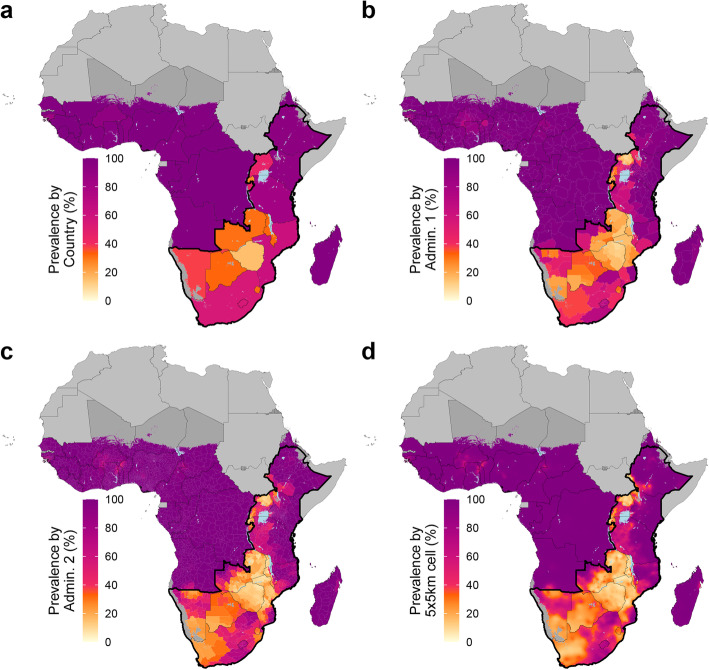
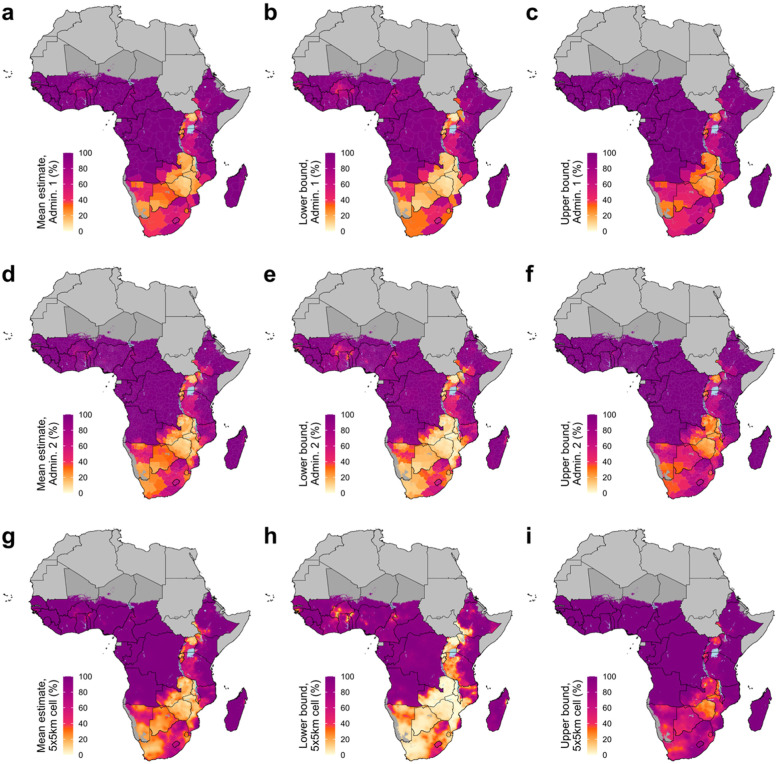
We analyzed geo-located MC prevalence data from 109 household surveys using a Bayesian geostatistical modeling framework to estimate adult MC prevalence and the number of circumcised and uncircumcised men aged 15-49 in 38 countries in sub-Saharan Africa at a 5 × 5-km resolution and among first administrative level (typically provinces or states) and second administrative level (typically districts or counties) units.
We found striking within-country and between-country variation in MC prevalence; most (12 of 14) priority countries had more than a twofold difference between their first administrative level units with the highest and lowest estimated prevalence in 2017. Although estimated national MC prevalence increased in all priority countries with the onset of VMMC campaigns, seven priority countries contained both subnational areas where estimated MC prevalence increased and areas where estimated MC prevalence decreased after the initiation of VMMC campaigns. In 2017, only three priority countries (Ethiopia, Kenya, and Tanzania) were likely to have reached the MC coverage target of 80% at the national level, and no priority country was likely to have reached this goal in all subnational areas.
Despite MC prevalence increases in all priority countries since the onset of VMMC campaigns in 2008, MC prevalence remains below the 80% coverage target in most subnational areas and is highly variable. These mapped results provide an actionable tool for understanding local needs and informing VMMC interventions for maximum impact in the continued effort towards ending the HIV epidemic in sub-Saharan Africa.
在撒哈拉以南非洲,艾滋病毒仍然是育龄男女疾病负担的最大原因。自愿男性包皮环切术(VMMC)可将艾滋病毒母婴传播的风险降低 50-60%。世界卫生组织(世卫组织)和联合国艾滋病规划署(艾滋病署)确定了 14 个重点国家开展 VMMC 运动,并设定了 80%的 15-49 岁男性覆盖目标。从 2008 年到 2017 年,重点国家报告了超过 1800 万例 VMMC。尽管如此,人们对男性包皮环切率(MC)的当地差异知之甚少。
我们使用贝叶斯地质统计建模框架分析了来自 109 项家庭调查的地理定位 MC 流行率数据,以估计撒哈拉以南非洲 38 个国家 5×5 公里分辨率以及第一行政级别(通常是省或州)和第二行政级别(通常是区或县)单位中 15-49 岁男性的成人 MC 流行率和已行包皮环切和未行包皮环切的男性人数。
我们发现 MC 流行率存在显著的国内和国家间差异;在 14 个重点国家中,有 12 个国家的第一行政级别单位之间的差异超过两倍,2017 年估计的最高和最低流行率之间存在差异。尽管随着 VMMC 运动的开展,所有重点国家的全国 MC 流行率都有所增加,但在 VMMC 运动开始后,七个重点国家既包含了估计 MC 流行率增加的次国家地区,也包含了估计 MC 流行率下降的地区。2017 年,只有三个重点国家(埃塞俄比亚、肯尼亚和坦桑尼亚)有可能在全国范围内达到 80%的 MC 覆盖目标,而且没有一个重点国家在所有次国家地区都有可能达到这一目标。
尽管自 2008 年 VMMC 运动开始以来,所有重点国家的 MC 流行率都有所上升,但在大多数次国家地区,MC 流行率仍低于 80%的覆盖目标,而且差异很大。这些映射结果提供了一个可行的工具,可用于了解当地需求,并为 VMMC 干预措施提供信息,以在继续努力终结撒哈拉以南非洲的艾滋病毒流行方面实现最大影响。