Division of Cancer Epidemiology and Genetics, National Cancer Institute, National Institutes of Health, Bethesda, MD, USA.
Department of Public Health Sciences, University of Virginia, Charlottesville, VA, USA.
J Natl Cancer Inst. 2022 Feb 7;114(2):263-270. doi: 10.1093/jnci/djab186.
Incidence of estrogen receptor (ER)-negative breast cancer, an aggressive subtype, is highest in US African American women and in Southern residents but has decreased overall since 1992. We assessed whether ER-negative breast cancer is decreasing in all age groups and cancer registries among non-Hispanic White (NHW), non-Hispanic Black (NHB), and Hispanic White (HW) women.
We analyzed 17 Surveillance, Epidemiology, and End-Results (SEER) Program registries (12 for 1992-2016; 5 for 2000-2016) to assess NHW, NHB, and HW trends by ER status and age group (30-39 years, 40-49 years, 50-69 years, 70-84 years). We used hierarchical age-period-cohort models that account for sparse data, which improve estimates to quantify between-registry heterogeneity in mean incidence rates and age-adjusted trends vs SEER overall.
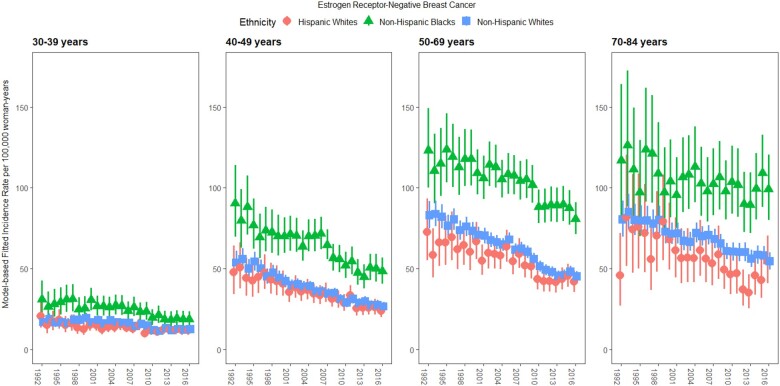
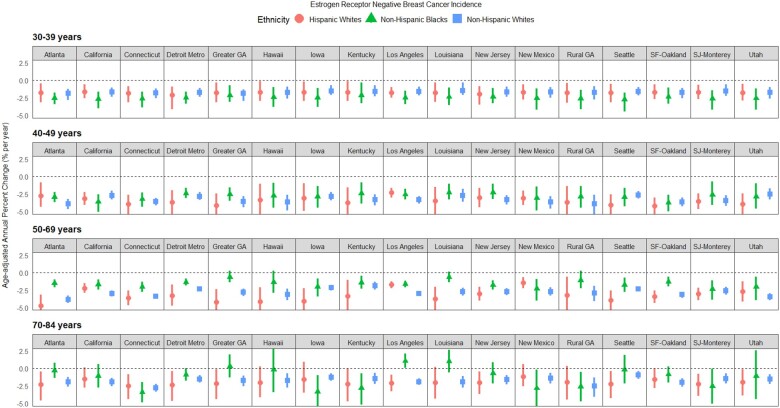
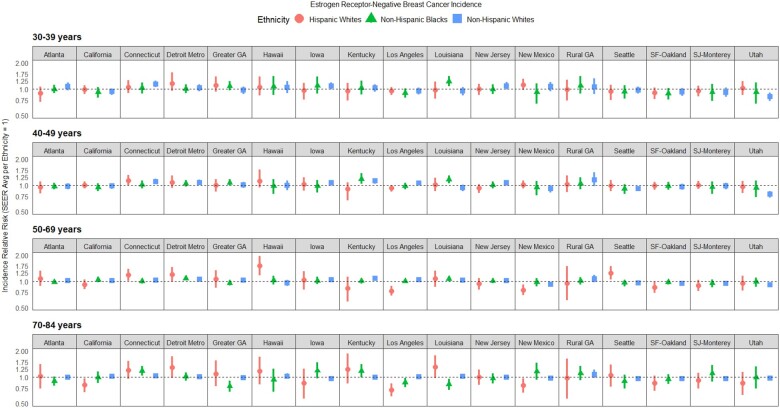
Overall, ER-negative incidence was highest in NHB, then NHW and HW women, and decreased from 1992-2016 in each age group and racial or ethnic group. The greatest decrease was for HW women aged 40-49 years, with an annual percent change of -3.5%/y (95% credible interval = -4.4%, -2.7%) averaged over registries. The trend heterogeneity was statistically significant in every race or ethnic and age group. Furthermore, the incidence relative risks by race or ethnicity compared with the race-specific SEER average were also statistically significantly heterogeneous across the majority of registries and age groups (62 of 68 strata). The greatest heterogeneity was seen in HW women, followed by NHB women, and the least in NHW women.
Decreasing ER-negative breast cancer incidence differs meaningfully by US region and age among NHB and HW women. Analytical studies including minority women from higher and lower incidence areas may provide insights into breast cancer racial disparities.
美国非洲裔美国女性和南部居民的雌激素受体(ER)阴性乳腺癌发病率最高,这种侵袭性亚型的发病率自 1992 年以来总体呈下降趋势。我们评估了 ER 阴性乳腺癌在所有年龄组和非西班牙裔白人(NHW)、非西班牙裔黑人(NHB)和西班牙裔白人(HW)女性中的癌症登记处是否都在减少。
我们分析了 17 个监测、流行病学和最终结果(SEER)计划登记处(12 个用于 1992-2016 年;5 个用于 2000-2016 年),以评估 ER 状态和年龄组(30-39 岁、40-49 岁、50-69 岁、70-84 岁)中 NHW、NHB 和 HW 的趋势。我们使用层次年龄-时期-队列模型来评估稀疏数据,该模型可以提高估计值,以量化各登记处之间平均发病率和年龄调整趋势与 SEER 整体之间的异质性。
总体而言,ER 阴性的发病率在 NHB 最高,其次是 NHW 和 HW 女性,并且在每个年龄组和种族或族裔群体中从 1992-2016 年下降。降幅最大的是年龄在 40-49 岁的 HW 女性,平均每个登记处的年百分比变化为-3.5%/y(95%可信区间= -4.4%,-2.7%)。在每个种族或族裔和年龄组中,趋势异质性均具有统计学意义。此外,与特定种族的 SEER 平均值相比,种族或族裔的发病率相对风险在大多数登记处和年龄组中也具有统计学意义的异质性(68 个分层中的 62 个)。HW 女性的异质性最大,其次是 NHB 女性,NHW 女性的异质性最小。
在美国,黑人女性和西班牙裔白人女性的 ER 阴性乳腺癌发病率随着地区和年龄的不同而显著下降。包括来自发病率较高和较低地区的少数族裔妇女在内的分析性研究可能为了解乳腺癌的种族差异提供线索。