Wang Da, Chen Chao, Ge Xiaoxu, Yang Qi, Huang Yuhuai, Ling Tianyi, Jin Tian, Yu Shaojun, Wang Jian, Sun Lifeng
Department of Colorectal Surgery and Oncology, Key Laboratory of Cancer Prevention and Intervention, Ministry of Education, The Second Affiliated Hospital, Zhejiang University School of Medicine, Hangzhou, Zhejiang Province, People's Republic of China.
Department of Cancer Institute, The Second Affiliated Hospital, Zhejiang University School of Medicine, Hangzhou, Zhejiang Province, People's Republic of China.
Cancer Manag Res. 2021 Aug 29;13:6767-6774. doi: 10.2147/CMAR.S320179. eCollection 2021.
This study aimed to analyze clinicopathological, survival, prognostic factors, as well as the timing of brain metastases (BM) in colorectal cancer (CRC) using data from a Chinese center.
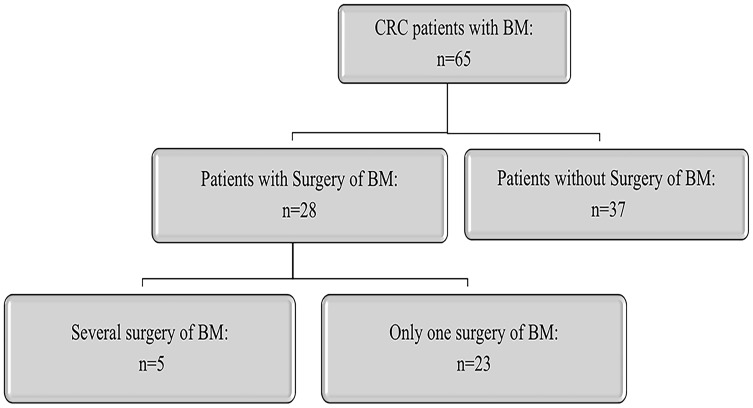
Data of 65 consecutive CRC patients with BM were collected from a single institution in China. The time from primary tumor surgery to the occurrence of BM was calculated. Kaplan-Meier analysis was used to evaluate cumulative survival of patients. Factors associated with prognosis of overall survival (OS) were explored using Cox's proportional hazard regression models.
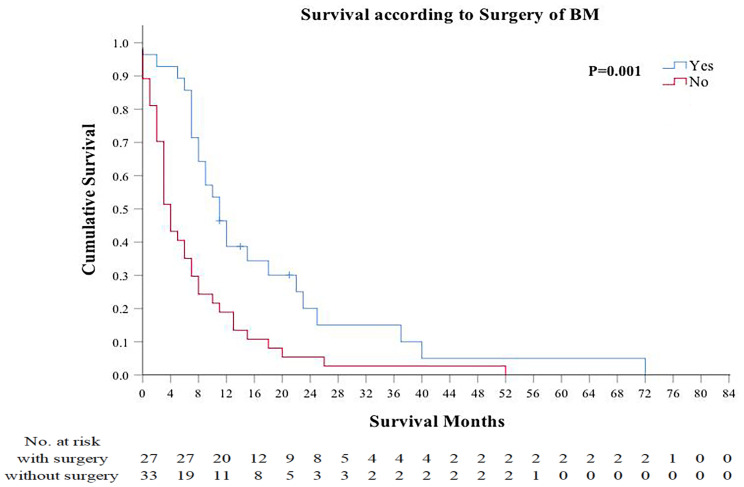
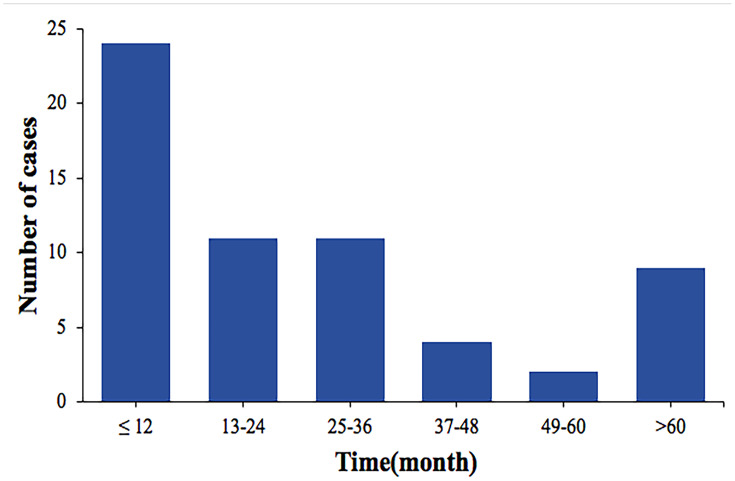
The median time interval from CRC surgery to the diagnosis of BM was 24 months. After diagnosis of BM, median OS values for patients were 11 months. Extracranial metastases occurred in 45 cases (69.2%) when BM was diagnosed, and 58.5% of these patients with lung metastases Time of BMs (=0.018), presence of extracranial metastases (=0.033), treatment (=0.003), CA199 (=0.034), CA125 (<0.001), CA242 (=0.018), and CA211 (=0.012) were associated with OS of patients through univariate analysis. Multivariate analysis using a Cox regression model showed that only treatment was an independent predictor for OS (conservative treatment; HR=1.861, 95% CI=1.077-3.441; =0.048).
Surgical treatment of metastatic lesions may be an alternative choice for CRC patients with BM. Identifying the timing of brain metastases can help to detect this disease early, leading to a better survival outcome.
本研究旨在利用来自中国某中心的数据,分析结直肠癌(CRC)的临床病理特征、生存情况、预后因素以及脑转移(BM)的发生时间。
从中国一家机构收集了65例连续的CRC合并BM患者的数据。计算从原发肿瘤手术到BM发生的时间。采用Kaplan-Meier分析评估患者的累积生存率。使用Cox比例风险回归模型探索与总生存(OS)预后相关的因素。
从CRC手术到BM诊断的中位时间间隔为24个月。BM诊断后,患者的中位OS值为11个月。诊断BM时,45例(69.2%)患者发生颅外转移,其中58.5%的患者有肺转移。BM发生时间(=0.018)、颅外转移的存在(=0.033)、治疗方式(=0.003)、CA199(=0.034)、CA125(<0.001)、CA242(=0.018)和CA211(=0.012)通过单因素分析与患者的OS相关。使用Cox回归模型进行多因素分析显示,只有治疗方式是OS的独立预测因素(保守治疗;HR=1.861,95%CI=1.077 - 3.441;=0.048)。
对于CRC合并BM的患者,转移灶的手术治疗可能是一种替代选择。确定脑转移的时间有助于早期发现这种疾病,从而获得更好的生存结果。