Sawakwongpra Kritchakorn, Tangmansakulchai Kulvadee, Ngonsawan Wasinee, Promwan Sasithorn, Chanchamroen Sujin, Quangkananurug Wiwat, Sriswasdi Sira, Jantarasaengaram Surasak, Ponnikorn Saranyoo
Chulabhorn International College of Medicine, Thammasat University, Khlong Luang, Pathum Thani 12120, Thailand.
Next Generation Genomic, Pathum Wan, Bangkok 10330, Thailand.
Biomed Rep. 2021 Oct;15(4):82. doi: 10.3892/br.2021.1458. Epub 2021 Aug 9.
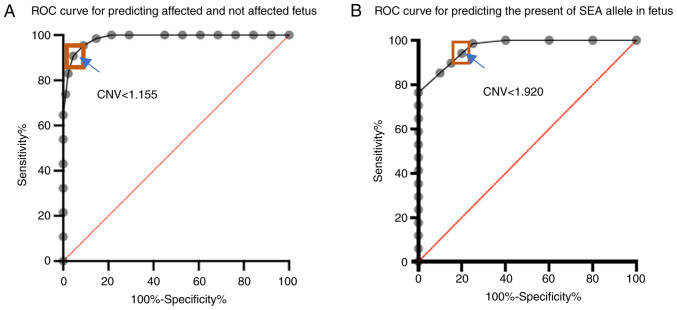
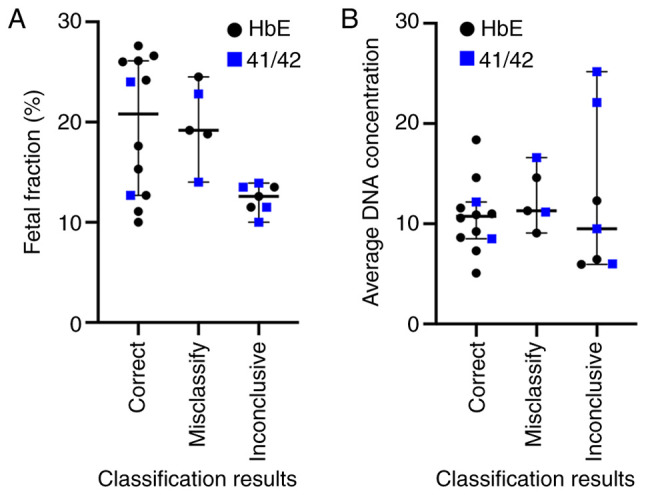
Non-invasive prenatal diagnosis (NIPD) of isolated cell-free DNA from maternal plasma has been applied to detect monogenic diseases in the fetus. Droplet digital PCR (ddPCR) is a sensitive and quantitative technique for NIPD. In the present study, the development and evaluation of ddPCR-based assays for common α and β-thalassemia variants amongst the Asian population was described; specifically, Southeast Asian (SEA) deletion, HbE, and 41/42 (-CTTT). SEA is caused by deletion of a 20 kb region surrounding the α-globin gene, whilst HbE and 41/42 (-CTTT) are caused by point mutations on the β-globin gene. Cell-free DNA samples from 46 singleton pregnant women who were carriers of these mutations were isolated and quantified using ddPCR with specially designed probes for each target allele. Allelic copy number calculation and likelihood ratio tests were used to classify fetal genotypes. Classification performances were evaluated against ground truth fetal genotypes obtained from conventional amniocentesis. Copy number variation analysis of SEA deletion accurately classified fetal genotypes in 20 out of 22 cases with an area under the receiver operating characteristic curve of 0.98 for detecting Hb Bart's hydrops fetalis. For HbE cases, 10 out of 16 samples were correctly classified, and three were inconclusive. For 41/42 (-CTTT) cases, 2 out of 8 were correctly classified, and four were inconclusive. The correct genotype was not rejected in any inconclusive case and may be resolved with additional ddPCR experiments. These results indicate that ddPCR-based analysis of maternal plasma can become an accurate and effective NIPD for SEA deletion α-(0) thalassemia. Although the performance of ddPCR on HbE and 41/42 (-CTTT) mutations were not sufficient for clinical application, these results may serve as a foundation for future works in this field.
从母体血浆中分离游离DNA进行无创产前诊断(NIPD)已被用于检测胎儿的单基因疾病。液滴数字PCR(ddPCR)是一种用于NIPD的灵敏且定量的技术。在本研究中,描述了基于ddPCR的检测亚洲人群中常见α和β地中海贫血变异体的方法的开发与评估;具体包括东南亚(SEA)缺失型、HbE和41/42(-CTTT)。SEA是由α-珠蛋白基因周围20 kb区域的缺失引起的,而HbE和41/42(-CTTT)是由β-珠蛋白基因上的点突变引起的。使用针对每个目标等位基因的特殊设计探针,通过ddPCR从46名单胎孕妇的游离DNA样本中分离并定量,这些孕妇是这些突变的携带者。采用等位基因拷贝数计算和似然比检验对胎儿基因型进行分类。根据从传统羊膜穿刺术获得的真实胎儿基因型评估分类性能。SEA缺失的拷贝数变异分析在22例病例中的20例中准确分类了胎儿基因型,检测Bart水肿胎儿的受试者操作特征曲线下面积为0.98。对于HbE病例,16个样本中的10个被正确分类,3个结果不确定。对于41/42(-CTTT)病例,8个中的2个被正确分类,4个结果不确定。在任何不确定的病例中,正确的基因型都未被排除,可能通过额外的ddPCR实验得到解决。这些结果表明,基于ddPCR的母体血浆分析可成为SEA缺失型α-(0)地中海贫血准确有效的无创产前诊断方法。虽然ddPCR对HbE和41/42(-CTTT)突变的检测性能不足以用于临床应用,但这些结果可为该领域未来的工作奠定基础。