Yang Anhui, Sun Zhen, Liu Rui, Liu Xin, Zhang Yue, Zhou Yulin, Qiu Ye, Zhang Xinrui
School of Life Sciences, Jilin University, Changchun, China.
Department of Pharmacy, Changchun University of Chinese Medicine, Changchun, China.
Front Oncol. 2021 Aug 26;11:727605. doi: 10.3389/fonc.2021.727605. eCollection 2021.
Liver cancer is one of the most malignant human cancers, with few treatments and a poor prognosis. Erianin (ERN) is a natural compound with multiple pharmacological activities that has been reported to have numerous excellent effects against liver cancer in experimental systems. However, its application has been limited due to its poor aqueous solubility and numerous off-target effects. This study aimed to improve the therapeutic efficacy of ERN by developing novel ERN-loaded tumor-targeting nanoparticles.
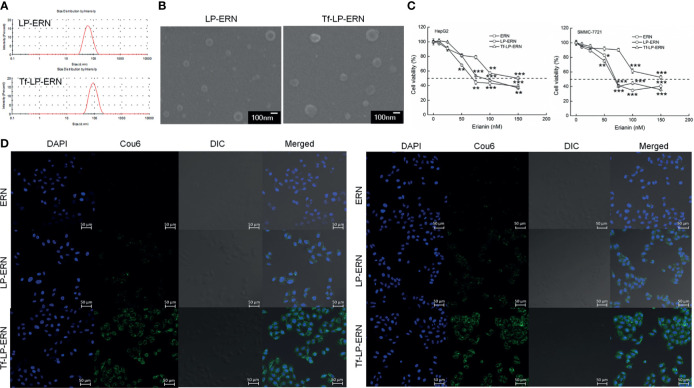
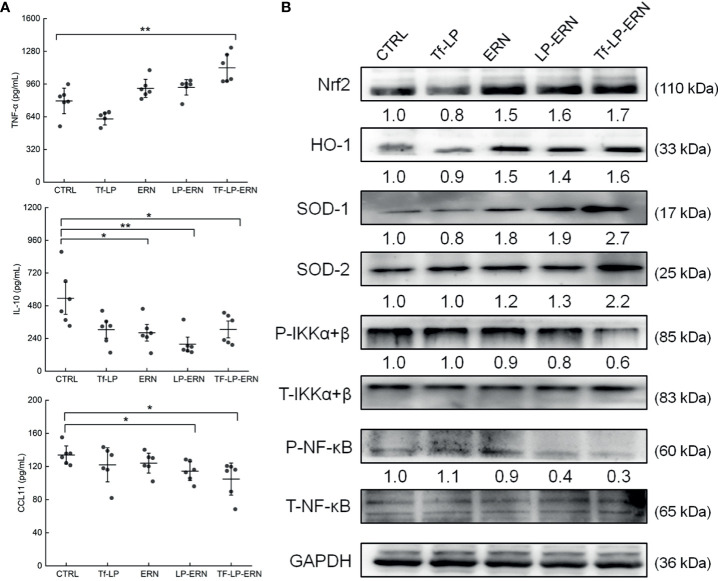
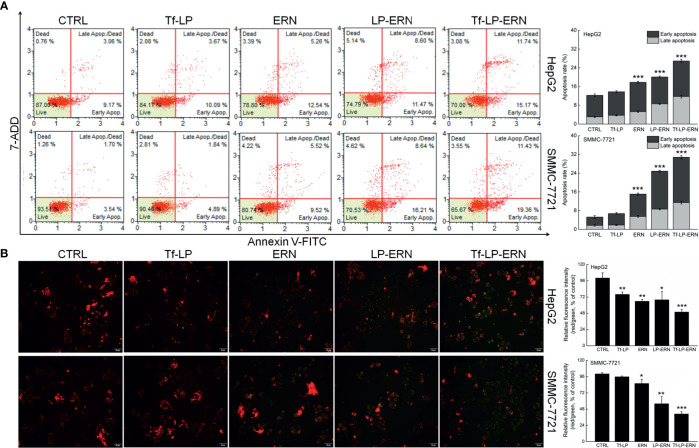
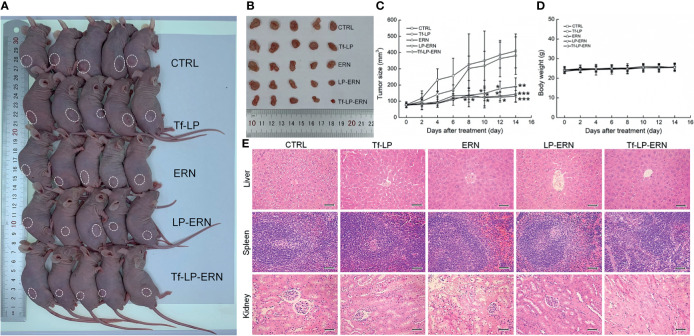
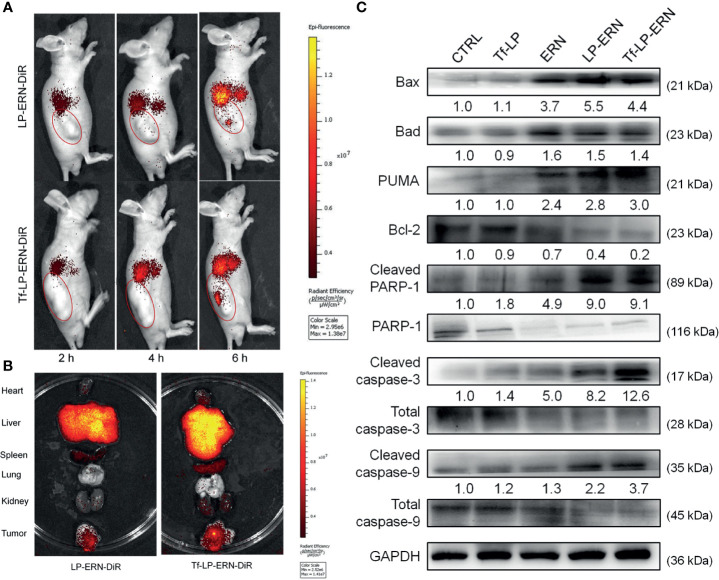
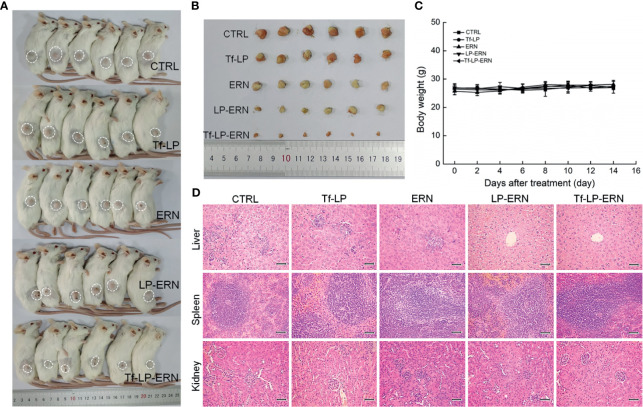
In this study, ERN was loaded into liposomes by ethanol injection (LP-ERN), and the resulting LP-ERN nanoparticles were treated with transferrin to form Tf-LP-ERN to improve the solubility and enhance the tumor-targeting of ERN. LP-ERN and Tf-LP-ERN nanoparticles had smooth surfaces and a uniform particle size, with particle diameters of 62.60 nm and 88.63 nm, respectively. In HepG2 and SMMC-7721 cells, Tf-LP-ERN induced apoptosis, decreased mitochondrial membrane potentials and increased ERN uptake more effectively than free ERN and LP-ERN. In xenotransplanted mice, Tf-LP-ERN inhibited tumor growth, but had a minimal effect on body weight and organ morphology. In addition, Tf-LP-ERN nanoparticles targeted tumors more effectively than free ERN and LP-ERN nanoparticles, and in tumor tissues Tf-LP-ERN nanoparticles promoted the cleavage PARP-1, caspase-3 and caspase-9, increased the expression levels of Bax, Bad, PUMA, and reduced the expression level of Bcl-2. Moreover, in the spleen of heterotopic tumor model BALB/c mice, ERN, LP-ERN and Tf-LP-ERN nanoparticles increased the expression levels of Nrf2, HO-1, SOD-1 and SOD-2, but reduced the expression levels of P-IKKα+β and P-NF-κB, with Tf-LP-ERN nanoparticles being most effective in this regard. Tf-LP-ERN nanoparticles also regulated the expression levels of TNF-α, IL-10 and CCL11 in serum.
Tf-LP-ERN nanoparticles exhibited excellent anti-liver cancer activity and by inducing cellular apoptosis, exhibiting immunoregulatory actions, and targeting tumor tissues, and did so more effectively than free ERN and LP-ERN nanoparticles. These results suggest that the clinical utility of a Tf-conjugated LP ERN-delivery system for the treatment of liver cancer warrants exploration.
肝癌是人类最恶性的癌症之一,治疗方法有限且预后较差。毛萼乙素(ERN)是一种具有多种药理活性的天然化合物,在实验系统中已报道其对肝癌具有诸多优异的疗效。然而,由于其水溶性差和众多脱靶效应,其应用受到限制。本研究旨在通过开发新型负载ERN的肿瘤靶向纳米颗粒来提高ERN的治疗效果。
在本研究中,通过乙醇注入法将ERN负载到脂质体中(LP-ERN),然后用转铁蛋白处理所得的LP-ERN纳米颗粒以形成Tf-LP-ERN,以提高溶解性并增强ERN的肿瘤靶向性。LP-ERN和Tf-LP-ERN纳米颗粒表面光滑且粒径均匀,粒径分别为62.60 nm和88.63 nm。在HepG2和SMMC-7721细胞中,Tf-LP-ERN比游离ERN和LP-ERN更有效地诱导细胞凋亡、降低线粒体膜电位并增加ERN摄取。在异种移植小鼠中,Tf-LP-ERN抑制肿瘤生长,但对体重和器官形态影响最小。此外,Tf-LP-ERN纳米颗粒比游离ERN和LP-ERN纳米颗粒更有效地靶向肿瘤,在肿瘤组织中,Tf-LP-ERN纳米颗粒促进PARP-1、caspase-3和caspase-9的裂解,增加Bax、Bad、PUMA的表达水平,并降低Bcl-2的表达水平。此外,在异位肿瘤模型BALB/c小鼠的脾脏中,ERN、LP-ERN和Tf-LP-ERN纳米颗粒增加Nrf2、HO-1、SOD-1和SOD-2的表达水平,但降低P-IKKα+β和P-NF-κB的表达水平,其中Tf-LP-ERN纳米颗粒在这方面最有效。Tf-LP-ERN纳米颗粒还调节血清中TNF-α、IL-10和CCL11的表达水平。
Tf-LP-ERN纳米颗粒通过诱导细胞凋亡、发挥免疫调节作用和靶向肿瘤组织表现出优异的抗肝癌活性,且比游离ERN和LP-ERN纳米颗粒更有效。这些结果表明,用于治疗肝癌的Tf偶联LP ERN递送系统的临床应用值得探索。