Wongtrakul Wasit, Niltwat Sorachat, Charatcharoenwitthaya Phunchai
Division of Gastroenterology, Department of Medicine, Faculty of Medicine Siriraj Hospital, Mahidol University, Bangkok, Thailand.
Department of Research and Development, Faculty of Medicine Siriraj Hospital, Mahidol University, Bangkok, Thailand.
Front Med (Lausanne). 2021 Aug 27;8:744713. doi: 10.3389/fmed.2021.744713. eCollection 2021.
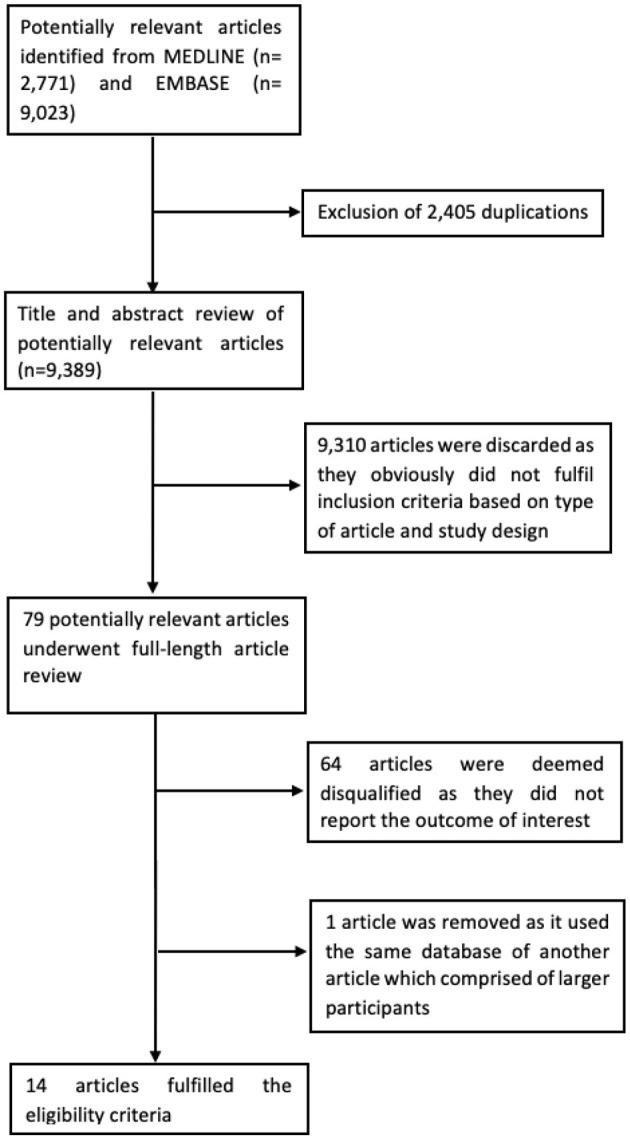
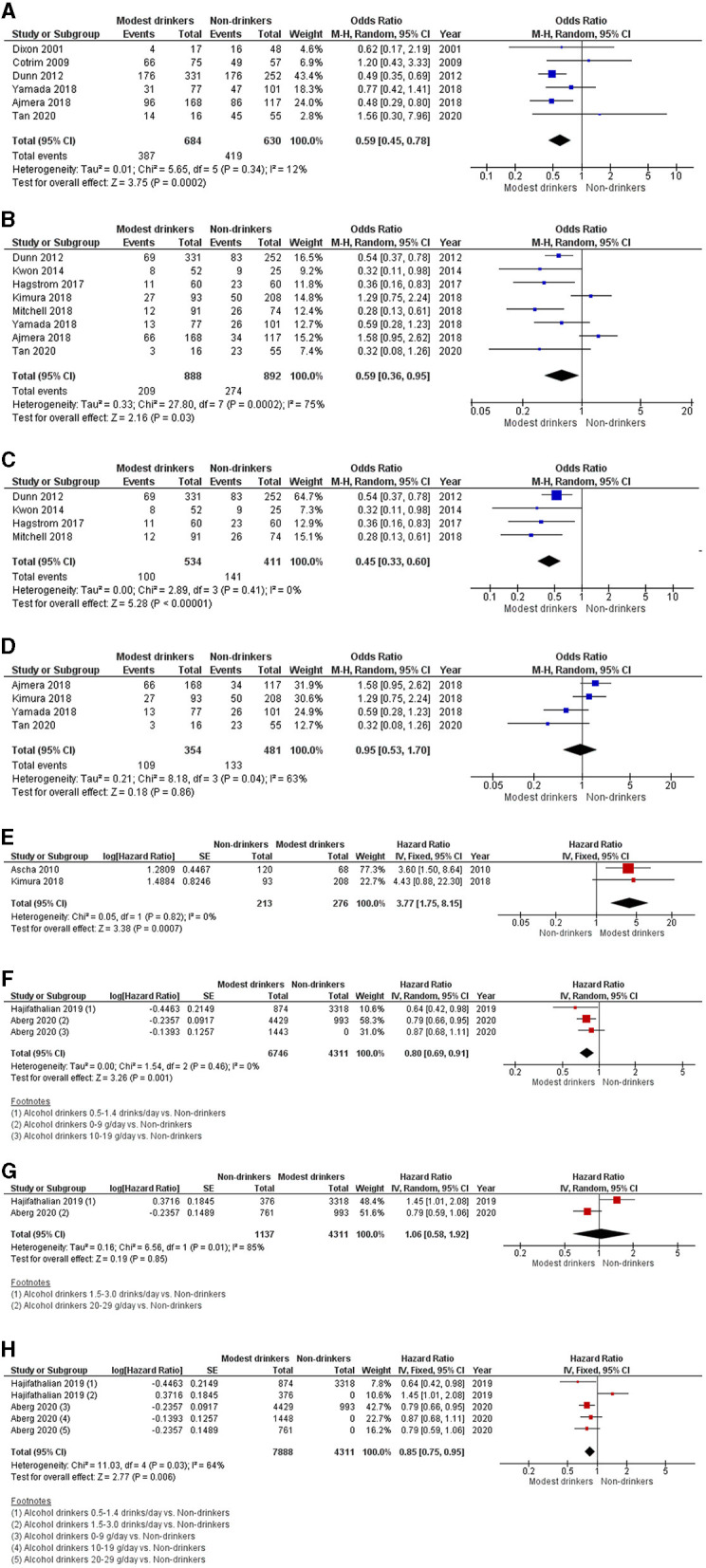
There is no consensus regarding modest alcohol consumption in patients with non-alcoholic fatty liver disease (NAFLD) due to conflicting results. The aim of this meta-analysis was to examine the effects of modest alcohol consumption on histological severity, histological course, hepatocellular carcinoma, and long-term clinical outcomes in NAFLD patients. We searched MEDLINE and EMBASE databases from inception to October 2020 for studies evaluating the effects of modest alcohol consumption among patients with NAFLD. A random-effects meta-analysis using pooled odds ratio (OR) and hazard ratio (HR) was calculated with 95% confidence interval (CI). Study quality was assessed with the Newcastle-Ottawa Scale. Fourteen cross-sectional or cohort studies with aggregate data on 14,435 patients were included in the analysis. Modest alcohol consumption resulted in lower risks for steatohepatitis (OR 0.59; 95% CI 0.45-0.78; = 12%) and advanced fibrosis (OR 0.59, 95% CI 0.36-0.95; = 75%). Histological follow-up data showed that modest alcohol use was associated significantly with less steatohepatitis resolution but not with fibrosis progression. The HR for developing hepatocellular carcinoma was 3.77 (95% CI 1.75-8.15; = 0%). NAFLD patients with modest alcohol intake had a lower mortality risk than lifelong abstainers (HR 0.85; 95% CI 0.75-0.95; = 64%). This meta-analysis suggests that medical advice for modest alcohol drinking should be made cautiously in caring for an individual patient based on the clinical context. Practically, patients with steatohepatitis or advanced fibrosis should avoid alcohol use, whereas patients with low fibrosis risk may be allowed for modest and safe drinking.
由于结果相互矛盾,对于非酒精性脂肪性肝病(NAFLD)患者适度饮酒尚无共识。本荟萃分析的目的是研究适度饮酒对NAFLD患者组织学严重程度、组织学病程、肝细胞癌及长期临床结局的影响。我们检索了MEDLINE和EMBASE数据库,从建库至2020年10月,以查找评估适度饮酒对NAFLD患者影响的研究。使用合并比值比(OR)和风险比(HR)进行随机效应荟萃分析,并计算95%置信区间(CI)。采用纽卡斯尔-渥太华量表评估研究质量。分析纳入了14项横断面或队列研究,汇总数据涉及14435例患者。适度饮酒可降低脂肪性肝炎(OR 0.59;95%CI 0.45 - 0.78;P = 12%)和晚期纤维化(OR 0.59,95%CI 0.36 - 0.95;P = 75%)的风险。组织学随访数据显示,适度饮酒与脂肪性肝炎缓解减少显著相关,但与纤维化进展无关。发生肝细胞癌的HR为3.77(95%CI 1.75 - 8.15;P = 0%)。适度饮酒的NAFLD患者的死亡风险低于终身戒酒者(HR 0.85;95%CI 0.75 - 0.95;P = 64%)。本荟萃分析表明,在根据临床情况照顾个体患者时,应谨慎给出适度饮酒的医学建议。实际上,患有脂肪性肝炎或晚期纤维化的患者应避免饮酒,而纤维化风险较低的患者可允许适度且安全地饮酒。