Department of Family Medicine, Chungnam National University Hospital, 282, Munhwa-ro, Jung-gu, Daejeon, Republic of Korea.
Public Health and Medical Services Office, Chungnam National University Hospital, Daejeon, Republic of Korea.
BMC Public Health. 2020 Jan 21;20(1):90. doi: 10.1186/s12889-019-7820-z.
This study investigated the dose-response relationship between alcohol consumption and CVD incidence, conducting a meta-analysis of studies focusing on residents from local communities. Further, we examined whether light to moderate alcohol consumption had a protective effect on CVD incidence through a sub-group analysis.
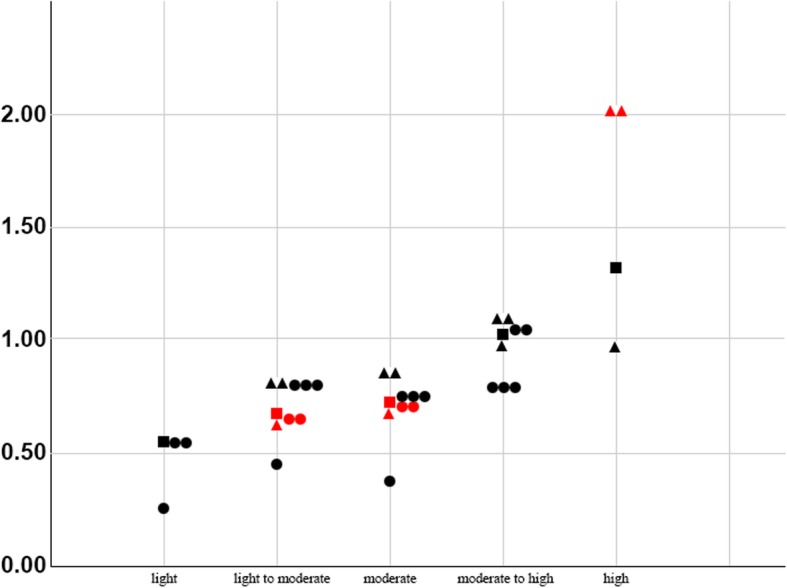
This study conducted a meta-analysis of the relationship between alcohol consumption and CVD incidence, selecting journals published up to December 2017. The alcohol consumption level was classified into non-consumers, light (0.01-10.0 g/day), light to moderate (10.1-20.0 g/day), moderate (20.1-40.0 g/day), moderate to high (40.1-60.0 g/day), and high (> 60.0 g/day) groups. The sub-group analysis was conducted according to the number of comorbidities and age.
Seven articles were selected in total for the meta-analysis. The mean Newcastle-Ottawa scale score was 8.14 points, suggesting studies were of high quality. There was a J-shaped dose-response relationship between alcohol consumption level and CVD incidence only in men. In general, light to moderate and moderate consumption lowered CVD incidence (Relative risk (RR) [95% confidence interval (CI)] was 0.68 [0.57-0.81] and 0.72 [0.58-0.90], respectively). In men with 3-4 comorbidities, there were no protective effects of light to moderate and moderate consumption on CVD incidence. In either groups of only men or men and women there were protective effects of light to moderate and moderate consumption on CVD incidence only in those aged between 41 and 65.
We found that light to moderate and moderate alcohol consumption had a protective effect on CVD incidence, there was no protective effect either in those with at least three comorbidities or people aged 40 or younger.
We conclude that not all local community residents experience a protective effect of light to moderate consumption on CVD incidence. As such, it is necessary to recommend a moderate amount of drinking or less for each individual.
本研究通过对来自社区居民的研究进行荟萃分析,探讨了饮酒量与心血管疾病(CVD)发病之间的剂量-反应关系。此外,我们还通过亚组分析来检验轻至中度饮酒是否对 CVD 发病有保护作用。
本研究对截至 2017 年 12 月发表的关于饮酒与 CVD 发病关系的期刊进行了荟萃分析。将饮酒水平分为非饮酒者、轻度(0.01-10.0 g/天)、轻至中度(10.1-20.0 g/天)、中度(20.1-40.0 g/天)、中至高度(40.1-60.0 g/天)和高度(>60.0 g/天)组。根据共病数量和年龄进行亚组分析。
共有 7 篇文章被纳入荟萃分析。纽卡斯尔-渥太华量表的平均评分为 8.14 分,表明研究质量较高。仅在男性中观察到饮酒水平与 CVD 发病之间存在 J 型剂量-反应关系。总体而言,轻至中度和中度饮酒可降低 CVD 发病风险(相对风险(RR)[95%置信区间(CI)]分别为 0.68[0.57-0.81]和 0.72[0.58-0.90])。在有 3-4 种共病的男性中,轻至中度和中度饮酒对 CVD 发病没有保护作用。仅在男性或男女混合组中,在 41-65 岁的人群中,轻至中度和中度饮酒对 CVD 发病才有保护作用。
我们发现,轻至中度和中度饮酒对 CVD 发病有保护作用,但在至少有 3 种共病或 40 岁以下的人群中,这种保护作用并不存在。
我们的结论是,并非所有社区居民都能从轻至中度饮酒中获得 CVD 发病的保护作用。因此,有必要针对每个人推荐适量饮酒或更少饮酒。