• 文献检索
  • 文档翻译
  • 深度研究
  • 学术资讯
  • Suppr Zotero 插件Zotero 插件
  • 邀请有礼
  • 套餐&价格
  • 历史记录
应用&插件
Suppr Zotero 插件Zotero 插件浏览器插件Mac 客户端Windows 客户端微信小程序
定价
高级版会员购买积分包购买API积分包
服务
文献检索文档翻译深度研究API 文档MCP 服务
关于我们
关于 Suppr公司介绍联系我们用户协议隐私条款
关注我们

Suppr 超能文献

核心技术专利:CN118964589B侵权必究
粤ICP备2023148730 号-1Suppr @ 2026

文献检索

告别复杂PubMed语法,用中文像聊天一样搜索,搜遍4000万医学文献。AI智能推荐,让科研检索更轻松。

立即免费搜索

文件翻译

保留排版,准确专业,支持PDF/Word/PPT等文件格式,支持 12+语言互译。

免费翻译文档

深度研究

AI帮你快速写综述,25分钟生成高质量综述,智能提取关键信息,辅助科研写作。

立即免费体验

新型冠状病毒肺炎患者炎症参数与垂体-甲状腺轴的相关性。

Correlation between inflammatory parameters and pituitary-thyroid axis in patients with COVID-19.

机构信息

Endocrinology Division, Hospital José María Ramos Mejía, Ciudad Autónoma de Buenos Aires, Argentina.

Internal Medicine Division, Hospital José María Ramos Mejía, Ciudad Autónoma de Buenos Aires, Argentina.

出版信息

Endocrine. 2021 Dec;74(3):455-460. doi: 10.1007/s12020-021-02863-2. Epub 2021 Sep 13.

DOI:10.1007/s12020-021-02863-2
PMID:34515958
原文链接:https://pmc.ncbi.nlm.nih.gov/articles/PMC8436010/
Abstract

PURPOSE

Inflammation plays a critical role in the progression of COVID-19. Nonthyroidal illness syndrome (NTIS) has been increasingly recognized in affected patients. We aim to evaluate the correlation of thyroid hormones with markers of inflammation and association with disease outcome in hospitalized patients with COVID-19, and in two profiles of NTIS (low T3-normal/low FT4 vs. low T3-high FT4).

METHODS

consecutive patients admitted to a nonintensive care unit for COVID-19 were recruited. Infection was mild in 22%, moderate in 27.1% and severe in 50.8%; 7.41% died. T4, T3, FT4, FT3, and their ratios (T3/T4, FT3/FT4) were correlated with albumin, ferritin, fibrinogen, erythrocyte sedimentation rate (ESR), C-reactive protein (CRP), lactate dehydrogenase (LDH), and D-dimer.

RESULTS

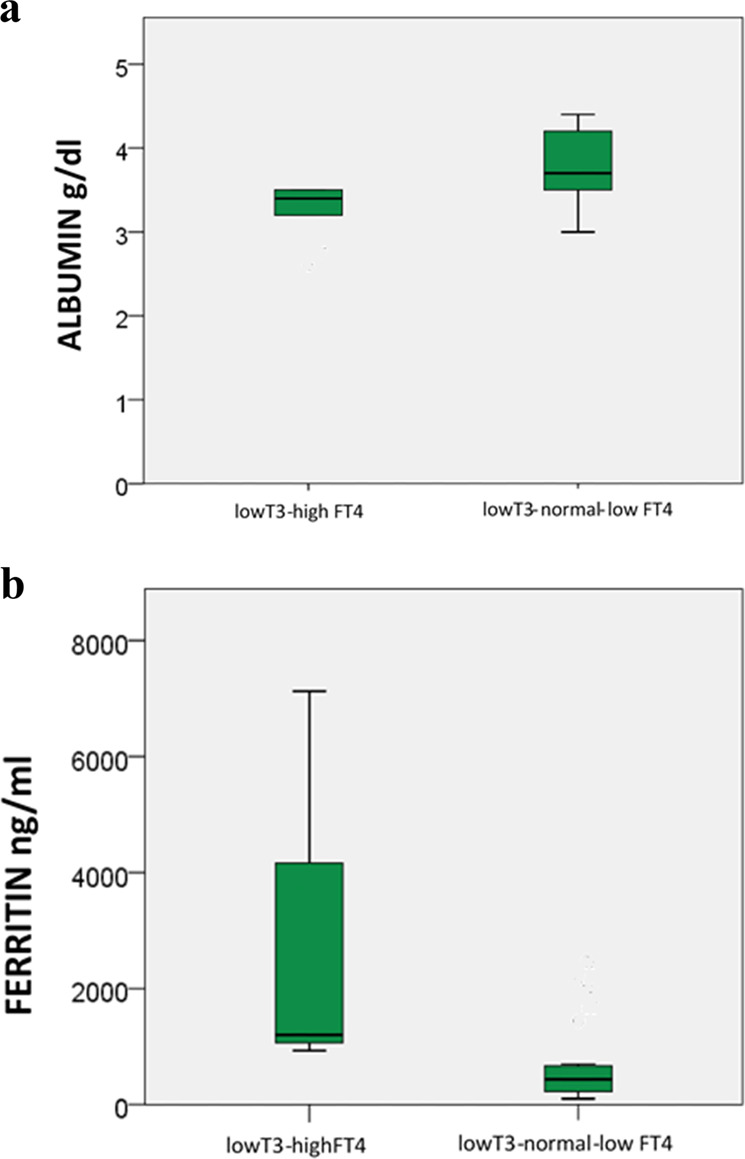
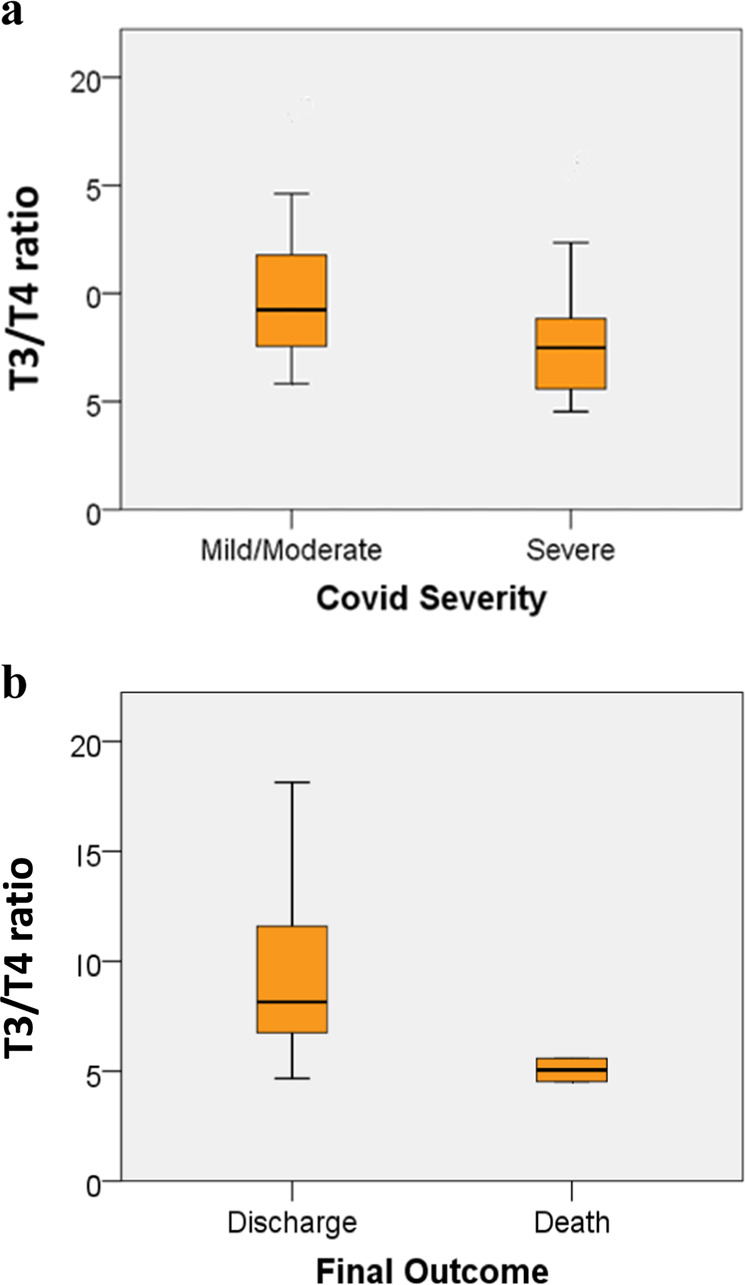
Fifty five patients (50.9% men, median age 56 years) were included. Albumin correlated positively with T3 and hormones ratios, but negatively with FT4. T3, FT3, T3/T4, and FT3/FT4 correlated inversely with ferritin, fibrinogen, ESR, CRP, LDH, and D-dimer. FT4 showed direct correlation with fibrinogen and ESR. T3/T4 was lower in severe compared to mild/moderate disease [7.5 (4.5-15.5) vs. 9.2 (5.8-18.1); p = 0.04], and lower in patients who died than in those discharged [5 (4.53-5.6) vs. 8.1 (4.7-18.1); p = 0.03]. A low T3/high FT4 profile was associated with lower albumin, higher ferritin, and severity.

CONCLUSION

In this cohort, thyroid hormones correlated with inflammation and outcome. T3 and T3/T4 correlated inversely with inflammatory markers; a low T3/T4 ratio was associated with severity and poor prognosis. Patients with low T3 but high FT4 had higher ferritin, lower albumin, and more severe disease at presentation.

摘要

目的

炎症在 COVID-19 的进展中起着关键作用。非甲状腺疾病综合征(NTIS)在受影响的患者中越来越被认识到。我们旨在评估甲状腺激素与炎症标志物的相关性,并在 COVID-19 住院患者中以及在两种 NTIS 谱(低 T3-正常/低 FT4 与低 T3-高 FT4)中评估其与疾病结局的相关性。

方法

连续招募因 COVID-19 入住非重症监护病房的患者。感染程度为轻度的占 22%,中度的占 27.1%,重度的占 50.8%;7.41%的患者死亡。T4、T3、FT4、FT3 及其比值(T3/T4、FT3/FT4)与白蛋白、铁蛋白、纤维蛋白原、红细胞沉降率(ESR)、C 反应蛋白(CRP)、乳酸脱氢酶(LDH)和 D-二聚体相关。

结果

55 名患者(50.9%为男性,中位年龄 56 岁)被纳入研究。白蛋白与 T3 和激素比值呈正相关,但与 FT4 呈负相关。T3、FT3、T3/T4 和 FT3/FT4 与铁蛋白、纤维蛋白原、ESR、CRP、LDH 和 D-二聚体呈负相关。FT4 与纤维蛋白原和 ESR 呈正相关。与轻度/中度疾病相比,重度疾病患者的 T3/T4 比值较低[7.5(4.5-15.5)与 9.2(5.8-18.1);p=0.04],死亡患者的 T3/T4 比值低于出院患者[5(4.53-5.6)与 8.1(4.7-18.1);p=0.03]。低 T3/高 FT4 谱与较低的白蛋白、较高的铁蛋白和严重程度相关。

结论

在本队列中,甲状腺激素与炎症和预后相关。T3 和 T3/T4 与炎症标志物呈负相关;T3/T4 比值降低与严重程度和不良预后相关。T3 降低但 FT4 升高的患者在就诊时铁蛋白更高、白蛋白更低且疾病更严重。
https://cdn.ncbi.nlm.nih.gov/pmc/blobs/6619/8436010/5ea883d53953/12020_2021_2863_Fig2_HTML.jpg
https://cdn.ncbi.nlm.nih.gov/pmc/blobs/6619/8436010/6526e0c4d261/12020_2021_2863_Fig1_HTML.jpg
https://cdn.ncbi.nlm.nih.gov/pmc/blobs/6619/8436010/5ea883d53953/12020_2021_2863_Fig2_HTML.jpg
https://cdn.ncbi.nlm.nih.gov/pmc/blobs/6619/8436010/6526e0c4d261/12020_2021_2863_Fig1_HTML.jpg
https://cdn.ncbi.nlm.nih.gov/pmc/blobs/6619/8436010/5ea883d53953/12020_2021_2863_Fig2_HTML.jpg

相似文献

1
Correlation between inflammatory parameters and pituitary-thyroid axis in patients with COVID-19.新型冠状病毒肺炎患者炎症参数与垂体-甲状腺轴的相关性。
Endocrine. 2021 Dec;74(3):455-460. doi: 10.1007/s12020-021-02863-2. Epub 2021 Sep 13.
2
Nonthyroidal illness syndrome (NTIS) in severe COVID-19 patients: role of T3 on the Na/K pump gene expression and on hydroelectrolytic equilibrium.严重 COVID-19 患者中的非甲状腺疾病综合征 (NTIS):T3 对钠/钾泵基因表达和水电解质平衡的作用。
J Transl Med. 2021 Dec 3;19(1):491. doi: 10.1186/s12967-021-03163-z.
3
Association of Reduced Free T3 to Free T4 Ratio with Lower Serum Creatinine in Japanese Hemodialysis Patients.日本血液透析患者中游离三碘甲状腺原氨酸与游离甲状腺素比值降低与血清肌酐水平较低的相关性
Nutrients. 2021 Dec 17;13(12):4537. doi: 10.3390/nu13124537.
4
Prevalence of malnutrition-inflammation complex syndrome and its correlation with thyroid hormones in chronic haemodialysis patients.慢性血液透析患者中营养不良-炎症复合综合征的患病率及其与甲状腺激素的相关性。
Nefrologia (Engl Ed). 2018 Jan-Feb;38(1):57-63. doi: 10.1016/j.nefro.2017.07.001. Epub 2017 Oct 26.
5
[Effects of various contraceptives on laboratory parameters in diagnosis of thyroid gland function with special reference to the free hormones FT4 and FT3].[各种避孕药对甲状腺功能诊断中实验室参数的影响,特别提及游离激素FT4和FT3]
Z Gesamte Inn Med. 1992 Feb;47(2):58-64.
6
The Association of TSH and Thyroid Hormones With Lymphopenia in Bacterial Sepsis and COVID-19.促甲状腺激素(TSH)和甲状腺激素与细菌性败血症和 COVID-19 中淋巴细胞减少症的关系。
J Clin Endocrinol Metab. 2021 Jun 16;106(7):1994-2009. doi: 10.1210/clinem/dgab148.
7
The significance of high thyroxine in hospitalized patients with low thyroid-stimulating hormone.促甲状腺激素水平低的住院患者甲状腺素水平高的意义。
Endocrine. 2021 May;72(2):445-451. doi: 10.1007/s12020-020-02463-6. Epub 2020 Sep 2.
8
Are thyroid function tests too frequently and inappropriately requested?甲状腺功能检查的申请是否过于频繁且不合理?
J Endocrinol Invest. 1999 Mar;22(3):184-90. doi: 10.1007/BF03343539.
9
The contribution of total and free iodothyronines to welfare maintenance and management stress coping in Ruminants and Equines: Physiological ranges and reference values.总甲状腺素和游离甲状腺素对反刍动物和马属动物维持健康及应对管理应激的作用:生理范围和参考值
Res Vet Sci. 2018 Jun;118:134-143. doi: 10.1016/j.rvsc.2018.01.025. Epub 2018 Feb 2.
10
Thyroid dysfunction in COVID-19 patients.新型冠状病毒肺炎患者的甲状腺功能障碍。
J Endocrinol Invest. 2021 Dec;44(12):2735-2739. doi: 10.1007/s40618-021-01599-0. Epub 2021 Jun 8.

引用本文的文献

1
Comorbidity of PaO/FiO and nonthyroidal illness syndrome synergistically predicts 28-day mortality in sepsis: A retrospective cohort study from the MIMIC-IV database.动脉血氧分压与吸入氧浓度比值(PaO/FiO)合并非甲状腺疾病综合征可协同预测脓毒症患者28天死亡率:一项来自MIMIC-IV数据库的回顾性队列研究
Sci Prog. 2025 Jul-Sep;108(3):368504251359356. doi: 10.1177/00368504251359356. Epub 2025 Jul 22.
2
Thyroid function during COVID-19 and post-COVID complications in adults: a systematic review.成人新冠病毒感染期间的甲状腺功能及新冠后并发症:一项系统综述
Front Endocrinol (Lausanne). 2025 Feb 4;15:1477389. doi: 10.3389/fendo.2024.1477389. eCollection 2024.
3

本文引用的文献

1
Thyroid sequelae of COVID-19: a systematic review of reviews.COVID-19 所致甲状腺后遗症:系统评价综述。
Rev Endocr Metab Disord. 2021 Jun;22(2):485-491. doi: 10.1007/s11154-021-09653-1. Epub 2021 Apr 11.
2
Potential Interaction Between SARS-CoV-2 and Thyroid: A Review.新型冠状病毒与甲状腺之间潜在的相互作用:综述。
Endocrinology. 2021 Mar 1;162(3). doi: 10.1210/endocr/bqab004.
3
Thyroid complications of SARS and coronavirus disease 2019 (COVID-19).SARS 和 2019 冠状病毒病(COVID-19)的甲状腺并发症。
Evaluation of the hematological parameters, inflammatory biomarkers, and thyroid hormones in hypothyroidism patients.
甲状腺功能减退症患者血液学参数、炎症生物标志物及甲状腺激素的评估。
BMC Res Notes. 2024 Dec 27;17(1):390. doi: 10.1186/s13104-024-07048-4.
4
Impact of thyroid hormones on predicting the occurrence of persistent inflammation, immunosuppression, and catabolism syndrome in patients with sepsis.甲状腺激素对预测脓毒症患者持续性炎症、免疫抑制和分解代谢综合征发生的影响。
Front Endocrinol (Lausanne). 2024 Oct 16;15:1417846. doi: 10.3389/fendo.2024.1417846. eCollection 2024.
5
Total triiodothyronine level associated with disease severity for patients with emergent status.总三碘甲状腺原氨酸水平与急症患者疾病严重程度相关。
Sci Rep. 2024 Jul 26;14(1):17170. doi: 10.1038/s41598-024-68195-z.
6
[Related factors of euthyroid sick syndrome in patients with sepsis].[脓毒症患者甲状腺功能正常病态综合征的相关因素]
Beijing Da Xue Xue Bao Yi Xue Ban. 2024 Jun 18;56(3):526-532. doi: 10.19723/j.issn.1671-167X.2024.03.021.
7
Thyroid dysfunction in COVID-19.COVID-19 相关甲状腺功能障碍。
Nat Rev Endocrinol. 2024 Jun;20(6):336-348. doi: 10.1038/s41574-023-00946-w. Epub 2024 Feb 12.
8
The immune factors have complex causal regulation effects on inflammatory bowel disease.免疫因素对炎症性肠病具有复杂的因果调节作用。
Front Immunol. 2024 Jan 9;14:1322673. doi: 10.3389/fimmu.2023.1322673. eCollection 2023.
9
The prevalence of thyroid disorders in COVID-19 patients: a systematic review and meta-analysis.COVID-19 患者甲状腺疾病的患病率:系统评价和荟萃分析。
BMC Endocr Disord. 2024 Jan 2;24(1):5. doi: 10.1186/s12902-023-01534-9.
10
Predictive Effects of FT3/FT4 on Diabetic Kidney Disease: An Exploratory Study on Hospitalized Euthyroid Patients with T2DM in China.游离三碘甲状腺原氨酸/游离甲状腺素对糖尿病肾病的预测作用:一项针对中国住院的甲状腺功能正常的2型糖尿病患者的探索性研究。
Biomedicines. 2023 Aug 7;11(8):2211. doi: 10.3390/biomedicines11082211.
Endocr J. 2021 Feb 28;68(2):129-136. doi: 10.1507/endocrj.EJ20-0443. Epub 2021 Jan 19.
4
Thyroid Function Before, During, and After COVID-19.新冠病毒感染前后甲状腺功能的变化。
J Clin Endocrinol Metab. 2021 Jan 23;106(2):e803-e811. doi: 10.1210/clinem/dgaa830.
5
Thyroid Dysfunction in Relation to Immune Profile, Disease Status, and Outcome in 191 Patients with COVID-19.191 例 COVID-19 患者的甲状腺功能障碍与免疫谱、疾病状况和预后的关系。
J Clin Endocrinol Metab. 2021 Jan 23;106(2):e926-e935. doi: 10.1210/clinem/dgaa813.
6
Thyrotoxicosis in patients with COVID-19: the THYRCOV study.COVID-19 患者中的甲状腺毒症:THYRCOV 研究。
Eur J Endocrinol. 2020 Oct;183(4):381-387. doi: 10.1530/EJE-20-0335.
7
Thyroid Function Analysis in 50 Patients with COVID-19: A Retrospective Study.50 例 COVID-19 患者甲状腺功能分析:一项回顾性研究。
Thyroid. 2021 Jan;31(1):8-11. doi: 10.1089/thy.2020.0363. Epub 2020 Jul 10.
8
Multisystem Inflammatory Syndrome in Children in New York State.纽约州儿童多系统炎症综合征。
N Engl J Med. 2020 Jul 23;383(4):347-358. doi: 10.1056/NEJMoa2021756. Epub 2020 Jun 29.
9
The complement system in COVID-19: friend and foe?新型冠状病毒肺炎中的补体系统:是敌是友?
JCI Insight. 2020 Aug 6;5(15):140711. doi: 10.1172/jci.insight.140711.
10
The cytokine storm in COVID-19: An overview of the involvement of the chemokine/chemokine-receptor system.COVID-19 中的细胞因子风暴:趋化因子/趋化因子受体系统的参与概述。
Cytokine Growth Factor Rev. 2020 Jun;53:25-32. doi: 10.1016/j.cytogfr.2020.05.003. Epub 2020 May 11.