Department of Infectious Diseases and Dermatovenerology, Faculty of Medicine, Vilnius University, Vilnius University Hospital Santaros Klinikos, Vilnius, Lithuania.
Department of Infectious Diseases, CHIP, Rigshospitalet, Copenhagen, Denmark.
BMC Infect Dis. 2021 Sep 13;21(Suppl 2):845. doi: 10.1186/s12879-021-06537-2.
Indicator condition guided HIV testing is a proven effective strategy for increasing HIV diagnosis in health care facilities. As part of the INTEGRATE Joint Action, we conducted four pilot studies, aiming to increase integrated testing for HIV/HCV/HBV and sexually transmitted infections, by introducing and expanding existing indicator condition guided HIV testing methods.
Pilot interventions included combined HIV/HCV testing in a dermatovenerology clinic and a clinic for addictive disorders in Lithuania; Increasing HIV testing rates in a tuberculosis clinic in Romania by introducing a patient information leaflet and offering testing for HIV/HCV/sexually transmitted infections to chemsex-users in Barcelona. Methods for implementing indicator condition guided HIV testing were adapted to include integrated testing. Testing data were collected retrospectively and prospectively. Staff were trained in all settings, Plan-do-study-act cycles frequently performed and barriers to implementation reported.
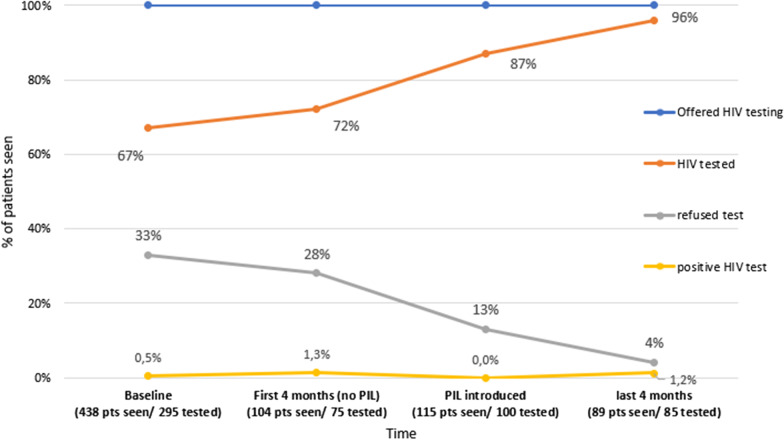
In established indicator conditions, HIV absolute testing rates increased from 10.6 to 71% in the dermatovenerology clinic over an 18 months period. HIV testing rates improved from 67.4% at baseline to 94% in the tuberculosis clinic. HCV testing was added to all individuals in the dermatovenerology clinic, eight patients of 1701 tested positive (0.47%). HBV testing was added to individuals with sexually transmitted infections with a 0.44% positivity rate (2/452 tested positive). The Indicator condition guided HIV testing strategy was expanded to offer HIV/HCV testing to people with alcohol dependency and chemsex-users. 52% of chemsex-users tested positive for ≥ 1 sexually transmitted infection and among people with alcohol dependency 0.3 and 3.7% tested positive for HIV and HCV respectively.
The four pilot studies successfully increased integrated testing in health care settings, by introducing testing for HBV/HCV and sexually transmitted infections along with HIV testing for established indicator conditions and expanding the strategy to include new indicators; alcohol dependency and chemsex. HCV testing of individuals with alcohol abuse showed high positivity rates and calls for further implementation studies. Methods used for implementing indicator condition guided HIV Testing have proven transferable to implementation of integrated testing.
指标条件引导的 HIV 检测是一种已被证实可有效提高医疗机构中 HIV 诊断率的策略。作为 INTEGRATE 联合行动的一部分,我们开展了四项试点研究,旨在通过引入和扩展现有的指标条件引导 HIV 检测方法,增加 HIV/HCV/HBV 和性传播感染的综合检测。
试点干预措施包括在立陶宛的皮肤科和成瘾障碍诊所开展 HIV/HCV 联合检测;在罗马尼亚的结核病诊所引入患者信息传单并为“化学性交”使用者提供 HIV/HCV/性传播感染检测,以提高 HIV 检测率;以及在巴塞罗那为有感染风险的人提供 HIV 检测。实施指标条件引导 HIV 检测的方法进行了调整,纳入了综合检测。收集回顾性和前瞻性检测数据。所有地点的工作人员都接受了培训,经常进行“计划-执行-研究-行动”循环,并报告实施障碍。
在已确立的指标条件下,皮肤科诊所的 HIV 绝对检测率从 18 个月前的 10.6%上升至 71%;结核病诊所的 HIV 检测率从基线时的 67.4%提高至 94%。在皮肤科诊所,所有患者均接受 HCV 检测,1701 名患者中有 8 人检测呈阳性(0.47%);对患有性传播感染的患者增加了 HBV 检测,452 名患者中有 2 人(0.44%)检测呈阳性。指标条件引导 HIV 检测策略扩展至为酒精依赖和“化学性交”使用者提供 HIV/HCV 检测。52%的“化学性交”使用者检测出至少一种性传播感染呈阳性,而酒精依赖者中 HIV 和 HCV 的阳性率分别为 0.3%和 3.7%。
四项试点研究通过在既定指标条件下引入 HBV/HCV 和性传播感染检测,并将策略扩展到包括新指标(酒精依赖和“化学性交”),成功地提高了医疗保健环境中的综合检测率。对有酒精滥用的个体进行 HCV 检测显示出高阳性率,需要进一步开展实施研究。实施指标条件引导 HIV 检测所用的方法已被证明可转移到综合检测的实施中。