Department of Infectious Diseases and Dermatovenerology, Institute of Clinical Medicine, Faculty of Medicine, Vilnius University, Vilnius, Lithuania.
Infectious Diseases Centre, Vilnius University Hospital Santaros Klinikos, Vilnius, Lithuania.
BMC Infect Dis. 2019 Jan 7;19(1):21. doi: 10.1186/s12879-018-3661-0.
HIV transmission remains a major concern in Eastern Europe, and too many people are diagnosed late. Expanded testing strategies and early and appropriate access to care are required. Infectious disease departments might be targets for expanded HIV testing owing to the intense passage of key patient populations that carry indicators of HIV disease. Our objective was to evaluate the feasibility and clinical effectiveness of a fully integrated, opt-out routine, rapid HIV testing program.
A retrospective four-year study of a screening program was conducted from 2010 through 2014. The program was divided into two periods: from 2010 to 2012 (pilot study) and from 2013 to 2014. The pilot study consisted of routine HIV testing of patients aged 18-55 that were hospitalized in one department. In the second period, all inpatients aged 18-65 were eligible. Targeted testing was conducted in the other inpatient department during the pilot study and the outpatient department during both periods.
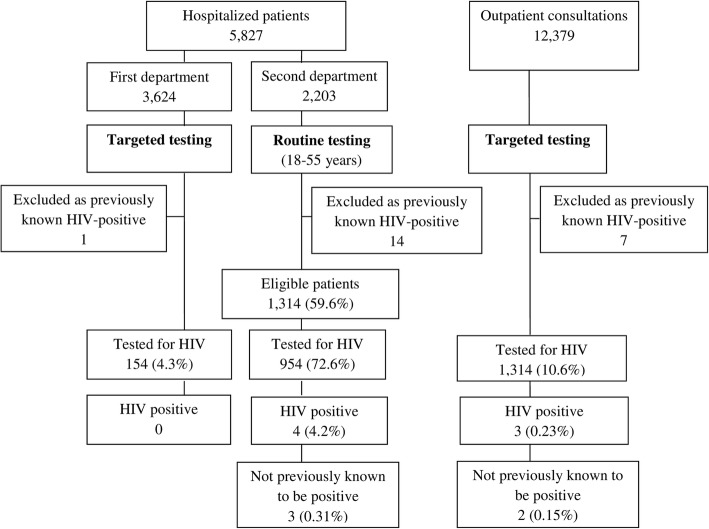
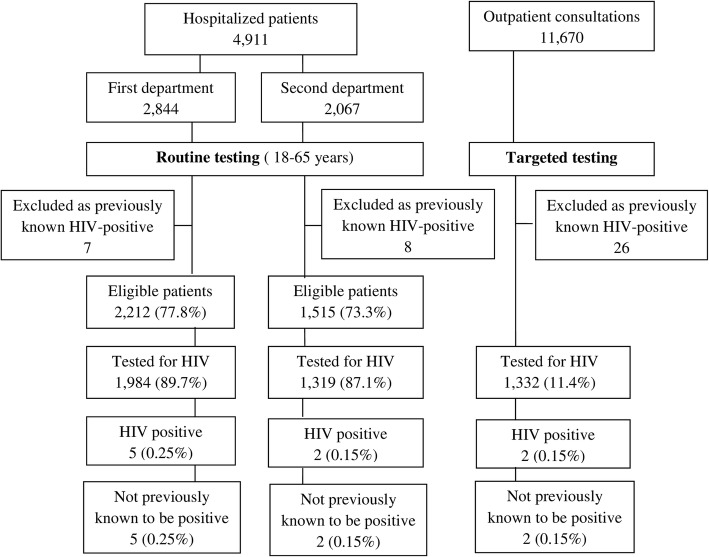
During the pilot study, 2203 patients were hospitalized, 1314 (59.6%) were eligible, 954 (72.6%) were tested, and 3 (0.31%) were newly diagnosed HIV-positive. In the second period, 4911 patients were hospitalized, 3727 (75.9%) were eligible, 3303 (88.6%) were tested, and 7 (0.21%) were HIV-positive. In total, 2800 targeted tests were performed, and 4 (0.14%) patients tested positive with newly discovered HIV. All 14 newly diagnosed patients were provided with care. Comparing cumulative groups of routine and targeted testing, the HIV prevalence was 0.23% vs. 0.14% (p = 0.40) and was above the reported cost-effectiveness threshold of 0.1% (p = 0.012). A lower proportion of advanced disease and a higher proportion of heterosexually transmitted infection were found in the routine testing group.
Routine HIV testing in admissions of infectious diseases is acceptable, feasible, sustainable and clinically effective. Compared to targeted testing, routine testing helped to discover more patients in earlier stages and those with heterosexually transmitted HIV infection.
艾滋病毒传播仍然是东欧的一个主要问题,有太多人被诊断为时已晚。需要扩大检测策略,并及早和适当地提供护理。传染病科可能是扩大艾滋病毒检测的目标,因为有很多关键的患者群体,他们带有艾滋病毒疾病的指标。我们的目标是评估一个完全整合的、默认选择的常规、快速艾滋病毒检测方案的可行性和临床效果。
对 2010 年至 2014 年期间的筛查方案进行了为期四年的回顾性研究。该方案分为两个阶段:2010 年至 2012 年(试点研究)和 2013 年至 2014 年。试点研究包括对一个科室住院的 18-55 岁的患者进行常规艾滋病毒检测。在第二个时期,所有 18-65 岁的住院患者都有资格参加。在试点研究期间,在另一个住院科室和两个时期的门诊科室进行了针对性检测。
在试点研究期间,有 2203 名患者住院,1314 名(59.6%)符合条件,954 名(72.6%)接受了检测,3 名(0.31%)新诊断为艾滋病毒阳性。在第二个时期,有 4911 名患者住院,3727 名(75.9%)符合条件,3303 名(88.6%)接受了检测,7 名(0.21%)艾滋病毒阳性。总共进行了 2800 次有针对性的检测,有 4 名(0.14%)患者新发现艾滋病毒阳性。所有 14 名新诊断的患者都得到了护理。将常规和有针对性的检测累积组进行比较,艾滋病毒的流行率为 0.23%比 0.14%(p=0.40),高于报告的成本效益阈值 0.1%(p=0.012)。在常规检测组中,发现的晚期疾病比例较低,异性传播感染的比例较高。
传染病科住院患者的常规艾滋病毒检测是可以接受的、可行的、可持续的,并且具有临床效果。与针对性检测相比,常规检测有助于发现更多处于早期阶段的患者,以及异性传播感染的患者。