Department of Medicine, Division of General Medicine, Emory University School of Medicine, Atlanta, Georgia, USA.
Department of Medicine, Division of Geriatrics and Gerontology, Emory University School of Medicine, Atlanta, Georgia, USA.
BMJ Open Qual. 2021 Sep;10(3). doi: 10.1136/bmjoq-2021-001496.
To assess whether engagement in a COVID-19 remote patient monitoring (RPM) programme or telemedicine programme improves patient outcomes.
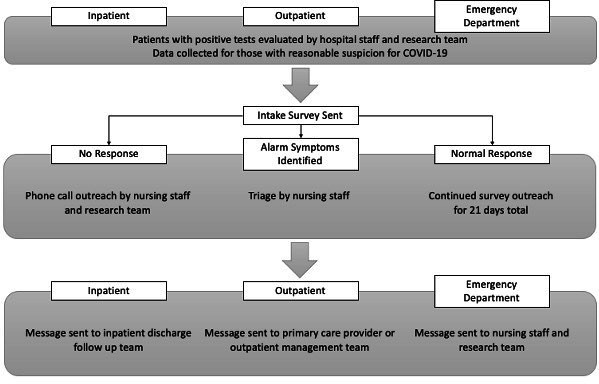
This is a retrospective cohort study analysing patient responsiveness to our RPM survey or telemedicine visits and outcomes during the COVID-19 pandemic. Daily text message surveys and telemedicine consultations were offered to all patients who tested positive for SARS-CoV-2 at our institutional screening centres. Survey respondents with alarm responses were contacted by a nurse. We assessed the relationship between virtual engagement (telemedicine or RPM survey response) and clinical outcomes using multivariable logistic regression.
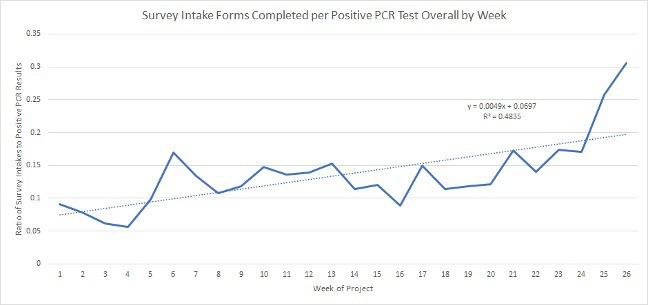
Between 10 July 2020 and 2 January 2021, 6822 patients tested positive, with 1230 (18%) responding to at least one survey. Compared with non-responders, responders were younger (49 vs 53 years) and more likely to be white (40% vs 33%) and female (65% vs 55%) and had fewer comorbidities. After adjustment, individuals who engaged virtually were less likely to experience an emergency department visit, hospital admission or intensive care unit-level care.
Telemedicine and RPM programme engagement (vs no engagement) were associated with better outcomes, but this was likely due to differences in groups at baseline rather than the efficacy of our intervention alone.
评估参与 COVID-19 远程患者监测(RPM)计划或远程医疗计划是否能改善患者结局。
这是一项回顾性队列研究,分析了患者对我们的 RPM 调查或远程医疗访问的反应以及在 COVID-19 大流行期间的结局。我们向在机构筛查中心检测出 SARS-CoV-2 阳性的所有患者提供每日短信调查和远程医疗咨询。对有警报反应的调查受访者,护士会与其联系。我们使用多变量逻辑回归评估虚拟参与(远程医疗或 RPM 调查回复)与临床结局之间的关系。
2020 年 7 月 10 日至 2021 年 1 月 2 日期间,有 6822 名患者检测呈阳性,其中 1230 名(18%)至少回复了一次调查。与未回复者相比,回复者更年轻(49 岁 vs 53 岁),更可能是白人(40% vs 33%)和女性(65% vs 55%),合并症较少。调整后,虚拟参与的个体更不可能到急诊就诊、住院或入住重症监护病房。
远程医疗和 RPM 计划参与(与不参与相比)与更好的结局相关,但这可能是由于基线人群的差异,而不仅仅是我们干预的效果。