Cancer Research UK Manchester Institute, The University of Manchester, Manchester, UK.
Wellcome Centre for Cell-Matrix Research, Faculty of Biology, Medicine and Health, The University of Manchester, Manchester, UK.
Nat Mater. 2022 Jan;21(1):110-119. doi: 10.1038/s41563-021-01085-1. Epub 2021 Sep 13.
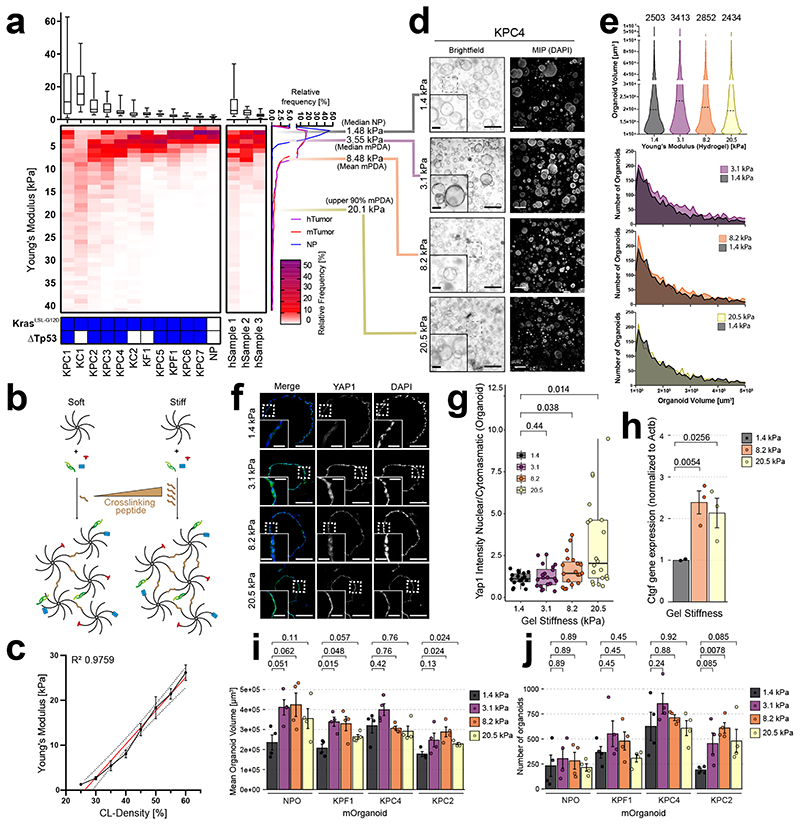
Experimental in vitro models that capture pathophysiological characteristics of human tumours are essential for basic and translational cancer biology. Here, we describe a fully synthetic hydrogel extracellular matrix designed to elicit key phenotypic traits of the pancreatic environment in culture. To enable the growth of normal and cancerous pancreatic organoids from genetically engineered murine models and human patients, essential adhesive cues were empirically defined and replicated in the hydrogel scaffold, revealing a functional role of laminin-integrin α/α signalling in establishment and survival of pancreatic organoids. Altered tissue stiffness-a hallmark of pancreatic cancer-was recapitulated in culture by adjusting the hydrogel properties to engage mechano-sensing pathways and alter organoid growth. Pancreatic stromal cells were readily incorporated into the hydrogels and replicated phenotypic traits characteristic of the tumour environment in vivo. This model therefore recapitulates a pathologically remodelled tumour microenvironment for studies of normal and pancreatic cancer cells in vitro.
体外实验模型能够捕捉人类肿瘤的生理病理特征,对于基础和转化癌症生物学研究至关重要。在这里,我们描述了一种完全合成的水凝胶细胞外基质,旨在培养中模拟胰腺环境的关键表型特征。为了使来自基因工程小鼠模型和人类患者的正常和癌变胰腺类器官在该水凝胶支架中生长,我们通过经验定义并复制了必需的黏附信号,揭示了层粘连蛋白-整合素 α/α 信号在胰腺类器官的建立和存活中的功能作用。通过调整水凝胶特性以参与机械感应途径并改变类器官的生长,在培养中再现了组织硬度的改变——这是胰腺癌的一个标志。胰腺基质细胞很容易整合到水凝胶中,并复制了体内肿瘤微环境的表型特征。因此,该模型再现了病理性重塑的肿瘤微环境,可用于体外研究正常和胰腺癌细胞。