Cell Communication Lab, Department of Oncology, University College London Cancer Institute, London, UK.
Stromal Immunology Lab, MRC Laboratory for Molecular Cell Biology, University College London, London, UK.
Nat Methods. 2020 Mar;17(3):335-342. doi: 10.1038/s41592-020-0737-8. Epub 2020 Feb 17.
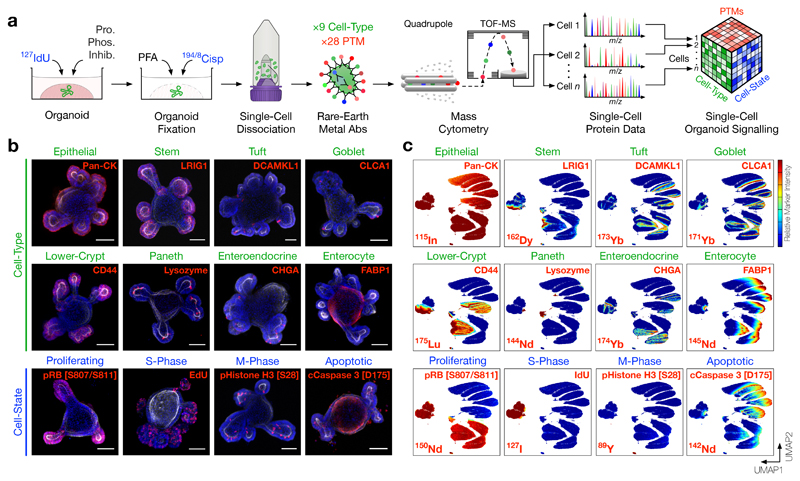
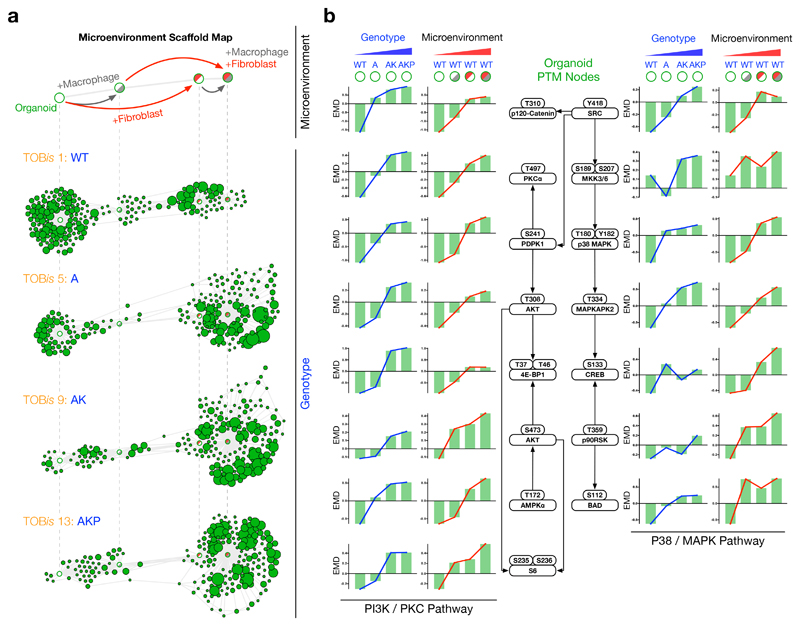
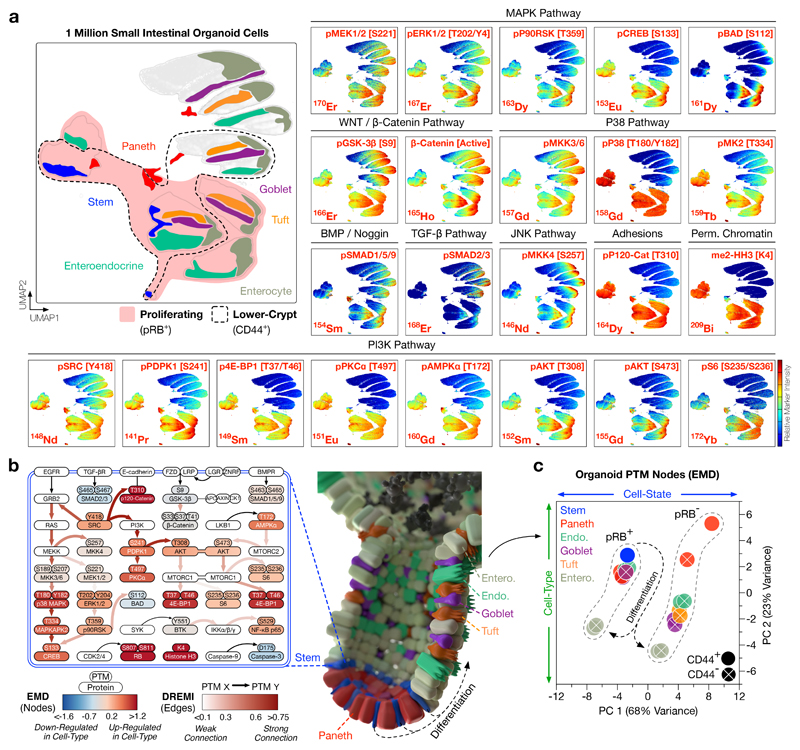
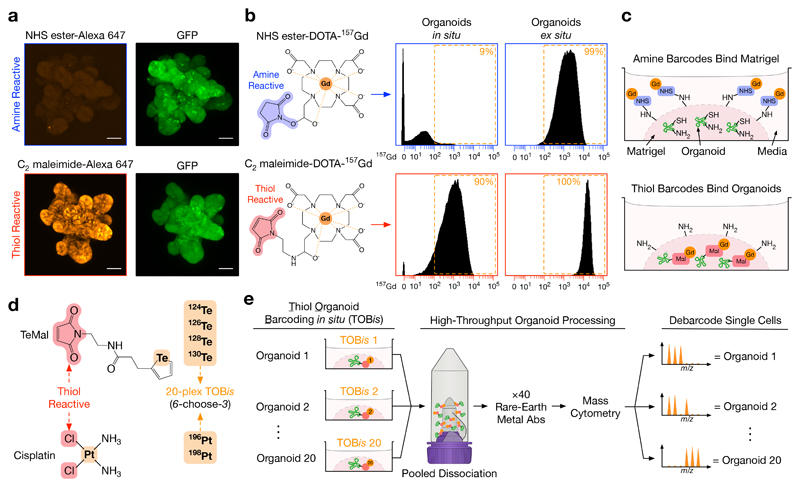
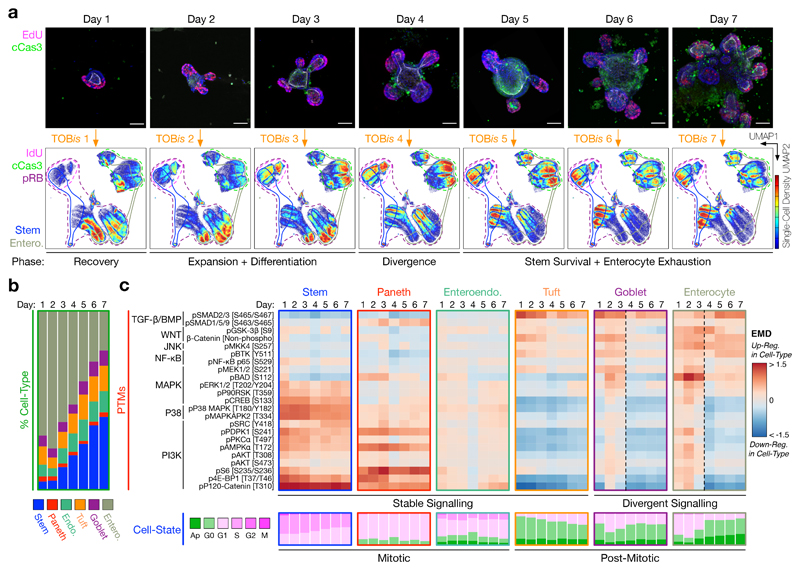
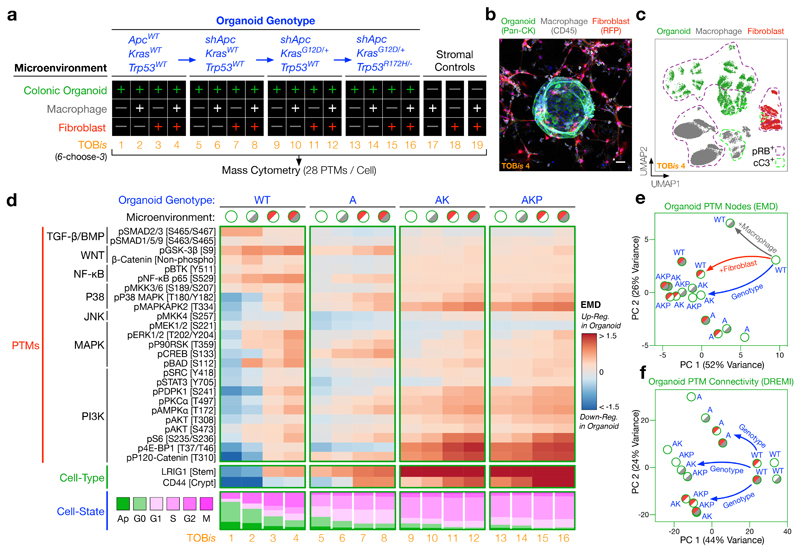
Despite the widespread adoption of organoids as biomimetic tissue models, methods to comprehensively analyze cell-type-specific post-translational modification (PTM) signaling networks in organoids are absent. Here, we report multivariate single-cell analysis of such networks in organoids and organoid cocultures. Simultaneous analysis by mass cytometry of 28 PTMs in >1 million single cells derived from small intestinal organoids reveals cell-type- and cell-state-specific signaling networks in stem, Paneth, enteroendocrine, tuft and goblet cells, as well as enterocytes. Integrating single-cell PTM analysis with thiol-reactive organoid barcoding in situ (TOBis) enables high-throughput comparison of signaling networks between organoid cultures. Cell-type-specific PTM analysis of colorectal cancer organoid cocultures reveals that shApc, Kras and Trp53 cell-autonomously mimic signaling states normally induced by stromal fibroblasts and macrophages. These results demonstrate how standard mass cytometry workflows can be modified to perform high-throughput multivariate cell-type-specific signaling analysis of healthy and cancerous organoids.
尽管类器官已被广泛用作仿生组织模型,但缺乏全面分析类器官中细胞类型特异性翻译后修饰(PTM)信号网络的方法。在这里,我们报告了类器官和类器官共培养物中此类网络的多元单细胞分析。通过质谱细胞术对从小肠类器官中获得的超过 100 万个单细胞中的 28 种 PTM 进行的同时分析,揭示了干细胞、潘氏细胞、肠内分泌细胞、微绒毛和杯状细胞以及肠细胞中的细胞类型和细胞状态特异性信号网络。将单细胞 PTM 分析与原位硫醇反应类器官条形码技术(TOBis)相结合,可实现类器官培养物之间信号网络的高通量比较。结直肠癌细胞类器官共培养物的细胞类型特异性 PTM 分析表明,shApc、Kras 和 Trp53 细胞自主模拟通常由基质成纤维细胞和巨噬细胞诱导的信号状态。这些结果表明如何修改标准的质谱细胞术工作流程以对健康和癌变的类器官进行高通量多元细胞类型特异性信号分析。