Chinsky Ravi, Morris Alexander, Suh Angela, Hum Avery, Wolin Danielle, Harper Brian, Blazey William, Yao Sheldon, Krishnamachari Bhuma
New York Institute of Technology College of Osteopathic Medicine, 101 Northern Blvd, Glen Head, NY 11545 USA.
Med Sci Educ. 2021 Sep 8;31(6):1859-1867. doi: 10.1007/s40670-021-01374-z. eCollection 2021 Dec.
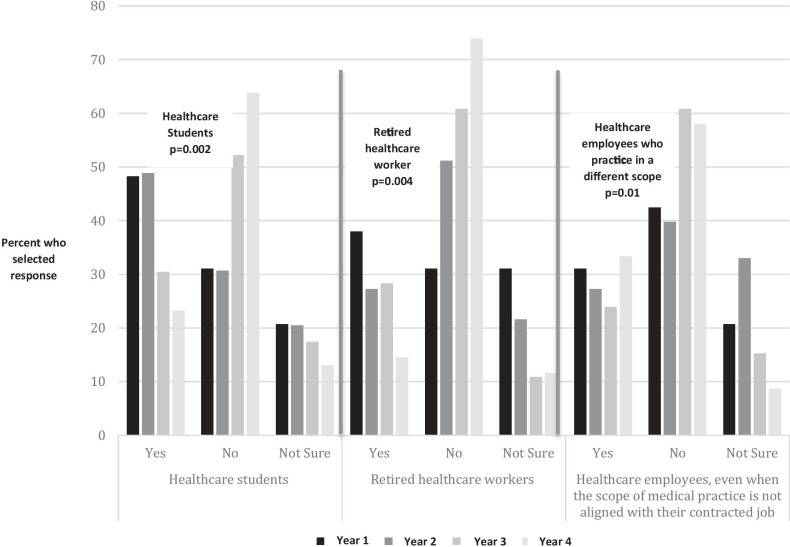
The COVID-19 pandemic caused a large strain on the US medical system, with shortage of medical personnel being a key issue. The role of medical school students during a pandemic is not well established. Understanding the perspectives of medical students with regard to their role is essential in determining how to facilitate the use of their skills in combating the pandemic. To evaluate medical student perspectives on the COVID-19 pandemic, an anonymous online survey was distributed to medical students, primarily in the Northeastern United States. In the sample of 232 students, there were significant differences between students in different class years when assessing moral obligations to assist with the COVID-19 pandemic ( = 0.002). A higher percentage of first and second year medical students (pre-clinical training, around 48%) felt that healthcare students are morally obligated to assist as compared to third and fourth year students (clinical training, 30.43% of third years and 23.19% of fourth years). In all class years, the majority said they would regret their decision if they had chosen not to study medicine (62.32% to 79.31%) and most students did not feel their motivation to become a physician had been decreased (84.78% to 87.50%). Though the study was limited because the majority of subjects were from New York, the results provide insight into medical students' attitudes about the COVID-19 pandemic and can be used in the planning of how best to utilize medical students in this and in future situations.
The online version contains supplementary material available at 10.1007/s40670-021-01374-z.
新冠疫情给美国医疗系统带来了巨大压力,医疗人员短缺是一个关键问题。医学院学生在疫情期间的作用尚未明确。了解医学生对自身角色的看法对于确定如何在抗击疫情中发挥他们的技能至关重要。为了评估医学生对新冠疫情的看法,我们向主要来自美国东北部的医学生发放了一份匿名在线调查问卷。在232名学生的样本中,不同年级的学生在评估协助应对新冠疫情的道德义务时存在显著差异(P = 0.002)。与三、四年级学生(临床培训阶段,三年级为30.43%,四年级为23.19%)相比,一、二年级医学生(临床前培训阶段,约48%)中认为医学生在道德上有义务提供协助的比例更高。在所有年级中,大多数人表示如果当初选择不学医,他们会后悔自己的决定(62.32%至79.31%),并且大多数学生觉得自己成为医生的动力并未减弱(84.78%至87.50%)。尽管该研究存在局限性,因为大多数受试者来自纽约,但研究结果为了解医学生对新冠疫情的态度提供了见解,可用于规划如何在当前及未来情况下最佳地利用医学生。
在线版本包含可在10.1007/s40670-021-01374-z获取的补充材料。