Division of Surgery and Interventional Science, Hampstead Campus, University College London, 9th Floor, Royal Free Hospital, Rowland Hill Street, London, NW3 2PF, UK.
Medical School, University of Birmingham, Birmingham, B296QU, UK.
Updates Surg. 2022 Apr;74(2):391-401. doi: 10.1007/s13304-021-01168-3. Epub 2021 Sep 14.
Clinical practice guidelines aim to support clinicians in providing clinical care and should be supported by evidence. There is currently no information on whether clinical practice guidelines in laparoscopic surgery are supported by evidence.
We performed a systematic review and identified clinical practice guidelines of laparoscopic surgery published in PubMed and Embase between March 2016 and February 2019. We performed an independent assessment of the strength of recommendation based on the evidence provided by the guideline authors. We used the 'Appraisal of Guidelines for Research & Evaluation II' (AGREE-II) Tool's 'rigour of development', 'clarity of presentation', and 'editorial independence' domains to assess the quality of the guidelines. We performed a mixed-effects generalised linear regression modelling.
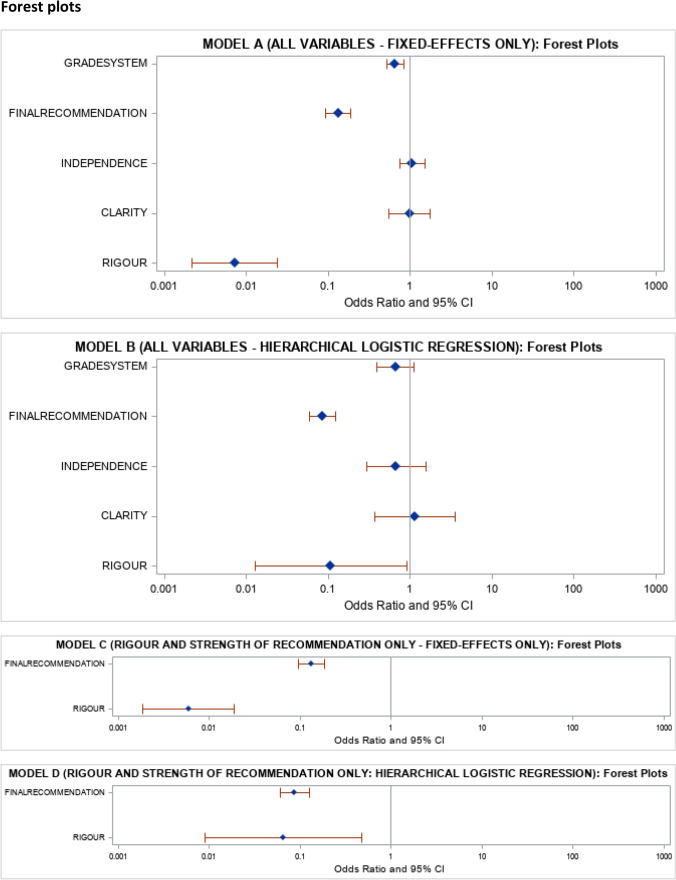
We retrieved 63 guidelines containing 1905 guideline statements. The median proportion of 'difference in rating' of strength of recommendation between the guideline authors and independent assessment was 33.3% (quartiles: 18.3%, 55.8%). The 'rigour of development' domain score (odds ratio 0.06; 95% confidence intervals 0.01-0.48 per unit increase in rigour score; P value = 0.0071) and whether the strength of recommendation was 'strong' by independent evaluation (odds ratio 0.09 (95% confidence intervals 0.06-0.13; P value < 0.001) were the only determinants of difference in rating between the guideline authors and independent evaluation.
A considerable proportion of guideline statements in clinical practice guidelines in laparoscopic surgery are not supported by evidence. Guideline authors systematically overrated the strength of the recommendation (i.e., even when the evidence points to weak recommendation, guideline authors made strong recommendations).
临床实践指南旨在为临床医生提供临床护理支持,且应得到证据的支持。目前尚无信息表明腹腔镜手术的临床实践指南是否有证据支持。
我们进行了一项系统评价,在 2016 年 3 月至 2019 年 2 月期间,在 PubMed 和 Embase 中确定了发表的腹腔镜手术临床实践指南。我们根据指南作者提供的证据,独立评估推荐强度。我们使用“评估指南研究与评价 II”(AGREE-II)工具的“制定严谨性”、“表述清晰性”和“编辑独立性”领域来评估指南的质量。我们进行了混合效应广义线性回归建模。
我们检索到 63 条指南,其中包含 1905 条指南陈述。指南作者和独立评估之间推荐强度“评分差异”的中位数比例为 33.3%(四分位数:18.3%,55.8%)。“制定严谨性”领域评分(比值比 0.06;每单位严谨性评分增加,推荐强度的差异比为 0.01-0.48;P 值=0.0071)和独立评估的推荐强度是否为“强”(比值比 0.09(95%置信区间 0.06-0.13;P 值<0.001)是指南作者和独立评估之间评分差异的唯一决定因素。
腹腔镜手术临床实践指南中的相当一部分指南陈述没有得到证据的支持。指南作者系统地高估了推荐强度(即,即使证据表明推荐强度较弱,指南作者也做出了强烈的推荐)。