Hematopoietic Cell Transplant and Cellular Therapy Program, Massachusetts General Hospital, Boston, MA.
Department of Stem Cell Transplantation and Cellular Therapy, The University of Texas MD Anderson Cancer Center, Houston, TX.
Blood Adv. 2021 Oct 26;5(20):4278-4284. doi: 10.1182/bloodadvances.2021004941.
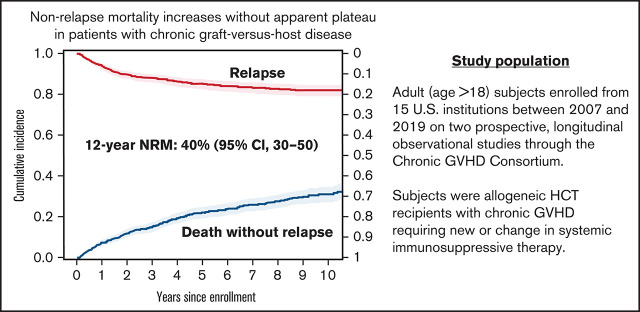
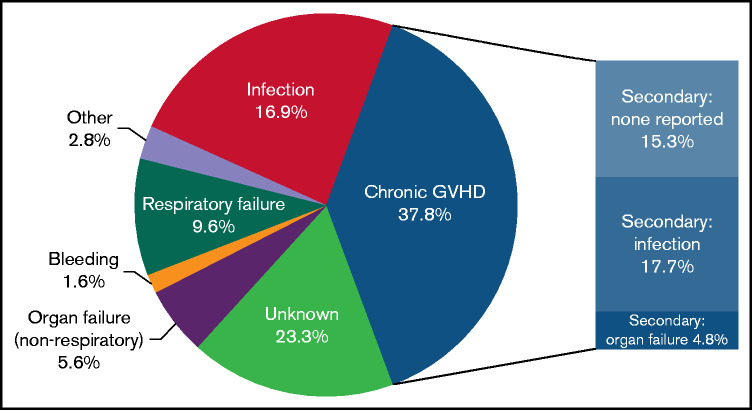
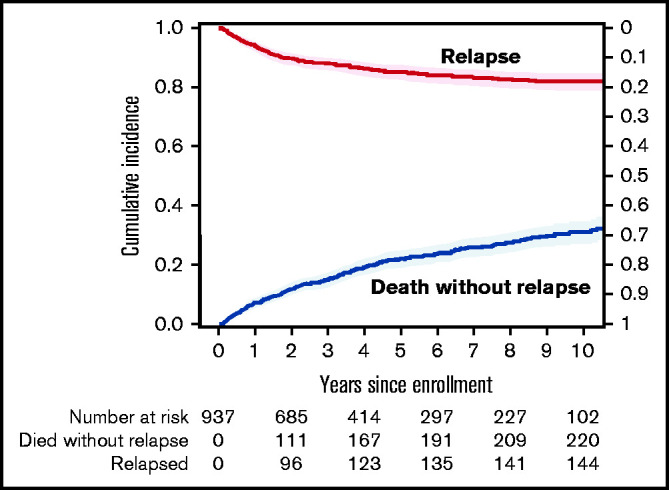
Chronic graft-versus-host disease (cGVHD) is the leading cause of late morbidity and mortality after allogeneic hematopoietic cell transplantation. To better understand patients at highest risk for nonrelapse mortality (NRM), we analyzed patient-, transplant-, and cGVHD-related variables, risk factors, and causes of nonrelapse deaths in an updated cohort of 937 patients enrolled on 2 prospective, longitudinal observational studies through the Chronic GVHD Consortium. The median follow-up of survivors was 4 years (range, 0.1 months to 12.5 years). Relapse accounted for 25% of the 333 deaths. The cumulative incidence of NRM was 22% at 5 years, and it increased over time at a projected 40% (95% confidence interval, 30%-50%) at 12 years. Centers reported that cGVHD (37.8%) was the most common cause of NRM and was associated with organ failure, infection, or additional causes not otherwise specified. The next most frequent causes without mention of cGVHD were infection (17%) and respiratory failure (10%). In multivariable analysis, an increased risk for NRM was significantly associated with the use of reduced intensity conditioning, higher total bilirubin, National Institutes of Health (NIH) skin score of 2 to 3, NIH lung score of 1 to 3, worse modified Human Activity Profile adjusted activity score, and decreased distance on walk test. To summarize, cGVHD NRM does not plateau but increases over time and is most commonly attributed to GVHD or infection, presumably associated with immunocompromised status. Severe skin and lung cGVHD remain challenging manifestations associated with increased NRM, for which novel therapeutic options that do not predispose patients to infections are needed.
慢性移植物抗宿主病(cGVHD)是异基因造血细胞移植后晚期发病和死亡的主要原因。为了更好地了解非复发死亡率(NRM)风险最高的患者,我们通过慢性移植物抗宿主病联盟分析了 937 例前瞻性、纵向观察性研究中的患者、移植和 cGVHD 相关变量、危险因素以及非复发死亡的原因。幸存者的中位随访时间为 4 年(范围:0.1 个月至 12.5 年)。复发占 333 例死亡的 25%。5 年时 NRM 的累积发生率为 22%,预计 12 年时 NRM 发生率将逐渐增加至 40%(95%置信区间:30%-50%)。各中心报告 cGVHD(37.8%)是 NRM 最常见的原因,与器官衰竭、感染或其他未明确原因相关。其次最常见的无 cGVHD 报道的原因是感染(17%)和呼吸衰竭(10%)。多变量分析显示,NRM 风险增加与使用强度降低的调理、总胆红素升高、NIH 皮肤评分 2-3 分、NIH 肺评分 1-3 分、改良人类活动概况调整后的活动评分较差以及步行测试距离缩短显著相关。总之,cGVHD 的 NRM 并未达到平台期,而是随时间增加,最常见的原因是 GVHD 或感染,可能与免疫抑制状态有关。严重的皮肤和肺部 cGVHD 仍然是与 NRM 增加相关的具有挑战性的表现,需要新型的治疗方法,这些方法不应使患者容易发生感染。