
S3QELs 可预防饮食诱导的肠道屏障功能障碍。
S3QELs protect against diet-induced intestinal barrier dysfunction.
机构信息
The Buck Institute for Research on Aging, Novato, California, USA.
出版信息
Aging Cell. 2021 Oct;20(10):e13476. doi: 10.1111/acel.13476. Epub 2021 Sep 14.
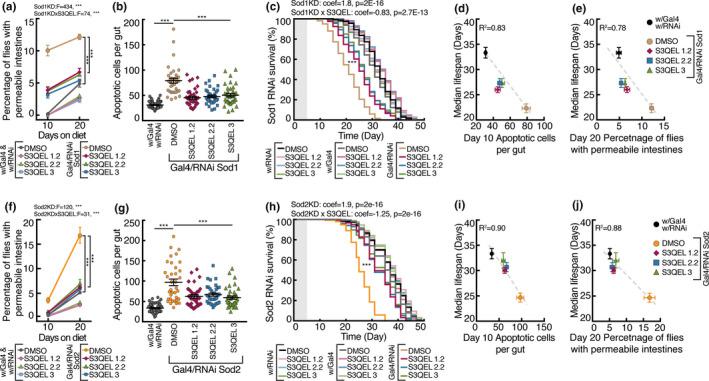
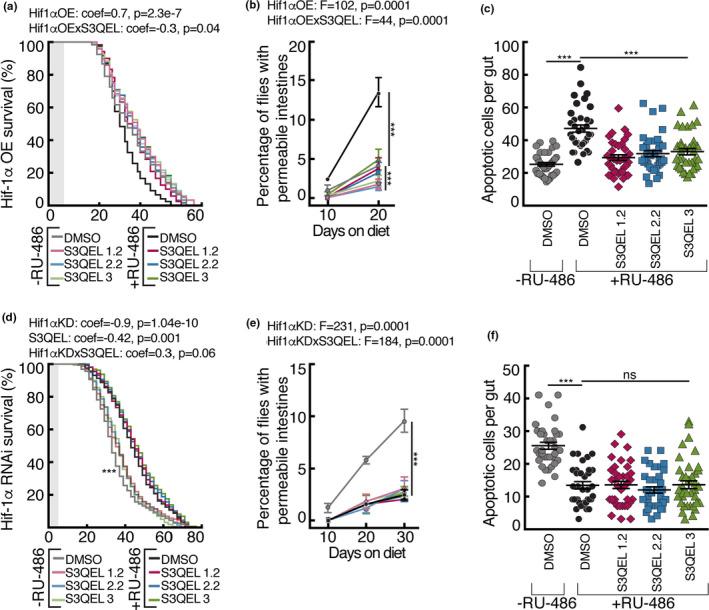
The underlying causes of aging remain elusive, but may include decreased intestinal homeostasis followed by disruption of the intestinal barrier, which can be mimicked by nutrient-rich diets. S3QELs are small-molecule suppressors of site III electron leak; they suppress superoxide generation at complex III of the mitochondrial electron transport chain without inhibiting oxidative phosphorylation. Here we show that feeding different S3QELs to Drosophila on a high-nutrient diet protects against greater intestinal permeability, greater enterocyte apoptotic cell number, and shorter median lifespan. Hif-1α knockdown in enterocytes also protects, and blunts any further protection by S3QELs. Feeding S3QELs to mice on a high-fat diet also protects against the diet-induced increase in intestinal permeability. Our results demonstrate by inference of S3QEL use that superoxide produced by complex III in enterocytes contributes to diet-induced intestinal barrier disruption in both flies and mice.
衰老的根本原因仍然难以捉摸,但可能包括肠道内稳态下降,随后肠道屏障被破坏,而富含营养的饮食可以模拟这种情况。S3QEL 是位点 III 电子泄漏的小分子抑制剂;它们抑制线粒体电子传递链复合物 III 中的超氧化物生成,而不抑制氧化磷酸化。在这里,我们表明,在高营养饮食中向果蝇喂食不同的 S3QEL 可以防止肠道通透性增加、肠细胞凋亡细胞数量增加和中位寿命缩短。肠细胞中 Hif-1α 的敲低也具有保护作用,并削弱了 S3QEL 进一步的保护作用。在高脂肪饮食中向小鼠喂食 S3QEL 也可以防止饮食引起的肠道通透性增加。我们的结果通过 S3QEL 使用的推断表明,肠细胞中复合物 III 产生的超氧化物有助于在果蝇和小鼠中饮食引起的肠道屏障破坏。


 Zotero 插件