Keramat Syed Afroz, Alam Khorshed, Ahinkorah Bright Opoku, Islam Md Sariful, Islam Md Irteja, Hossain Md Zobayer, Ahmed Sazia, Gow Jeff, Biddle Stuart J H
School of Business, University of Southern Queensland, Toowoomba, QLD, 4350, Australia.
Economics Discipline, Social Science School, Khulna University, Khulna, 9208, Bangladesh.
Clinicoecon Outcomes Res. 2021 Sep 7;13:777-788. doi: 10.2147/CEOR.S318094. eCollection 2021.
Both obesity and disability have been widely recognised as major public health challenges because they play significant roles in determining self-perceived general and mental health. Longitudinal studies of the relationship between obesity and disability with self-reported health outcomes are scarce. Therefore, the objective of the present study is to examine the relationship between obesity and disability with self-perceived general and mental health among Australian adults aged 15 years and above.
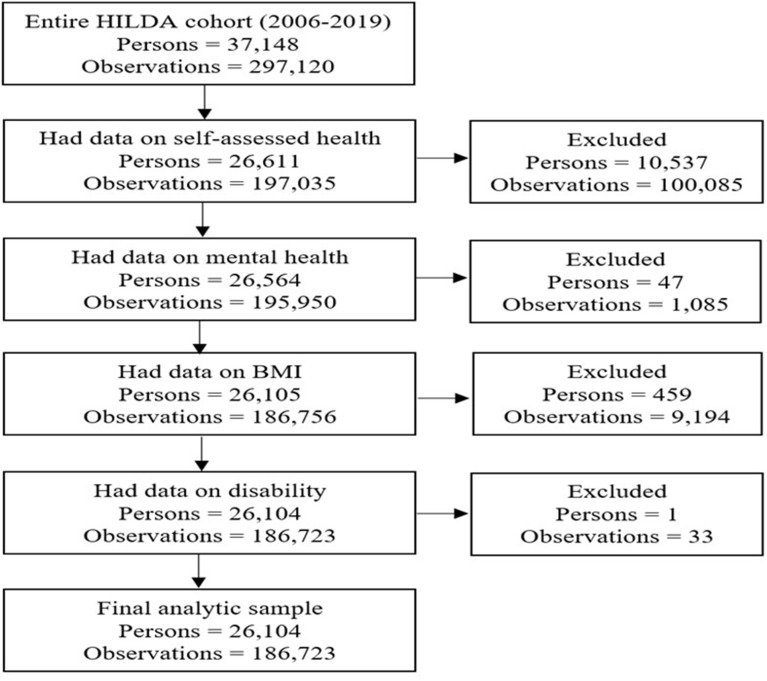
Data were extracted from the most recent 14 waves (waves 6 through 19) of the annual individual person dataset of the Household, Income and Labour Dynamics in Australia (HILDA) survey. The longitudinal random-effects logistic regression model was adopted to investigate the relationships between obesity and disability with self-reported health outcomes.
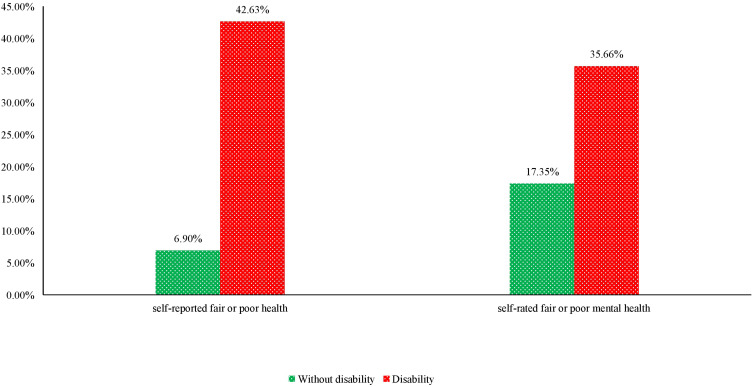
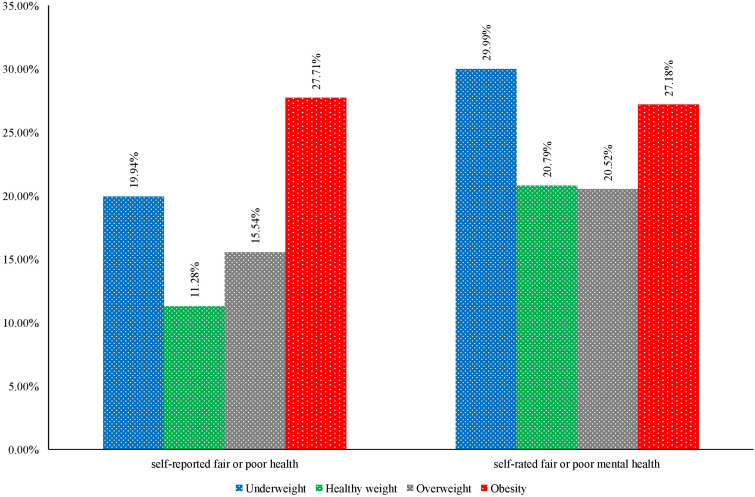
The results revealed that obese individuals and adults with some form of disability are more likely to report poor or fair general and mental health. The odds of self-reporting poor or fair general health were 2.40 and 6.07 times higher among obese (aOR: 2.40, 95% CI: 2.22-2.58) and adults with some form of disability (aOR: 6.07, 95% CI: 5.77-6.39), respectively, relative to adults with healthy weight and those without disability . The results also showed that self-rated poor or fair mental health were 1.22 and 2.40 times higher among obese adults (aOR: 1.22, 95% CI: 1.15-1.30) and adults with disability (aOR: 2.40, 95% CI: 2.30-2.51), respectively, compared to their healthy weight peers and peers without disability.
As governmental and non-governmental organisations seek to improve the community's physical and mental well-being, these organisations need to pay particular attention to routine health care prevention, specific interventions, and treatment practices, especially for obese and/or people with disabilities.
肥胖和残疾都已被广泛视为重大的公共卫生挑战,因为它们在决定自我感知的总体健康和心理健康方面发挥着重要作用。关于肥胖和残疾与自我报告健康结果之间关系的纵向研究很少。因此,本研究的目的是调查15岁及以上澳大利亚成年人中肥胖和残疾与自我感知的总体健康和心理健康之间的关系。
数据取自澳大利亚家庭、收入和劳动力动态(HILDA)调查年度个人数据集的最近14波(第6波至第19波)。采用纵向随机效应逻辑回归模型来研究肥胖和残疾与自我报告健康结果之间的关系。
结果显示,肥胖个体和有某种形式残疾的成年人更有可能报告总体健康和心理健康状况较差或一般。与体重健康且无残疾的成年人相比,肥胖者(调整后的比值比:2.40,95%置信区间:2.22 - 2.58)和有某种形式残疾的成年人(调整后的比值比:6.07,95%置信区间:5.77 - 6.39)自我报告总体健康状况较差或一般的几率分别高出2.40倍和6.07倍。结果还表明,与体重健康的同龄人及无残疾的同龄人相比,肥胖成年人(调整后的比值比:1.22,95%置信区间:1.15 - 1.30)和残疾成年人(调整后的比值比:2.40,95%置信区间:2.30 - 2.51)自我评定心理健康状况较差或一般的几率分别高出1.22倍和2.40倍。
随着政府和非政府组织寻求改善社区的身心健康,这些组织需要特别关注常规医疗保健预防、特定干预措施和治疗方法,尤其是针对肥胖者和/或残疾人。