
波兰类风湿关节炎的管理——日常实践可能并不总是符合循证指南。
Management of rheumatoid arthritis in Poland - where daily practice might not always meet evidence-based guidelines.
作者信息
Batko Bogdan, Korkosz Mariusz, Juś Anna, Wiland Piotr
机构信息
Department of Rheumatology, J. Dietl Specialist Hospital, Krakow, Poland.
Department of Rheumatology, Jagiellonian University Medical College, Krakow, Poland.
出版信息
Arch Med Sci. 2019 Mar 29;17(5):1286-1293. doi: 10.5114/aoms.2019.84092. eCollection 2021.
INTRODUCTION
International recommendations are intended to help rheumatologists in the effective management of rheumatoid arthritis (RA) through an evidence-based approach. This research aimed to evaluate management patterns and associated difficulties encountered by rheumatologists in daily practice.
MATERIAL AND METHODS
Interviewers recruited 101 Polish rheumatologists in a random quota-based, nationwide sample of outpatient clinics. Quantitative data were input online using a computer-assisted web interview tool.
RESULTS
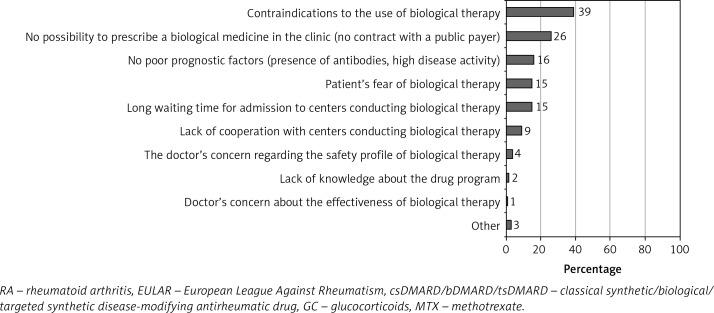
Disease-modifying antirheumatic drugs (DMARDs) are not initiated at the time of diagnosis in 15% of RA patients, most often due to difficulties in patient-provider communication. The RA activity is assessed every 4 to 6 months by 30% of rheumatologists, and 64% of patients are reported to never achieve remission. Composite indices are the most reliable indicators of remission only for 38% of responders. Despite inadequate disease control with ≥ 2 treatment schedules with synthetic DMARDs, 34% of these patients are not considered for biological DMARDs (bDMARDs). Contraindications and reimbursement barriers are the most frequently stated reasons. Therapy with glucocorticoid (GC) lasting over 3 months is reported by 70% of rheumatologists. International recommendations are stated as the most common basis for treatment decisions.
CONCLUSIONS
Awareness of recommendations is not sufficient to ensure their application in clinical practice. Inadequate management of RA is quite prevalent, with a substantial contribution of non-medical factors. Daily practice mainly deviates from guidelines regarding frequency and mode of monitoring measures, time to DMARD initiation, and duration of GC treatment. Education programs and policy changes may significantly narrow the gap between evidence and practice.
引言
国际指南旨在通过循证方法帮助风湿病学家有效管理类风湿关节炎(RA)。本研究旨在评估风湿病学家在日常实践中遇到的管理模式及相关困难。
材料与方法
访谈者在全国范围内基于随机配额抽取门诊样本,招募了101名波兰风湿病学家。定量数据通过计算机辅助网络访谈工具在线录入。
结果
15%的RA患者在确诊时未开始使用改善病情抗风湿药物(DMARDs),最常见的原因是医患沟通困难。30%的风湿病学家每4至6个月评估一次RA活动情况,据报告64%的患者从未实现缓解。综合指标仅对38%的应答者而言是最可靠的缓解指标。尽管使用合成DMARDs进行≥2种治疗方案后疾病控制不佳,但这些患者中有34%未被考虑使用生物DMARDs(bDMARDs)。最常提及的原因是禁忌证和报销障碍。70%的风湿病学家报告使用糖皮质激素(GC)治疗持续超过3个月。国际指南被认为是治疗决策最常见的依据。
结论
对指南的认知不足以确保其在临床实践中的应用。RA管理不当相当普遍,非医学因素起了很大作用。日常实践主要在监测措施的频率和方式、开始使用DMARDs的时间以及GC治疗持续时间方面偏离指南。教育项目和政策改变可能会显著缩小证据与实践之间的差距。


 Zotero 插件